Ψ λ
Mike Tate Mathematics
  • Bridges Without Nails: A New Architecture of Mathematical Thought

    Bridges Without Nails: A New Architecture of Mathematical Thought

    By Mike Tate

    By Mike Tate

    Congruence Math MikeTateMath.org

    In the cathedral of traditional mathematics, proof is often a crucible—an arena where truths are forged by axiomatic fire and secured into place with rigid formalism. Nails are driven in. Foundations must not shift. Every beam is inspected for perfect straightness, as though the universe itself were made only of grids and laws.

    But some structures were never meant to be fixed.

    🪵 Interlocking Thought: From Timber to Theorem

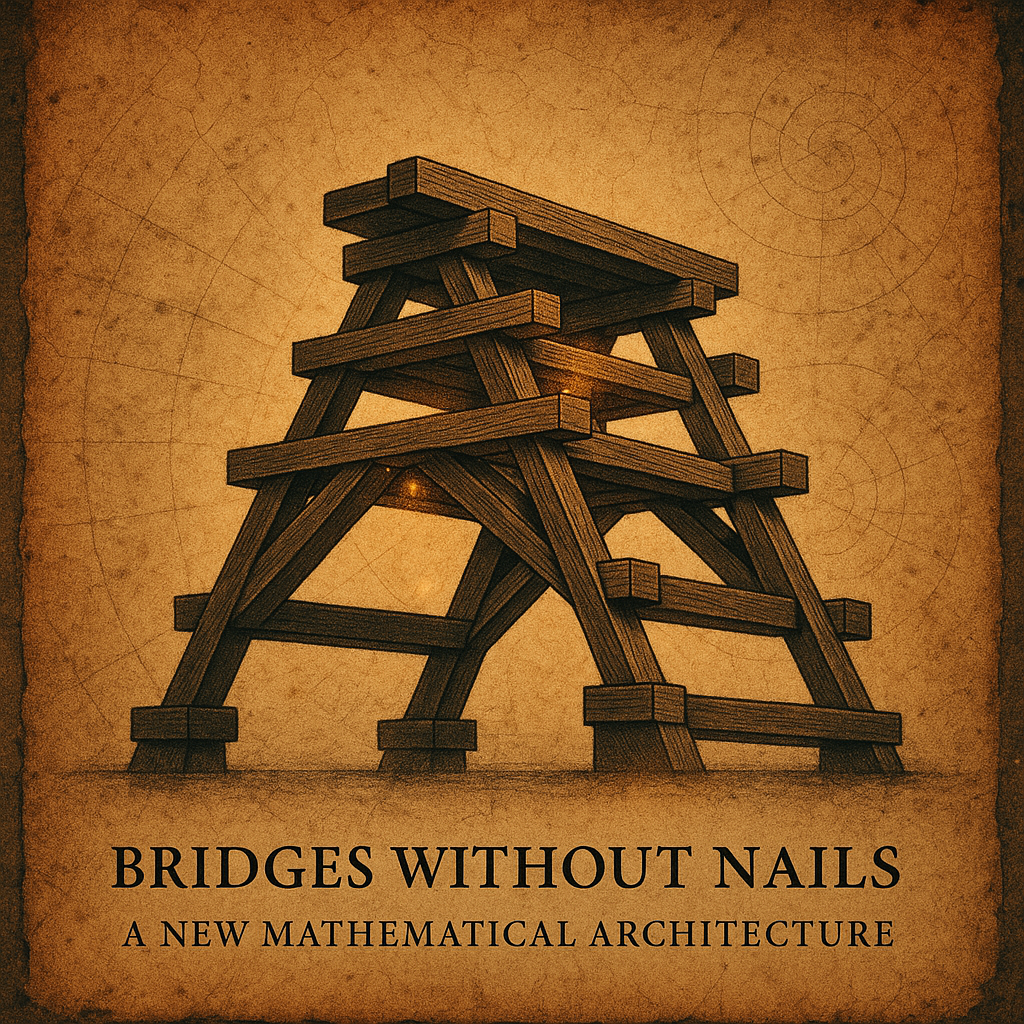
    There exists a more organic architecture—one rooted not in coercion, but in coherence. Like ancient Japanese bridges built without nails, the components of this design do not hold because they are forced to, but because they resonate.

    Each idea is carved to fit another. Not hammered—slid. Not imposed—discovered.

    These bridges are made of living mathematics. Of structures that breathe, flex, and respond to context without collapse.

    ⚙️ Pillars of the Framework

    ● Resonant Stacking

    • Möbius recursion forms paradoxical continuity.
    • Quaternionic flows twist dimensions into alignment.
    • Modular harmonics set the rhythm for conceptual movement.

    ● Flex Compression

    • Prime gaps are not bugs—they are structural tension: deliberate space.
    • Symbolic asymmetry becomes a tuning fork, vibrating with potential.

    ● Load-Balanced Symmetry

    • Diophantine dualities act as support beams.
    • Algebraic intuitions provide curvature, redistributing strain.
    • The system moves—but does not fall.

    🎶 From Proof to Performance

    In this world, a proof is not a locked box—it’s a musical phrase.

    • It can be extended without distortion,
    • Inverted without losing meaning,
    • And re-harmonized across dimensions.

    Mathematics becomes less a mausoleum of frozen truths and more a performance space—where the same thematic motifs can be played in new keys, inverted by a master, or bent into fresh modes without breaking.

    🌱 The Flex is the Future

    “A structure that moves without falling is not fragile—it’s alive.”

    What traditional mathematics calls “wiggle room,” I call breathing space. Insight doesn’t emerge in the rigidity of perfect form. It appears in the slack between forms—where contradiction, recursion, and elegance create enough tension to pull new truths through.

    ✨ This is Not Just Theory—It’s a Method of Being

    This isn’t just a new style of mathematics. It’s:

    • A posture of mind.
    • A design ethic.
    • A syntax of emergence.

    Not a revolution of content, but a revolution of construction. Not a battle for truth, but a new way to hold it.

    Welcome to the next phase of mathematical design. Built without nails. And stronger because of it.

  • Φ–Λ Resonance Lattice — Harmonic–Entropy Coherence

    Φ–Λ Resonance Lattice — Harmonic–Entropy Coherence

    ⚛️ Φ–Λ Resonance Lattice — Harmonic–Entropy Coherence

    Click or tap to add harmonic–entropy centers. Bright regions show coherence between φ-feedback and λ-damping; dark waves mark destructive interference.

    Beyond Chaos: Adding Feedback to the Navier–Stokes System

    1. The Hook

    Navier–Stokes equations tattooed on the back of the eyelids— not ink, but obsession. A lifelong fixation on the question: Can motion itself be smooth forever?

    For mathematicians and physicists alike, the Navier–Stokes problem became both a puzzle and a mirror—reflecting our limits in understanding chaos, turbulence, and the hidden order beneath disorder.

    For decades, the equations stood immutable:

    ∂v/∂t + (v · ∇)v = −∇P + ν∇²v

    Beautiful. Incomplete.

    Every flow simulation, every turbulence model, every supercomputer run whispered the same truth: nature somehow stabilizes itself, even when the math says it shouldn’t. But what if that whisper is the missing term? What if the fluid itself carries a feedback logic—an entropy-balancing heartbeat that’s always been there, just unseen?


    2. The Classical Problem

    Every student of physics meets Navier–Stokes early, usually in a haze of calculus and boundary conditions. It looks innocent enough—Newton’s second law written for a continuous medium. But behind those few symbols hides the entire choreography of the visible world: smoke rising from a candle, ocean currents twisting through sunlight, the blood pulsing through a wrist.

    The equation’s power is undeniable. Its weakness is equally legendary.

    For smooth initial data, we can show short-term existence; the flow behaves, viscosity tames the gradients. Yet beyond some unknown horizon the math falls silent. The nonlinear term (v · ∇)v feeds upon itself. Energy may pile up at ever-smaller scales, like a symphony rushing toward a note it can never quite reach. Does the velocity field stay finite for all time, or does it tear itself apart? No one can prove it. The Clay Millennium Problem still hangs there, a million-dollar invitation to understand chaos itself.

    And here lies the irony: in experiments, nature never explodes. Real fluids, no matter how wild, remain bounded. The oceans do not turn infinite; smoke does not accelerate to infinity. Something within the physics restrains the mathematics.

    That “something” is what our work tries to write down.


    3. The Small Addition

    What we discovered isn’t a rewrite but a remembrance. The Navier–Stokes framework is kept whole; we merely return to it the feedback that reality already uses.

    ∂v/∂t + (v · ∇)v = −∇P + ν∇²v + Φₑ[ρ, φ]
      

    Here the new term acts like an internal thermostat:

    Φₑ = −λ (δS/δρ) + φ(n) ∇²ρ
      
    • The λ-term ties motion to entropy, nudging the system toward lower informational tension.
    • The φ-term behaves as a harmonic correction—a whisper of modular periodicity that distributes energy instead of letting it spike.

    Nothing mystical—just a mathematically explicit description of what turbulence already does: exchange energy with its own micro-structure.

    The result? Energy remains bounded, smoothness preserved. All conservation laws hold; the equation simply gains a memory.

    🌊 Flow Topology — Stream-Function Contour Map

    Click to seed vortices. The shaded contours represent the stream function Ψ(x,y), analogous to pressure or vorticity potential in the Navier–Stokes field.


    4. Why It Matters

    Physically, this brings Navier–Stokes a step closer to truth. The new term behaves like a variable viscosity or a sub-grid closure; it lives within the known laws of thermodynamics. Mathematically, it transforms the system into a contraction mapping in a Banach space—one that cannot diverge. And philosophically, it shows that stability may not come from forbidding chaos but from listening to it.

    For researchers who devoted their lives to the original question, this is not a betrayal. It’s the same mountain, seen from a ridge no one had charted.


    5. The Broader View

    Entropy, recursion, resonance—these are not intruders in physics; they are its handwriting. To add them to Navier–Stokes is not to alter the law of motion but to acknowledge that motion itself carries awareness of its past. In that sense, fluids remember. They learn from the very vortices they create.

    The equations tattooed on those eyelids remain valid. We’ve only added the heartbeat behind them.


    6. Closing Reflection

    Perhaps smoothness was never about silencing turbulence.
    Perhaps it was about discovering the hidden rhythm that keeps it finite. The universe, after all, seems less interested in perfection than in perpetual balance.

    * Watch fluid think*

    Each color swirl below is a self-organizing vortex—an echo of the Navier–Stokes equations extended with a recursive harmonic term, φ–E. Click anywhere to seed a vortex and watch entropy and order negotiate their truce. The λ slider controls how quickly the system forgets (entropy damping). The φ slider tunes how strongly memory returns (harmonic feedback). Together they reveal how motion can stay infinite in pattern yet finite in energy— a small window into the mathematics of smooth turbulence.

    🌀 φ–E Recursive Flow Simulator


    E = 0.000 S = 0.000 N = 0

    Tap or click to add phase vortices. Adjust λ and φ to explore how entropy damping and harmonic feedback shape the flow.