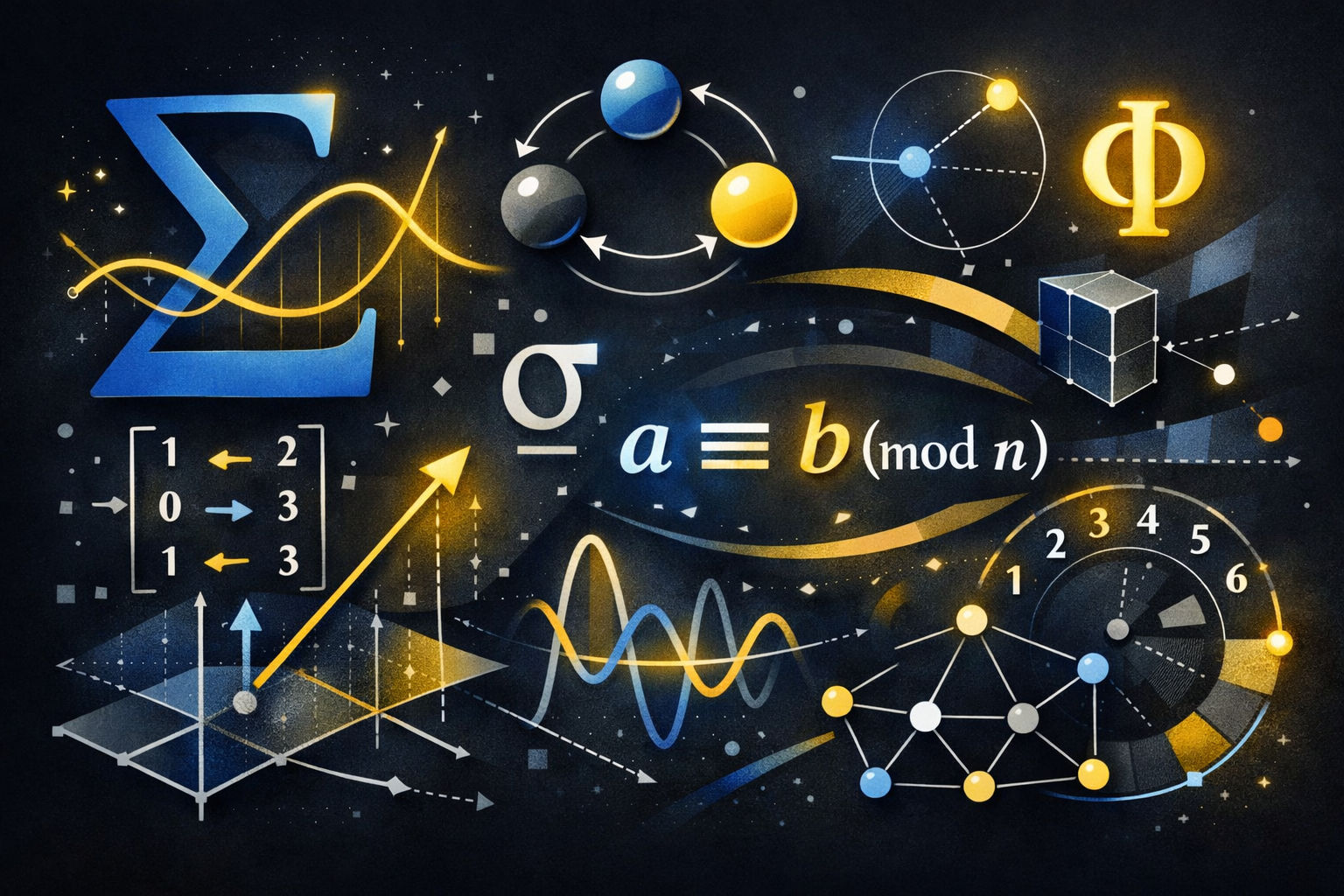
Algebra
Algebra is the study of structure, relation, and transformation. It does not merely compute isolated answers. It identifies the rules that remain true across many cases at once.
Where arithmetic handles specific numbers, algebra handles patterns. It gives us a language for symmetry, solvability, recurrence, growth, constraint, and abstraction. In practical terms, algebra is the framework that lets mathematics scale.
Generalization
Algebra replaces fixed values with variables, then studies what stays valid under substitution, rearrangement, and extension.
Structure
It organizes mathematical objects into systems such as groups, rings, fields, vector spaces, and recurrence frameworks.
Transformation
Algebra tracks how forms change while preserving underlying relations: symmetry, equivalence, invariance, and solvability.
What algebra does
Algebra compresses complexity into rules. It lets us describe entire families of behavior without recalculating every instance from scratch. That is why it sits underneath number theory, geometry, physics, cryptography, computation, and formal logic.
- It expresses patterns symbolically.
- It studies operations and their constraints.
- It classifies structures by what they preserve.
- It converts repeated behavior into reusable form.
Core algebraic ideas
- Variables: symbols standing for general elements or unknown quantities.
- Equations: claims of equivalence that define solution sets.
- Functions: mappings that describe dependence, growth, and transformation.
- Groups: systems of invertible operations encoding symmetry.
- Rings and fields: environments governing addition, multiplication, and solvability.
- Recurrence: rules where later states emerge from earlier ones.
Featured algebra topics on this site
Algebraic Symmetry
A direct look at invariance, balanced structure, and the way algebra captures transformations that preserve form.
De Moivre’s Formula
A compact bridge between powers, angles, and complex structure. This topic links algebraic expression to periodic form.
Recurrence Relations
Recursive rules turn algebra into motion. Recurrence relations describe how sequences evolve through repeated dependence.
Frobenius Method
A series-based method for solving differential equations near singular points, showing how algebraic structure supports analytic solution.
Why algebra matters
Algebra is productive because it reduces repetition. You do not have to program every case into a system one by one or teach every transformation manually. Once the structure is understood, many outcomes follow from the same governing form.
That is the real utility of algebra: fewer isolated procedures, more transferable law.
This page is designed as a visible hub: direct text, direct links, minimal dependency on interaction, and enough context for both readers and search engines to understand the section quickly.