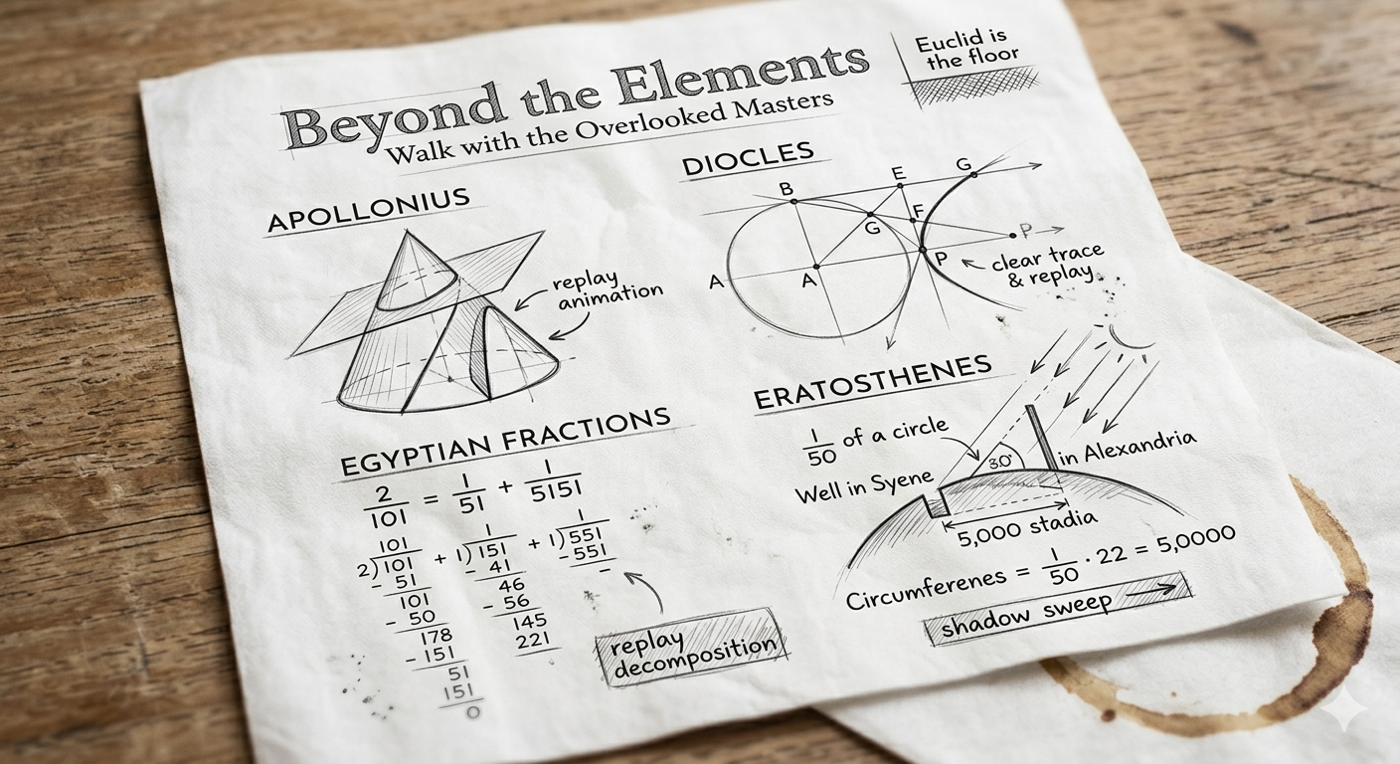
Ancient geometry in motion
Beyond the Elements
Walk with the Overlooked Masters
No “let x be such that” – watch the geometry move. Straightedge, shadow, cone, curve, and stepwise craft.
Euclid is the floor, not the ceiling. The Elements gave us grammar: definitions, postulates, common notions, and the elegant march of proof. But because Euclid is so focal, the mathematicians who came after – the ones who took his tools and built strange, difficult, beautiful things – are too often left in the footnotes.
Apollonius, Diocles, the scribes of the Rhind Papyrus, and Eratosthenes represent the cutting edge of ancient thought: the messy, brilliant, sometimes unsolved frontier. Here, you walk through their works not with symbols alone, but with moving visual methods.
The gallery of moving methods
AP
Apollonius of Perga
The Great Geometer. His Conics gave us ellipse, parabola, and hyperbola. Where Euclid feels like grammar, Apollonius feels like orbital mechanics.
Walk with him: You have a double cone. A luminous plane travels through it. When it cuts both nappes, the curve separates into two hyperbola branches. No equation required: cone, plane, curve.
plane loops automaticallybranches draw and fade
Auto-looping CSS animation
Why overlooked: Book V, on normals to conics, solves optimization problems geometrically long before calculus. Students inherit the shapes but rarely meet the mind that mastered their families.
DI
Diocles and the Cissoid
The Delian problem – doubling the cube – demanded a new curve. Diocles answered by inventing one.
Walk with him: A point E moves on the circle. Line AE meets the tangent at G. A point P is chosen so AP equals EG. As E moves, P traces the ivy-shaped cissoid.
EPABtangent
Trace draws itself in a loop
Why overlooked: The cissoid sits outside ordinary compass-straightedge construction. But it reveals a frontier skill: when old tools cannot solve the problem, invent the curve that can.
RH
Egyptian Fractions and the Rhind Papyrus
The scribe Ahmes recorded decompositions into distinct unit fractions. The method is ancient, algorithmic, and still alive.
Walk with the scribe: Start with 2/101. Take the largest unit fraction that does not exceed the remainder. Subtract, reduce, and continue until the remainder vanishes.
2/101 = 1/51 + 1/5151
Start 2/101Take 1/51Remainder 1/5151Complete
Start: 2/101
Step 1: choose 1/51 because 1/50 is too large.
Step 2: 2/101 – 1/51 = 1/5151.
Result: 2/101 = 1/51 + 1/5151.
Algorithm steps pulse in sequence
Why overlooked: Egyptian fractions are often treated like a classroom curiosity. But they point into additive number theory and open Erdos-Straus style questions.
ER
Eratosthenes and the Shadow
Known for the prime sieve, remembered less often for measuring Earth with a well, a stick, a shadow, and proportion.
Walk with him: In Syene, sunlight fell straight down a well. In Alexandria, a vertical stick cast a shadow. The local angle scaled up to the whole circumference of Earth.
SyeneAlexandriaangle grows
Shadow sweep loops: small local angle, global circumference.
Rays, shadow, and angle auto-loop
Why overlooked: Eratosthenes is reduced to a prime-finding trick, but his geodesy is a masterpiece of model-building from local observation: parallel rays, local shadow, global Earth.

