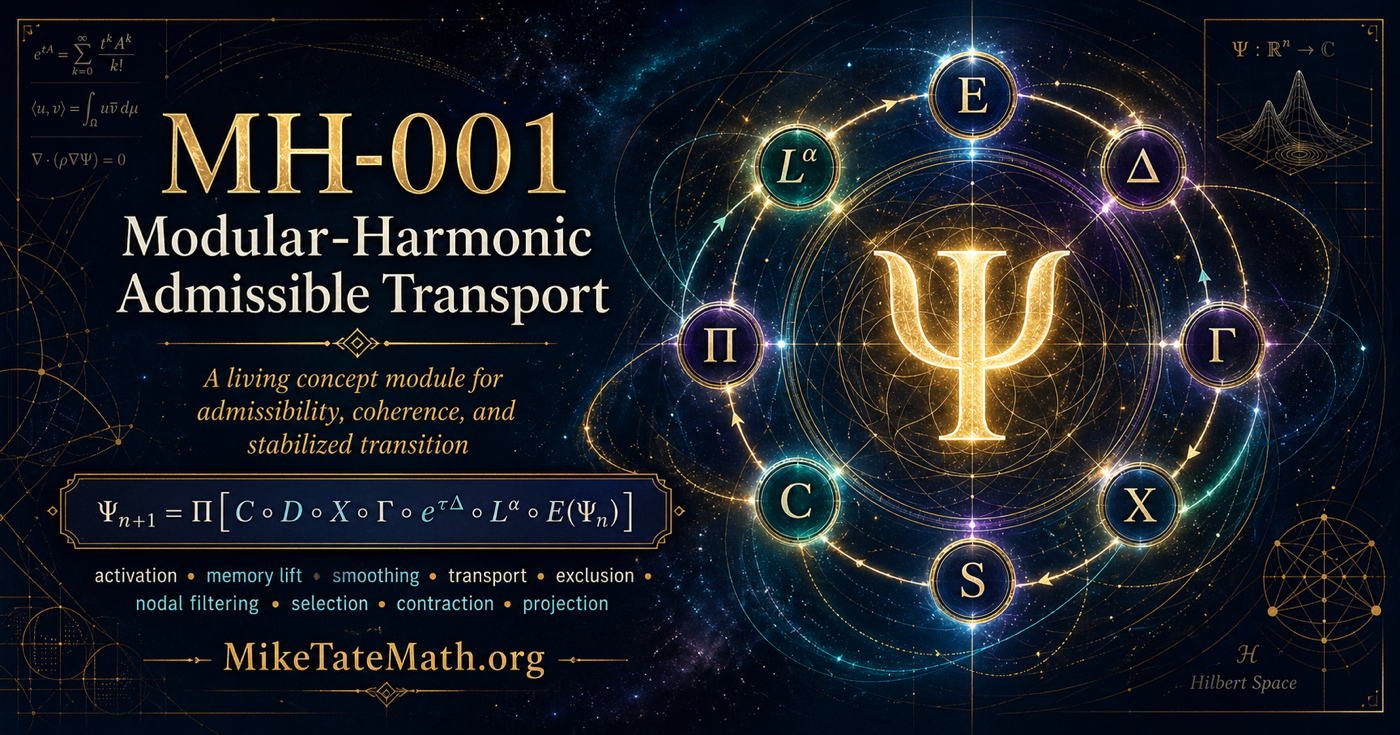
Modular-Harmonic Admissible Transport
A living concept module for admissibility, coherence, and stabilized transition.
A state does not become valid merely because it is computed. It must pass through a layered engine: activation, memory, smoothing, transport, exclusion, nodal filtering, selection, contraction, and projection.
Activation
The incoming state is energized. The engine marks a candidate transition and begins structured evaluation.
Operator E • phase 1 of 9The Engine Equation
This compact equation card gives the central operator composition and the minimum symbol map needed to read it.
Primary Evolution Law
Read from right to left: activate, remember, smooth, transport, exclude, filter, select, contract, and project into the next lawful state.
How to Read the Engine
The reverse-card layer becomes an accordion so conceptual density remains readable on phones.
Modular-Harmonic Admissible Transport treats transition as a layered passage. A candidate state becomes meaningful only when it survives activation, memory, smoothing, transport, exclusion, filtering, contraction, and final projection.
M is the manifold. Ψ is the state. E activates. Lᵅ carries memory. Δ smooths. Γ transports. X excludes. D filters. C contracts. Π projects into the lawful next state.
Activate → remember → smooth → transport → exclude → filter → select → contract → project. Each stage narrows the field of valid continuation.
Failures separate into arithmetic obstruction, harmonic obstruction, and geometric obstruction. This prevents vague failure and turns rejection into diagnosis.
Operator Procession
These cards highlight in sync with the animated engine.
E — Activation
Mark the candidate state as live and energized.
ELᵅ — Memory Lift
Carry prior structure into the transition.
LᵅΔ — Smoothing
Diffuse roughness across the manifold.
ΔΓ — Transport
Route the state through lawful geometry.
ΓX — Exclusion
Remove unstable or forbidden directions.
XD — Nodal Filter
Retain structurally compatible modes.
DS — Selection
Select viable admissible survivors.
SC — Contraction
Narrow the survivor set toward stability.
CΠ — Projection
Map the survivor into Ψₙ₊₁.
ΠObstruction Classes
Arithmetic
Residue, congruence, or modular support fails.
Harmonic
Phase, mode, or resonance structure cancels.
Geometric
The state cannot inhabit the target channel.
Mini Example
Backlink Constellation
Each backlink has a species: parent, child, sibling, prerequisite, application, tool, media, source, or thinker. Together, these pathways turn MH-001 into a navigable knowledge hub.
Recursive Harmonics
The larger family: recursion, resonance, modular structure, and coherence-preserving transformation.
Parent NodeModular-Harmonic Framework
The wider architecture that houses admissibility, residue flow, operator sequences, and symbolic geometry.
Child NodeMH-002 — Residue Transition Chains
The arithmetic specialization: finite residue manifolds, bounded jumps, and admissible modular corridors.
Child NodeMH-003 — Curved-Shell Equilibria
The geometric specialization: repulsion, geodesic transport, compact manifolds, and stable basins.
PrerequisiteFractional Lift Operators
The memory-bearing operator layer that explains why transition depth can be graded rather than merely discrete.
Sibling NodeTotient-Modulated Harmonic Scaling
A parallel coherence model using totient structure, scaling, primes, and phase behavior.
Sibling NodeSpinor Zeta Wedges
A zeta-phase companion concept linking critical-line landmarks, wedge sectors, and higher symmetry.
Sibling NodeGalois Groups
A symmetry-of-roots concept that pairs naturally with admissible transformation and structure preservation.
ApplicationNavier–Stokes Reharmonized
Applies symbolic modular encoding to flow, continuity, singularity control, and coherence preservation.
ApplicationThe Harmonic Bridge to Hodge
Connects harmonic decomposition, algebraic cycles, and modular congruence as a compression-style reading.
ApplicationHilbert’s 16th Reframed
Uses harmonic topology, symbolic compression, and limit-cycle thinking as a classical problem bridge.
Tool / SimulatorInteractive Tools
Route users toward visualizers, calculators, apps, games, and exploratory math interfaces.
Tool / GameSymbol Breaker
A playful learning bridge into primes, symbols, formulas, unlocks, and visual concept memory.
MediaVideos
Video explainers and visual walkthroughs for people who enter the work through motion and narration.
MediaAudio / Listening Layer
Sound, rhythm, and symbolic resonance assets that support the harmonic identity of the site.
Source / PaperPapers and Working Drafts
The formal document layer: proofs, drafts, PDFs, and deeper mathematical exposition.
Source / EbookVisual Ebooks
Infographic-style collages and short explanation nodes extending the system into readable issues.
Thinker LineageEuler
Connects totients, functions, products, analytic structure, and the arithmetic backbone of the framework.
Thinker LineageNoether
Symmetry, invariance, structure, and conservation principles as conceptual supports for admissible transformation.