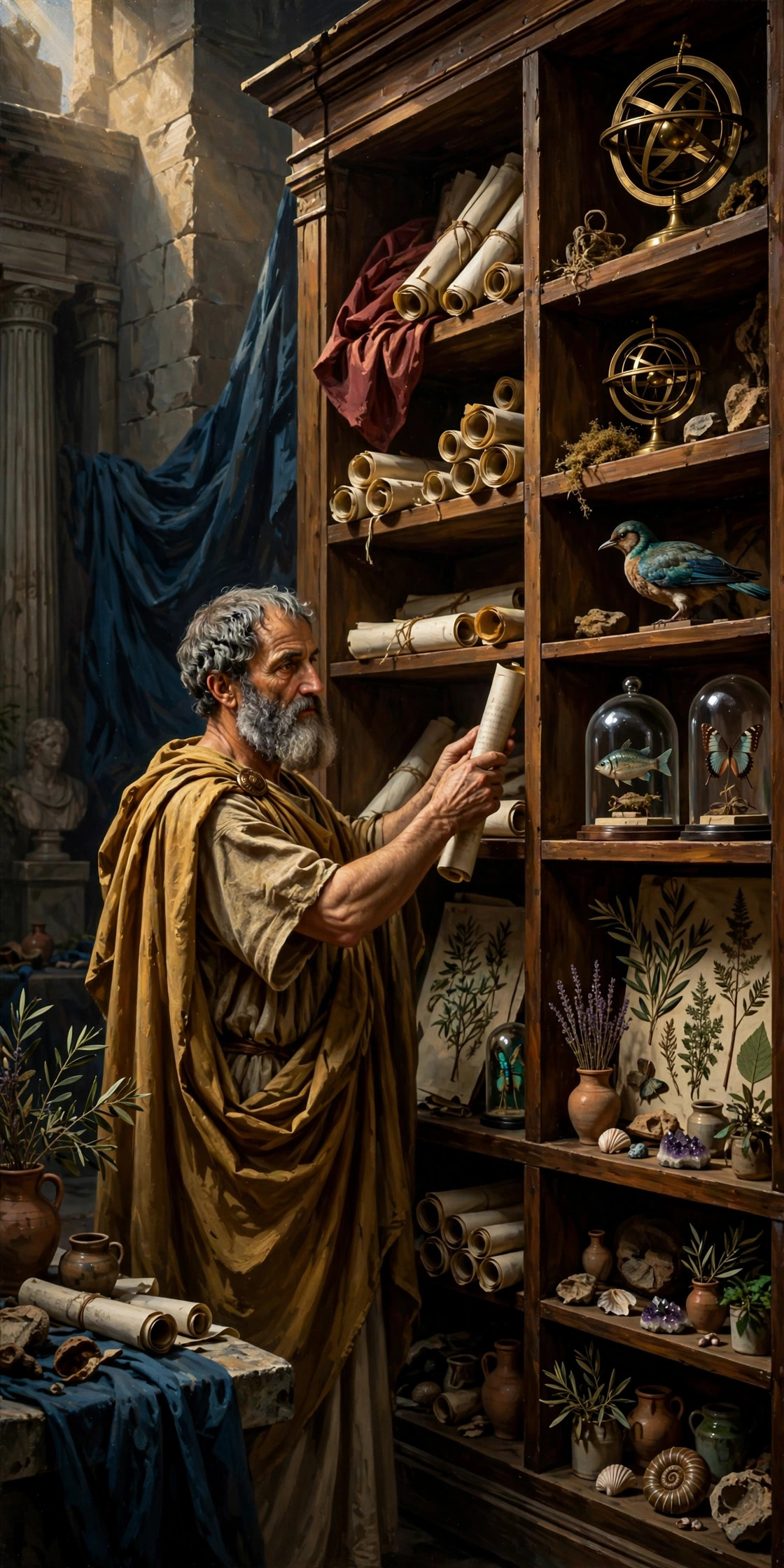
His books are not thirty separate books. They are one long act of categorization.
If you shelve Aristotle by subject, you miss him.
Logic on one shelf, physics on another, animals here, ethics there, poems in a corner by themselves — that is how a library has to store him, and it is exactly backwards. Read in the order his school filed him, Aristotle is not writing thirty books. He is running one operation, without interruption, from a noun to a tragedy.
That operation is categorization.
It is his biggest angle — bigger than any single doctrine he is famous for. The syllogism, the four causes, the virtues, the constitutions, the parts of a plot: underneath every one of them is the same move. Take a genus. Divide it by its differences. Give each resulting kind its own place, its own terms, and its own science. Then move up one level and do it again.
He even categorizes knowledge itself before he starts. Everything that can be known, he says, is known in one of three ways: theoretically, for its own sake — practically, in order to act well — or productively, in order to make something. Physics, ethics, and poetry are not three hobbies. They are the three boxes, and the whole corpus is sorted into them.
I. First, sort the words
Before any of the three comes a tool that belongs to none of them: the works later editors called the Organon, the instrument.
It begins with the Categories, and the beginning is a sorting. There are ten kinds of thing that can be said of anything: substance, quantity, quality, relation, place, time, position, possession, action, passion. A man, three feet long, pale, taller than his son, in the market, yesterday, sitting, wearing sandals, cutting, being cut. Before Aristotle will argue about the world, he wants to know what kind of word you just used.
Then the pipeline tightens, book by book. On Interpretation: words become statements, and statements become true or false. Prior Analytics: statements combine into the syllogism — if every A is B and every B is C, then every A is C, and the conclusion holds by the shape of the argument alone, no matter what A, B, and C are. Posterior Analytics: the syllogism tightened into demonstration, proof from first principles — his definition of what a science is, delivered inside the logic itself. And because sorting can be faked, the fence goes up last: the Topics for honest argument from opinion, the Sophistical Refutations for fallacies, each one named and filed.
Sort the words rightly, and proof has somewhere to stand. That sentence could go over the door of everything that follows.
II. Then sort nature
The Physics is not yet about any particular thing in nature. It is the vocabulary nature will be described in: form and matter, potentiality and actuality, and the four causes — what a thing is made of, what it is, what set it moving, and what it is for. Define those once, carefully, and every later book can spend them.
Then the scale descends. On the Heavens: the cosmos whole, spherical, eternal, turning on its spheres. On Generation and Corruption: below the Moon, where the four elements transform into one another and things come to be and pass away. Meteorology: the messy border zone — rain, comets, earthquakes, the Milky Way — irregular, but still sorted by cause.
And then the largest single block of writing he left us, the one modern readers most often skip: the animals. History of Animals collects the differences — who has blood and who doesn’t, who bears live young and who lays eggs. Parts of Animals takes the collected data and explains each part by its final cause, what it is for. Generation of Animals gives the origin. Data, then function, then cause. It is the Posterior Analytics turned loose on the living world — his method of proof, applied to squid and elephants with the same seriousness he gave to the stars.
III. The hinge: the soul
Between nature and everything human stands one short book, On the Soul, and it is the hinge of the whole corpus.
Soul, for Aristotle, is the form of a living body — and its powers come as a ladder. The nutritive power: taking in food, growing, reproducing — plants have this, and only this. The sensitive power: perception, appetite, movement — animals add it. The rational power: thought — we add that. Three rungs, each containing the ones below it.
Hold that ladder in mind, because the rest of the corpus climbs it in both directions. The biology below is the ladder described from outside. The ethics above is the ladder trained from inside.
IV. Being itself
Filed after the Physics — the Greek title, Metaphysics, literally means “the books after the Physics” — first philosophy asks the question the Physics vocabulary makes possible: what is being, as being? His answer starts where the Categories started. Substance is primary; everything else is said of it or exists in it. Form and matter, potentiality and actuality, get universalized here, and the four causes are traced back to a first one: the Unmoved Mover, pure actuality, thought thinking itself — the Physics‘ final argument arriving at its final category.
V. From the soul to the city
The Nicomachean Ethics takes the rational rung of the ladder and asks what it is for a human life to go well. The virtues are, of course, categorized — moral virtues of character, intellectual virtues of mind — and virtue itself is placed, precisely, as a mean between two vices, excess on one side and deficiency on the other. Courage between rashness and cowardice. Even how to live becomes a matter of correct placement.
The Politics runs the identical system at the scale of the city, and lets the growth be natural: household, then village, then the self-sufficient city, the polis. Then constitutions get the full treatment — sorted on two axes at once, how many rule and whether they rule for the common good or their own — and the famous six fall out of the grid: kingship and tyranny, aristocracy and oligarchy, polity and democracy. The taxonomy is not decoration on the argument. The taxonomy is the argument. Behind it stood the data: his school’s studies of 158 constitutions, of which exactly one, the Constitution of Athens, survives.
VI. And end with stories
Last, the productive books — and the corpus ends, wonderfully, not with the cosmos but with poems.
The Rhetoric sorts persuasion: three means of proof — the character of the speaker, the feeling of the audience, the argument itself — across three kinds of speech. And the Poetics sorts imitation by its medium, its object, and its manner, and epic, tragedy, and comedy fall out of the division. Then Aristotle dissects a plot exactly the way he dissected an animal: into parts, each with its function, the whole defined as that which has a beginning, a middle, and an end. The book on comedy is lost. The method that wrote it is visible on every surviving page.
VII. What we actually have
One honest caveat, because it changes how the corpus should be read. These are not the books Aristotle published. His published works were dialogues, praised in antiquity for their style — and they are lost, except in fragments. What survives are his school’s working treatises, the lecture files of the Lyceum, gathered and arranged into this order centuries later by Andronicus of Rhodes.
So the sequence is an editor’s filing. But the continuity is not an editor’s invention. Remove any stage and the next loses its vocabulary: the Ethics needs the soul’s ladder, the Politics needs the Ethics‘ account of the good, the Poetics needs the Physics‘ causes and its definition of a whole. The categorization runs unbroken because the system does.
Dante called him “the master of those who know.” The medieval schools called him, simply, The Philosopher. I think both titles undersell the strangeness of what he actually did. He did not just know things, in unusual quantity. He built the shelving that Western knowledge is still stored on — genus and species, definition by difference, every subject told to state its genus, divide it, and proceed in order.
We still live in his filing system. We just mistake it for the world.
— Mike Tate, MikeTateMath
Next in this line: a video version of this piece, in the Greek Mathematicians series — Aristotle, the man who sorted the world.