After Aristotle sorted the world, one man sorted number itself — and gave every kind a shape, a character, and a place.
Aristotle sorted the world. The next question was what to do with the one part of the world that isn’t physical at all.
Four centuries after Aristotle, in Gerasa — modern Jerash, in Jordan — a Pythagorean named Nicomachus of Gerasa wrote the Introduction to Arithmetic, and did to number what Aristotle had done to everything else. His book is a categorization. Even and odd, prime and composite, perfect and abundant and deficient, triangular, square, pentagonal — kind after kind, each defined, divided, and given its place. We know almost nothing about the man’s life. The book is the life. And the book ran the Western world’s arithmetic for a thousand years.
His operator is different from Aristotle’s, though. Aristotle classified by kind. Nicomachus classifies by shape.
I. Number, on its own
The first move is a separation. Before Nicomachus, Greek mathematics mostly studied number through geometry — Euclid’s number books argue with diagrams, magnitudes, lines. Nicomachus insists arithmetic stands alone: number considered in itself, before it measures anything. He even orders the four mathematical sciences — arithmetic, geometry, music, astronomy — and puts arithmetic first, because the others all need it and it needs none of them. The medieval schools took the order from him. It is the quadrivium, and he is its architect.
Then the sorting begins, and it begins the way Aristotle taught the world to begin: with even and odd, divided and divided again — even-times-even, even-times-odd, and the rest — then prime numbers, which he calls incomposite, against the composite numbers they build.
II. Numbers with characters
Then Nicomachus does something Aristotle would have recognized from the Ethics. He sorts numbers by their parts.
Add up a number’s proper divisors — its parts. If the parts sum to less than the number, the number is deficient. If they sum to more, it is abundant. And if they sum to exactly the number itself, it is perfect. He knew four: 6, 28, 496, 8128.
The language is not accidental, and it is not neutral. A perfect number, for Nicomachus, stands like Aristotle’s virtue: neither excess nor deficiency, but the exact mean, complete in itself. Deficiency is a lack, abundance is a kind of greed. Number, in his hands, has character. The classification is a moral anatomy of arithmetic — and it set the terms so firmly that mathematicians still use his three words today, and “perfect number” is still an open hunt: nobody knows whether an odd perfect number exists, or whether the even ones ever end.
III. Numbers you can draw
His deepest move, though, is the shapes.
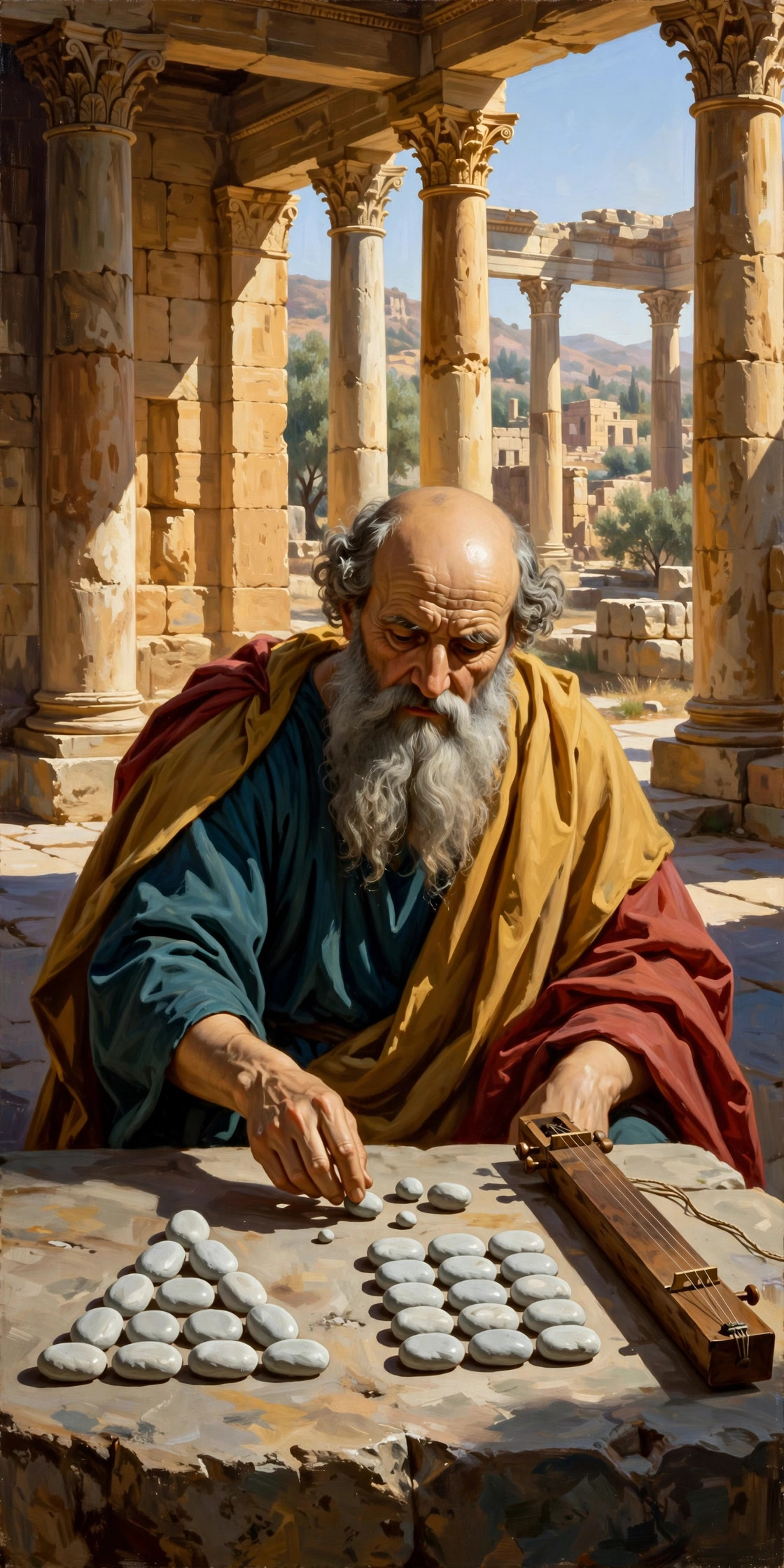
Lay out pebbles. Three pebbles make a triangle; so do 6, 10, 15 — the triangular numbers. Four pebbles make a square; so do 9, 16, 25. Five-sided figures give the pentagonal numbers: 5, 12, 22, 35. Every whole number belongs to a family of shapes, can be built up out of shapes, stacked into pyramids and cubes — figurate numbers, arithmetic you can see and touch.
And the shapes reveal what bare counting hides. Write out the odd numbers and take them in groups — the first one alone, the next two, the next three, the next four:
1 = 1
3 + 5 = 8
7 + 9 + 11 = 27
13 + 15 + 17 + 19 = 64
The sums are the cubes: 1, 8, 27, 64. Nicomachus saw that pattern and stated it, and stated its larger twin: add the cubes themselves, 1 + 8 + 27 + 64 + …, and the running totals are always squares — squares, specifically, of the triangular numbers. Number stacked on number lands back on shape. That is the whole of his arithmetic in a single gesture: what you can draw, you can trust.
IV. The tale he carried
Nicomachus also wrote on harmonics, and his Manual of Harmonics is where the most famous story in music theory survives: Pythagoras passing a blacksmith’s forge, hearing harmony in the hammers, and finding the weights stood as 12, 9, 8, and 6 — the ratios of the octave (2:1), the fifth (3:2), and the fourth (4:3).
As physics, the tale fails: a hammer’s pitch does not follow its weight the way a string’s pitch follows its length. As transmission, it is priceless. Nicomachus is the carrier — the ratios are real, the string is real, and for two thousand years the forge story was how the West learned them. Ratios, for him, are not abstractions. They are the arithmetic of consonance: number you can hear.
V. Where his sorting overran
Honesty requires one beat against him, because it is the most instructive beat in the book.
From his four perfect numbers he guessed a pattern: one perfect number in the units (6), one in the tens (28), one in the hundreds (496), one in the thousands (8128) — one per rank, forever, ending alternately in 6 and 8. It is a beautiful classification. It is also wrong. The fifth perfect number has eight digits, not five — 33,550,336 — and no perfect number at all lives in the ranks he skipped. He would not be corrected for over a thousand years.
That is the permanent risk of his operator, and of Aristotle’s: a taxonomy so satisfying that the mind promotes it from observation to law. The sorting was real. The pattern was a guess wearing the sorting’s authority.
VI. How a book becomes a thousand years
Nicomachus wrote in Greek, in a Roman province, as an empire’s subject. Then the book began to travel. Apuleius translated it into Latin (his version is lost). Around the year 500, Boethius reworked it as his own De arithmetica — and Boethius, not Nicomachus, is the name the Latin West read. Through Boethius the Introduction became the standard arithmetic of the medieval monastery and cathedral school: the book from which a millennium learned what a number is. Eastward it traveled too, into Arabic, in the translation tradition of Thābit ibn Qurra.
Strip the names away and the shape of the event is pure transmission: a classification made in Gerasa, carried by translators and one condemned Roman senator, becomes the shelf-structure of arithmetic for a civilization that never heard the author’s voice. Most students who learned from it had no idea it had an author at all.
Aristotle built the shelving. Nicomachus was the first to shelve number on it — shape by shape, kind by kind, character by character. Every time you meet a triangular number in a puzzle book, or a perfect number in a headline, you are reading his filing system.
We still count in his categories. We just mistake them for the numbers.
— Mike Tate, MikeTateMath