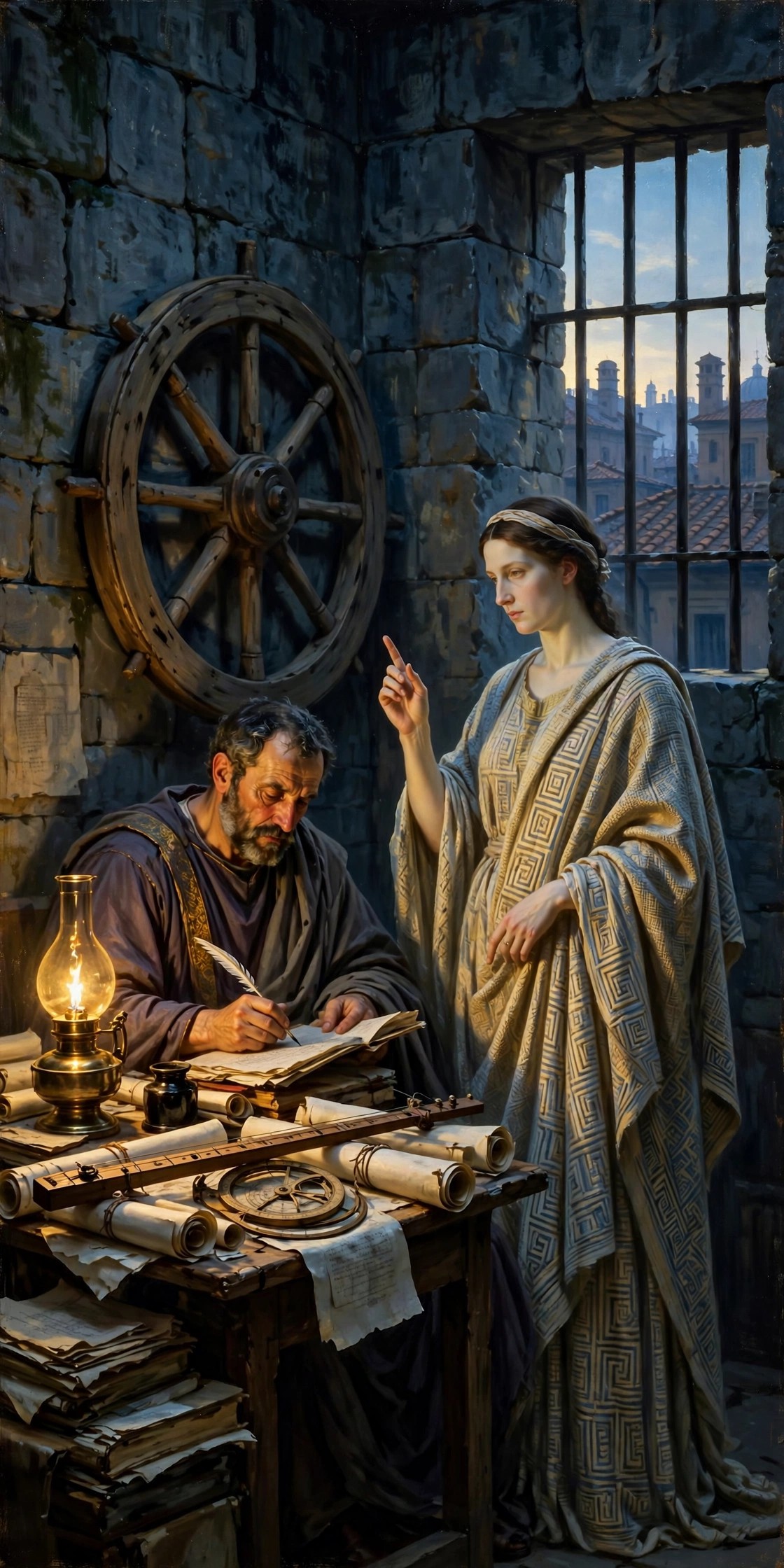
The last Roman took a Greek library into Latin — and finished the most famous of his books in a cell, waiting for the executioner.
Nicomachus sorted number and trusted the sorting to travel on its own. It didn’t. Books don’t cross from one language into another by themselves — somebody has to carry them, and the carrying is done by people, in lifetimes, under conditions.
The man who carried Nicomachus into Latin was Anicius Manlius Severinus Boethius: Roman senator, consul, the most learned man in the Latin West — and he did the last and greatest of his carrying in a prison cell at Pavia, condemned to death by the king he had served. Aristotle’s operator was SORT. Nicomachus’s was SHAPE. Boethius’s is CARRY — and his life is the proof of what the operator costs and what it buys.
I. The last Roman
Boethius was born around 477 into the Anicii, one of Rome’s great families — his father had been consul in 487 and died while the boy was young. He was raised in the house of Symmachus, the Senate’s leading voice, married Symmachus’s daughter Rusticiana, and rose the way Roman aristocrats had risen for a thousand years: consul himself in 510, under Theodoric, the Ostrogothic king who ruled Italy from Ravenna.
But the old world was already a performance. The empire in the West had fallen before Boethius was born; what remained was a Roman Senate doing Roman ceremony inside a Gothic kingdom. Boethius was fluent in the thing that was actually dying: Greek. He could read Plato and Aristotle in the original, in a West that almost no longer could. Gibbon would call him the last of the Romans — the final citizen the old republic would have recognized as its own.
The summit of the performance came in 522, when his two young sons held the consulship together — an almost unheard-of honor for one family — and Boethius stood before the Senate and gave the speech of thanks. The same year he became the king’s chief minister. Two years later he was in a cell.
II. The plan: everything, across
Because alongside the career there was the project, and the project was enormous. Boethius announced it plainly in a commentary: he would translate into Latin every work of Aristotle he could find, and every dialogue of Plato, and comment on them, and show the two masters agreeing at the root. Nothing less than the whole Greek philosophical library, ferried into Latin before the ferry stopped running.
He started with logic, the doorway discipline. He translated Porphyry’s Isagoge — the introduction to Aristotle’s categories — and commented on it twice. He translated Aristotle’s Categories and On Interpretation and commented on both. Those few books became what scholars call the logica vetus, the old logic — and for roughly six hundred years, they were effectively all the Aristotle the Latin West possessed. When medieval students “read Aristotle,” they read the pieces Boethius had carried, in Boethius’s Latin, thinking with Boethius’s commentary. The greatest philosopher of the tradition reached a civilization as a selection one man made.
That is the first law of the carry: the carrier chooses the cargo, and the choice becomes the canon.
III. The naming of the road
The mathematics came the same way. Boethius reworked Nicomachus’s Introduction to Arithmetic into his own De arithmetica — freely, as a Latin textbook — and in its preface he gave the four mathematical sciences the name the West would use for a thousand years: the quadrivium, the fourfold road. Arithmetic, music, geometry, astronomy: four ways, one road, walked in order, arithmetic first.
His De institutione musica did the same for harmonics, drawing on Nicomachus and Ptolemy, and sorted music itself into three kinds: musica mundana, the music of the spheres and the seasons; musica humana, the harmony that binds body and soul; and musica instrumentalis, the music actually played on strings and pipes. A student in a cathedral school in 1100 learning what music is was learning Boethius’s filing system — number you can hear, filed under number.
The quadrivium was not a metaphor. It was the curriculum: the actual list of subjects, in the actual order, that structured advanced education from his century until the Renaissance. One condemned senator’s preface became the West’s table of contents.
IV. The fall
In 523 it collapsed. A senator named Albinus was accused of treasonable letters to the emperor in Constantinople, and Boethius — by his own account, our main source — stood up in the Senate and defended him: if Albinus was guilty, so was he, and so was the whole Senate. The defense became the charge. Boethius was accused of treason himself, and of wanting to restore Roman liberty, and of practicing magic — his astronomy and mathematics read back to him as sorcery.
The Senate he had defended condemned him without a hearing he could answer. Theodoric confirmed the sentence. He was imprisoned at Pavia, held for months, and executed in 524 — beaten to death, the tradition says, after a cord tightened around his head. His father-in-law Symmachus, who had raised him, spoke in his defense and was executed the following year.
Notice what the fall was made of: a Greek-reading Roman, loyal to Roman forms, serving a Gothic king, destroyed by the suspicion that his learning and his loyalties pointed east. The cargo he had spent his life carrying — Greek thought in Latin dress — was precisely what made him look like a traitor.
V. What the carrying preserved — errors included
Here is the honesty beat, because CARRY has a shadow, and Boethius shows it better than anyone.
Fidelity is neutral. The carrier preserves mistakes with exactly the same care as truths. Boethius carried Nicomachus faithfully — including the guess we caught in the last post: the perfect numbers arriving one per rank, 6, 28, 496, 8128, ending alternately in 6 and 8. It was wrong. The fifth perfect number has eight digits. But because Boethius carried it, the error was not a marginal note in a Greek manuscript — it was the doctrine of Latin arithmetic, repeated by the schools for centuries on the authority of the transmission itself. The better the carrier, the longer the error lives. Authority compounds whatever it touches.
And there is a second strange silence in the cargo. The Consolation of Philosophy, the book he wrote in the cell, is the work of a man who had also written Christian theology — tracts on the Trinity, on the faith. Yet in the cell, facing death, he never once appeals to Christ, to scripture, to revelation. His comforter is Lady Philosophy, and her medicines are arguments: about Fortune, providence, eternity, the good. Scholars have puzzled over that silence for fifteen hundred years. Perhaps philosophy was simply the tool he trusted to work on a mind in despair. The silence is part of the cargo too — carried faithfully by every copyist, never explained.
VI. The book from the cell
The Consolation is built like nothing else: five books alternating prose and verse, a dialogue between the prisoner and Philosophy, who appears in his cell with her dress torn by the hands of squabbling schools. She drives out the poetic muses at his bedside — calls them stage girls — and begins the treatment. Fortune’s wheel, the image the whole Middle Ages would take from him, is hers: I raised you, she says, and my nature is to turn; you knew the game when you climbed on.
The argument climbs from Fortune to providence to the hardest problem he knew: if God sees everything in an eternal present, is anything free? His answer built the most famous definition of eternity ever written — the whole, simultaneous, and perfect possession of unbounded life. God does not foresee; he sees, all at once, the way you see what is in front of you — and a seen free act is still free. The distinction between providence and fate, and that definition of eternity, passed from the cell into the bloodstream of Western theology and philosophy, where they run still.
Then they killed him, and the carrying continued without the carrier. The Consolation became one of the most copied, most translated books of the medieval world: King Alfred rendered it into Old English, Chaucer into Middle English, Elizabeth I into her own English, in her own hand. His textbooks defined the schools; his logic defined Aristotle; his cell book defined consolation itself as a genre.
Nicomachus sorted the numbers. Boethius put the sorting on a boat. Empires are loud and brief; cargo is quiet and patient — and on the far shore, a thousand years of students opened the crates and thought the contents were simply what arithmetic, music, and philosophy were.
What survives of a civilization is whatever its carriers managed to hold.
— Mike Tate, MikeTateMath