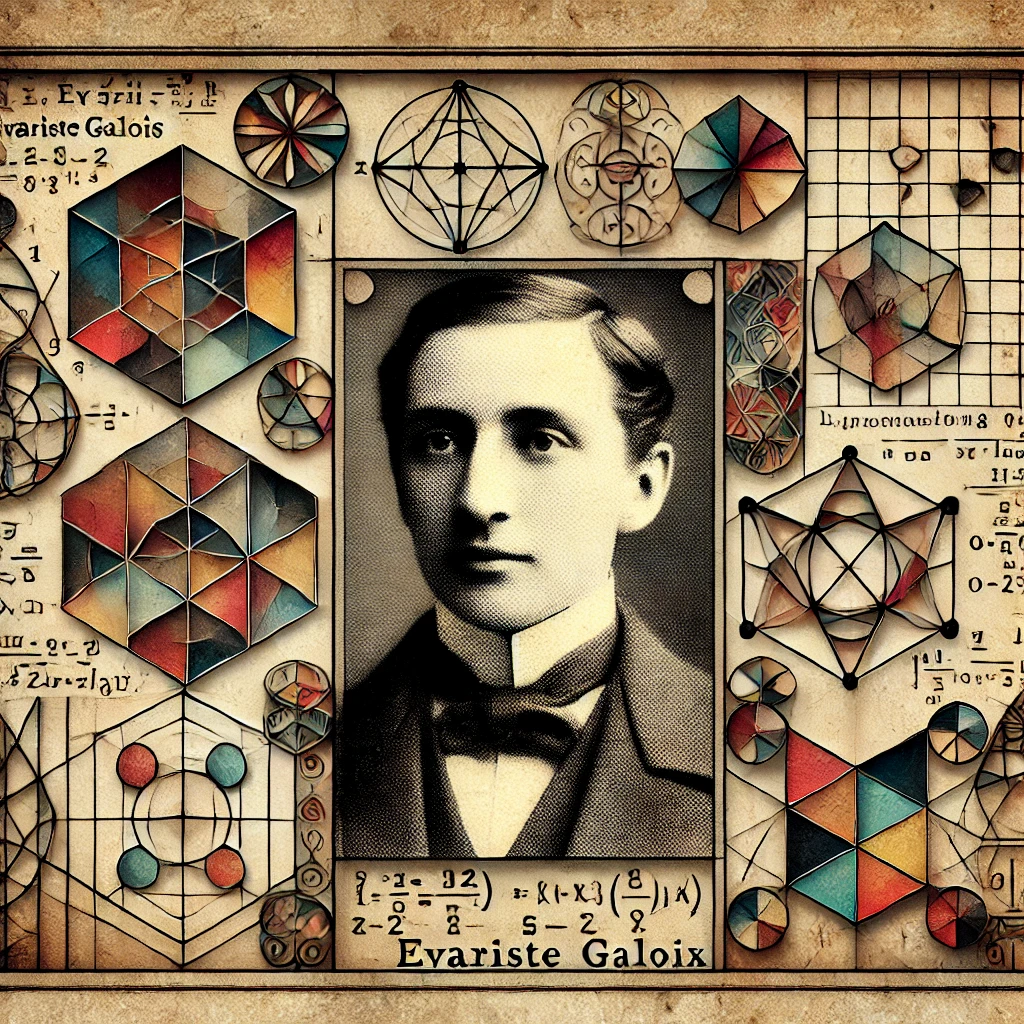
-The Hidden Symmetry of Equations-
Introduction: The Problem That Changed Mathematics
What do the orbits of planets, the structure of a molecule, and the security of your online banking have in common? They can all be understood through the lens of symmetry. In the early 19th century, a brilliant French mathematician named Évariste Galois developed a profound theory that used symmetry to solve one of the most ancient and frustrating problems in mathematics: determining which polynomial equations can be solved by a simple formula.
Galois’s revolutionary idea was to shift the focus from the roots of an equation to the symmetries between them. The object that captures these symmetries is now known as the Galois Group. This concept didn’t just solve the problem of solvability; it laid the foundation for vast areas of modern mathematics, including number theory and algebra.
- The Basic Idea: Symmetries of Solutions
Imagine you have a simple quadratic equation, like x² – 2 = 0. Its roots are √2 and -√2. Now, consider what happens if you secretly swap these two roots. Any true statement you can make about these numbers using basic arithmetic (addition, multiplication, etc.) will remain true after the swap. For example, (√2) + (-√2) = 0 becomes (-√2) + (√2) = 0, which is still true.
This “swapping” is a symmetry. The set of all such allowed permutations of the roots that preserve all algebraic relationships is the Galois Group of the equation.
For x² – 2 = 0, the Galois group has two elements: the “do nothing” permutation, and the “swap” permutation. It’s a mirror symmetry.
Basis: [1, √2]
| 1 | 0 |
| 0 | -1 |
| 1 |
| 2 |
- A Deeper Dive: What Exactly is a Galois Group?
To define it more formally:
- Start with a Polynomial: Take a polynomial with rational coefficients (e.g., x⁴ – 10x² + 1).
- Find its Roots: Identify all its solutions (roots), which may involve irrational or complex numbers (e.g., √2, -√2, √3, -√3).
- Consider the “Splitting Field”: This is the smallest collection of numbers you get by taking the rational numbers and adding all the roots of your polynomial. It’s the playground where all the action happens.
- Identify the Symmetries: The Galois Group is the collection of all field automorphisms of this splitting field that leave the original rational numbers completely unchanged. In simpler terms, it’s every possible way to shuffle the roots around without breaking any of the fundamental rules of arithmetic.
The structure of this group—its size and its internal architecture—encodes virtually everything you could want to know about the algebraic nature of the equation and its roots.
- The Monumental Conclusion: Solving the Quintic
Before Galois, mathematicians had formulas for solving quadratic, cubic, and quartic equations (degrees 2, 3, and 4). They desperately sought a similar “radical formula” for the quintic (degree 5).
Galois proved why this is impossible.
His genius was in connecting the solvability of an equation to the structure of its Galois group. He showed that an equation is “solvable by radicals” (meaning its roots can be expressed using a finite sequence of additions, multiplications, and roots like √ and ∛) if and only if its Galois Group is a “solvable group.”
· What is a Solvable Group? Informally, it’s a group that can be broken down into a sequence of simple, commutative (abelian) pieces, much like a tower of building blocks that are easy to stack.
Let’s apply this:
· Quadratic, Cubic, Quartic Equations: Their Galois groups, while complex, turn out to be solvable. This matches the fact that we have formulas for them.
· The General Quintic Equation: Galois showed that for a general quintic polynomial (like x⁵ – x + 1 = 0), the Galois group is the full symmetric group S₅. This group has 120 elements and, crucially, its structure is not solvable. It cannot be broken down into those nice, simple, commutative pieces.
Conclusion: There can be no general formula, like the quadratic formula, that works for all quintic equations. This was a stunning and definitive answer to a problem that had puzzled mathematicians for centuries.
- Beyond Solvability: The Power of the Galois Group
The influence of Galois theory extends far beyond proving the unsolvability of the quintic. It is a powerful tool that provides a “bridge” (a correspondence) between two seemingly different worlds:
World 1: Field Extensions World 2: Group Theory
(The “Playgrounds” of numbers) (The “Symmetries” of those playgrounds)
Larger, more complex fields Smaller, simpler subgroups
Intermediate fields Normal subgroups
This “Galois Correspondence” is a perfect dictionary. Problems that are very difficult in the world of fields can become much more manageable when translated into the language of groups.
Modern applications include:
· Number Theory: Galois groups are central to modern algebraic number theory, helping to classify prime numbers and understand Diophantine equations.
· Geometry: They are used to study the symmetries of geometric objects.
· Cryptography: The difficulty of problems related to certain Galois groups (like those of elliptic curves) forms the basis for some of the most secure encryption systems in use today.
Conclusion: A Legacy of Symmetry
Évariste Galois died tragically in a duel at the age of 20, but the theory he developed in the final years of his life forever changed the landscape of omathematics. He taught us that the key to understanding the solutions of an equation lies not in the solutions themselves, but in the beautiful, hidden symmetries that connect them. The Galois group is the precise mathematical object that captures this profound insight, serving as a timeless link between the explicit world of equations and the abstract world of symmetry.
x² – 2 = 0
Watch the symmetries: The Galois group consists of all permutations of roots that preserve algebraic relationships. The structure of this group determines if the equation can be solved with radicals.