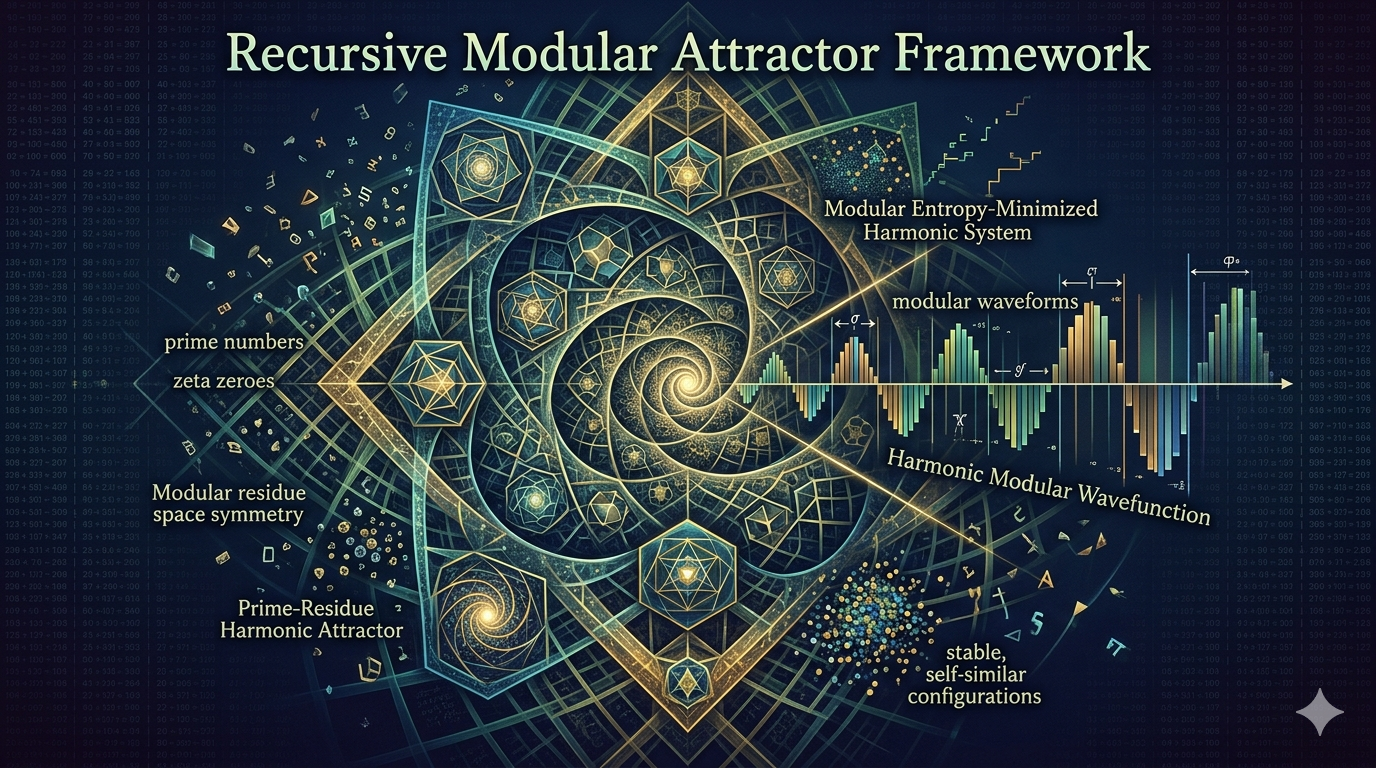

Recursive Modular Attractor Framework
This page defines a family of concepts built around modular recurrence, harmonic stabilization, residue-space symmetry, and entropy-reducing arithmetic structure. The emphasis is on a number-theoretic world in which repetition does not merely recur, but converges into stable, self-similar configurations.
Rather than treating prime distributions, zeta zeroes, and elliptic behavior as disconnected curiosities, this framework treats them as dynamically constrained patterns arising inside modular lattices.
Recursive Modular Attractor Framework
In this framework:
- Modular residues behave like oscillatory states.
- Attractors emerge from recursive interactions of residue cycles, such as totient-modulated spirals.
- The result is a computable lattice of prime-induced structures reflecting deeper laws of arithmetic dynamics.
This framework provides a basis for modeling number-theoretic phenomena as rule-based, complexity-constrained systems, analogous to cellular automata, but in modular arithmetic domains.
Modular Entropy-Minimized Harmonic System
These systems leverage:
- Residue symmetry to modulate and compress irregular sequences.
- Harmonic coherence, such as totient cycles or Eulerian paths, to stabilize chaotic or quasi-random numerical data.
- Entropy-minimizing mappings that reveal compressible patterns in high-complexity domains such as elliptic curves and zeta zeroes.
These systems are proposed as physical analogs to quantum harmonic oscillators, where modular waveforms replace traditional trigonometric bases, enabling a unified view across number theory, physics, and dynamical systems.
Cosmic Dance
This audio layer can function as an atmospheric companion to the framework: a sonic gesture toward recurrence, orbit, and harmonic return.
Prime-Residue Harmonic Attractor
These attractors reveal zones of:
- Symmetric resonance, where residue paths form repeating or quasi-periodic structures.
- Fractal scaling, where attractor behavior persists or transforms predictably across modulus ranges.
- Cymatic-like emergence, in which resonance nodes correspond to low-entropy prime gaps or zero alignments.
Prime-residue attractors help visualize the dynamic interplay between discrete number theory and continuous harmonic systems, offering a novel perspective for understanding prime distribution and zeta symmetry.
Harmonic Modular Wavefunction
Unlike classical wavefunctions, which use sine and cosine bases, modular wavefunctions:
- Are constructed using periodic residue functions such as totient, Möbius, or modular exponentiation.
- Capture phase alignment and interference patterns within residue space.
- Model recursion and resonance in a discrete system, providing insight into the spectral properties of arithmetic sequences.
This concept allows analogical transfer from quantum mechanics to number theory, forming one of the conceptual foundations of the Recursive Modular Attractor Framework.
Taken together, these definitions propose a common language for arithmetic recurrence, harmonic stabilization, entropy reduction, and modular pattern formation. The visual theme of the page can then mirror the mathematical idea: not random decoration, but layered recurrence converging toward a recognizable order.
