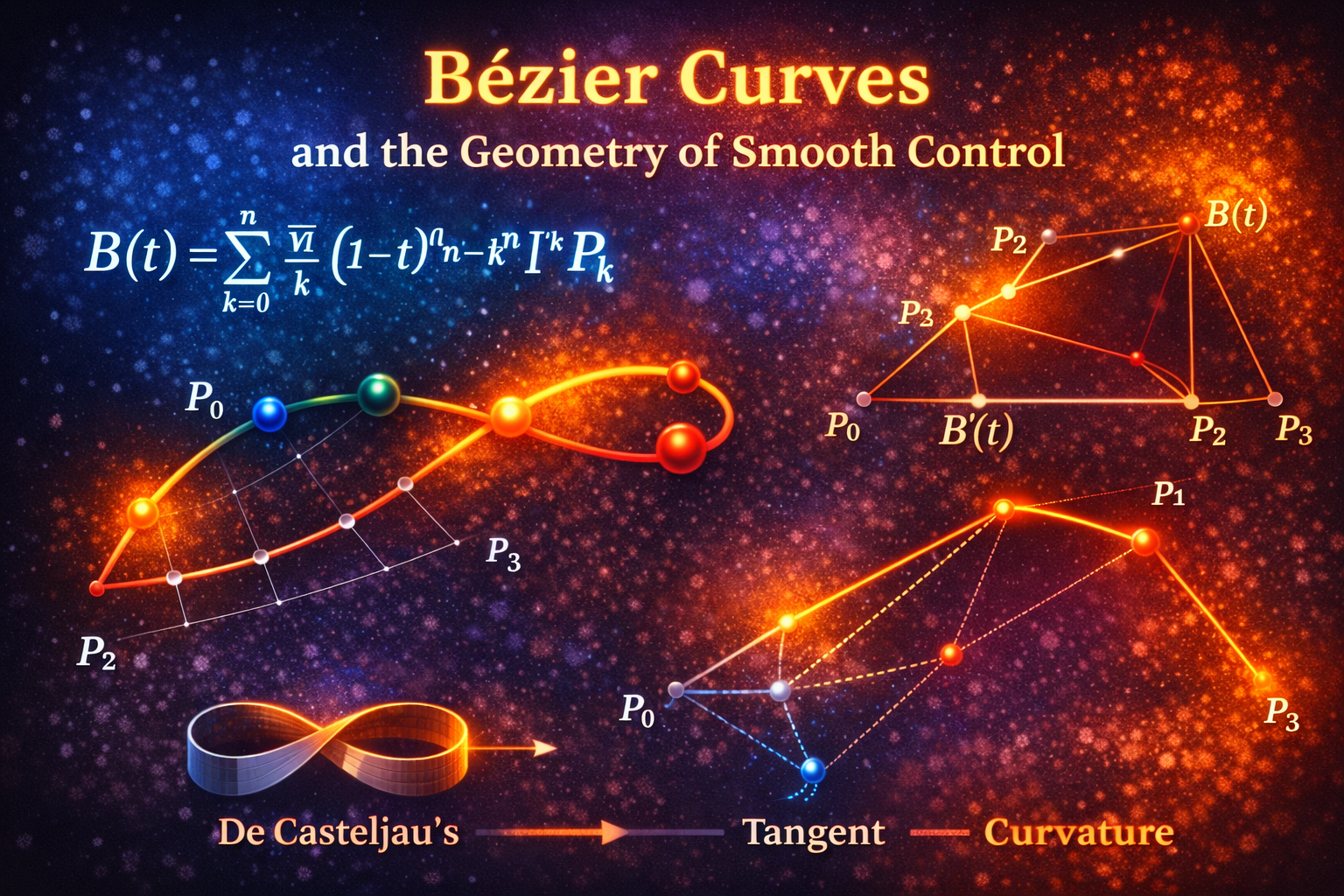
📐 What is a Bézier Curve?
A Bézier curve is a parametric curve defined by control points. Rather than passing through every point, the curve is pulled by them — a principle used throughout computer graphics, typography, CAD, and animation.
🧮 Mathematical Definition
A cubic Bézier curve with control points P₀, P₁, P₂, P₃ is defined by:
As t varies from 0 to 1, the curve smoothly interpolates between endpoints while respecting tangent directions.
🎨 Why Bézier Curves Matter
- Vector graphics & typography (SVG, fonts)
- Animation easing & interpolation
- Physical trajectories & splines
- Geometric continuity (C¹, C² smoothness)
Josephson Junctions · Phase Geometry
Smooth motion governed by phase, energy, and constraint
ℹ️ What is a Josephson Junction?
A Josephson junction consists of two superconductors separated by a thin barrier. Remarkably, current can flow without voltage, governed purely by a phase difference θ between quantum wavefunctions.
The system is described by a geometric rule:
I = I₀ sin(θ)
dθ/dt ∝ V
Instead of forces pushing particles, the system evolves by minimizing energy along a smooth phase landscape — much like a curve interpolating between control points.
SO(2) · Winding Number
Rotation as topology, not motion
ℹ️ What is SO(2)?
SO(2) is the group of rotations in the plane. Each element corresponds to a rotation by an angle θ:
R(θ) =
[ cosθ  −sinθ ]
[ sinθ   cosθ ]
Although θ and θ + 2π produce the same matrix, the path taken may differ. That difference is captured by the winding number.
Ampère’s Circuital Law · Circulation Geometry
How loops generate fields
ℹ️ What is Ampère’s Law?
Ampère’s circuital law relates the circulation of a field around a closed loop to what passes through the loop.
∮ B · dℓ = μ₀ I_enclosed
Geometrically, this says:
- Fields prefer to circulate
- Loops measure rotation
- Enclosed structure generates motion around it
This is the same logic behind phase winding, Josephson junctions, and rotation groups like SO(2).
Bézier → smooth paths
Josephson → phase loops
Ampère → circulation around structure