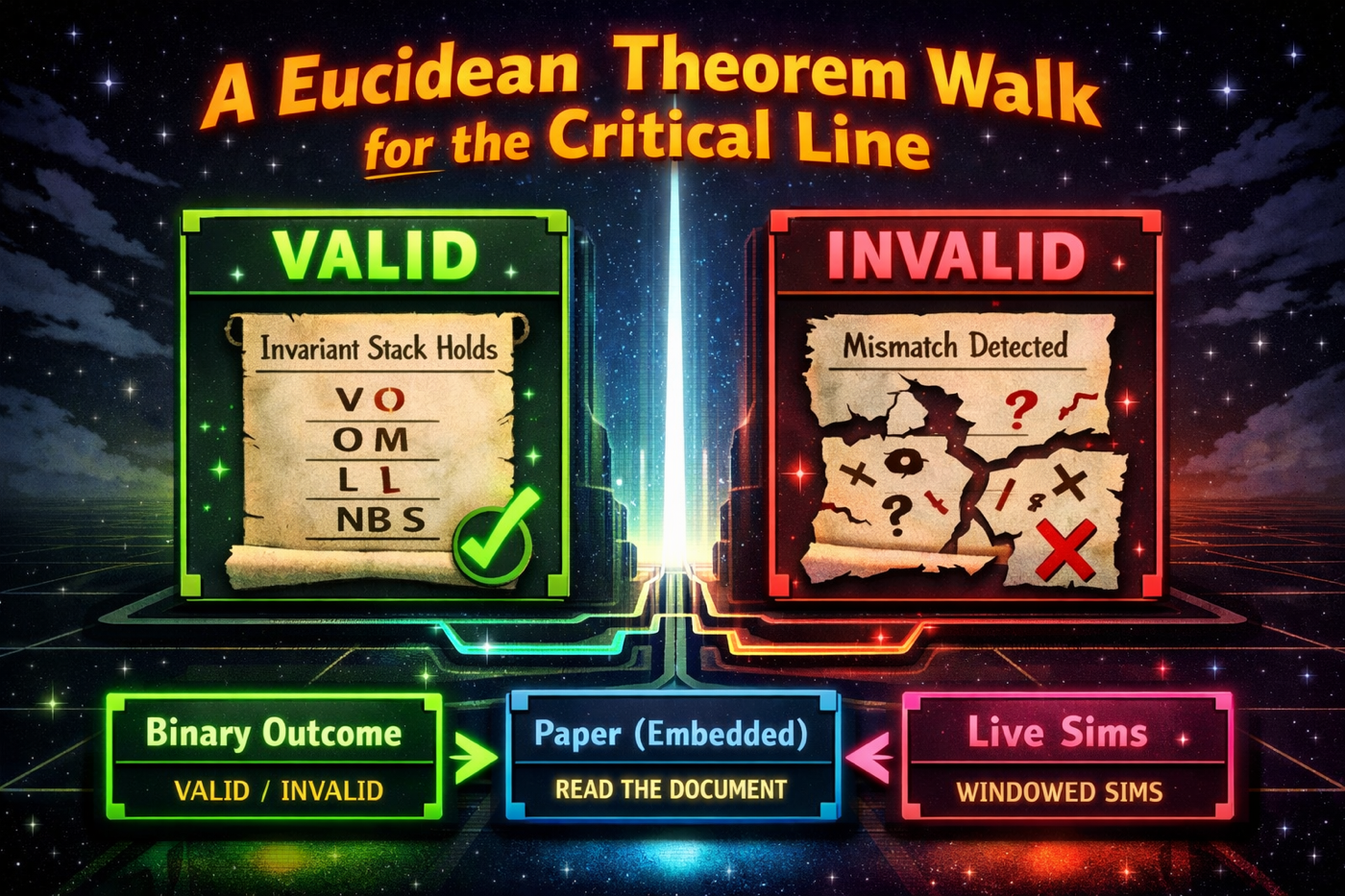
A Euclidean Theorem Walk for the Critical Line
Binary invariants: either the stack propagates and the critical line locks, or a mismatch becomes visible.
Binary Outcome VALID / INVALID
Paper (Embedded) scroll
Abstract start
A Euclidean-style walk framed as a binary outcome: either the invariant stack propagates and the critical line locks, or a mismatch appears that can be isolated.
Three claims scan
- Binary outcome: VALID vs INVALID.
- Bridge equivalences: energy ↔ positivity; energy ↔ NB distance; operator calibration ↔ critical-line mapping.
- Propagation: certify a window + monotone controls → global lock or explicit mismatch.
Invariant stack (V/O/M/L/NB/S) core
Load-bearing assumptions deep
- State assumptions for each equivalence direction (⇐ and ⇒).
- Define what “self-adjoint” means operationally in your mapping.
- Specify which monotonicity / compactness controls the propagation step.
Figures & diagrams share


Related next
🧠 Why Computation Wins ▾
Anyone can re-run your pipeline. Acceptance isn’t reproducible; computation is.
One counterexample input can shatter a claim immediately.
When it fails, you get where it fails: step, window, invariant.
Cache, reuse, compress: fewer steps, lower entropy, faster verification.
🪶 Quill logic vs auditable artifacts
“Quill & ink” can be correct yet hard to audit at scale. Computation produces artifacts: logs, certificates, replayable runs, and localized breach points.
- Human proof: compressed insight; risk of hidden assumptions.
- Computational proof: explicit witnesses + reproducible verification.
- Hybrid: prose explains; code verifies; certificates lock it down.
♾️ Atiyah ↔ Boltzmann Lens ▾
Insight-first: meaning and structure over ritualized formality.
Evidence and statistical structure win, even against institutional taste.
⚖️ “Math is not a democracy” (in this module)
Consensus is social; correctness is structural. Endorsement is not evidence. Auditable invariants and replayable checks are.
🧾 Certificates & Breach Logic ▾
Embed objections as drilldowns that self-neutralize via checks, breach markers, and replay steps.
✅ How breach points work
- Invariants: what must remain true to preserve the claim.
- Breach points: where an assumption breaks or a bound fails (mark red).
- Replay: re-run a targeted window or check to confirm.