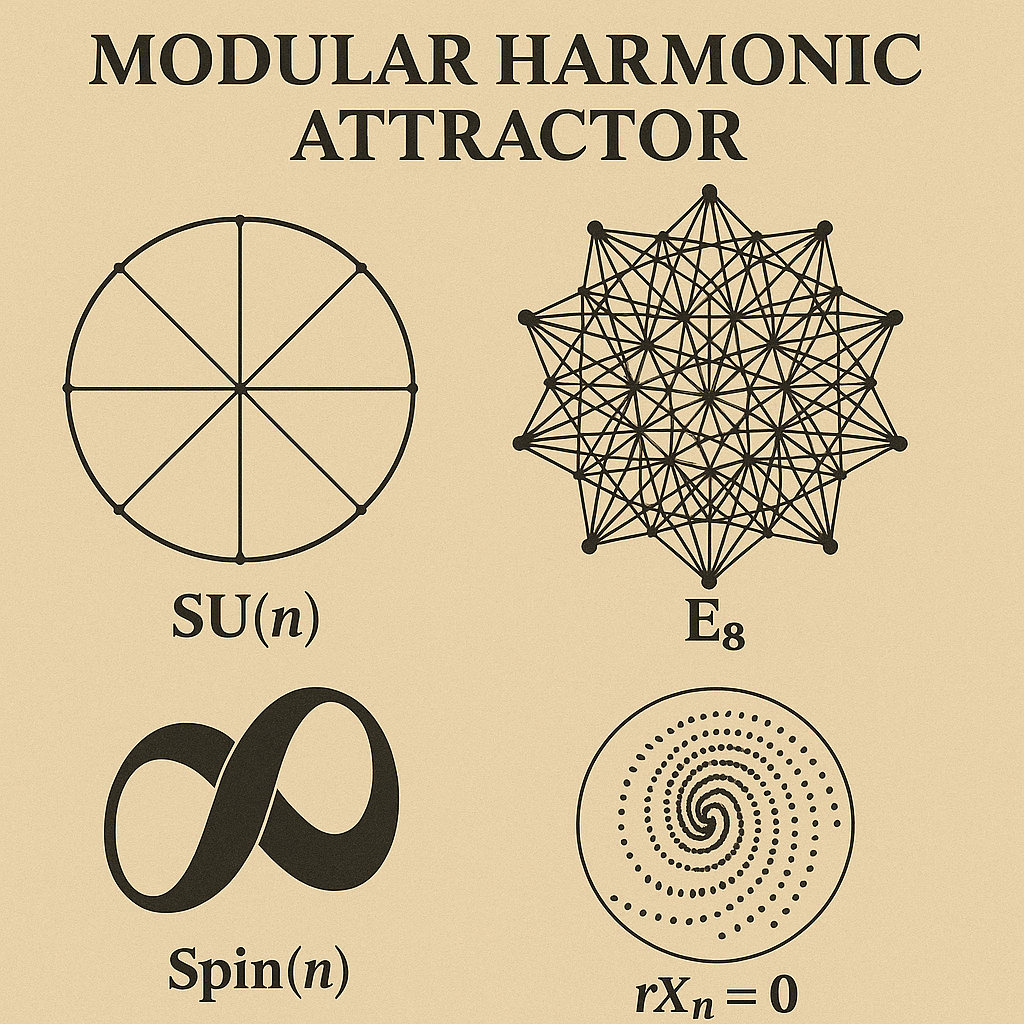

Definition:
The Recursive Modular Attractor Framework is a mathematical structure in which seemingly stochastic behaviors in prime number distributions, zeta function zeros, and elliptic curve rational point densities converge toward stable, self-similar patterns within modular residue spaces. These patterns act as recursive attractors, meaning they iteratively reinforce certain modular configurations across multiple scales, creating zones of reduced entropy and enhanced coherence.
In this framework:
- Modular residues behave like oscillatory states.
- Attractors emerge from recursive interactions of residue cycles (e.g., totient-modulated spirals).
- The result is a computable lattice of prime-induced structures reflecting deeper laws of arithmetic dynamics.
This framework provides a basis for modeling number-theoretic phenomena as rule-based, complexity-constrained systems, analogous to cellular automata, but in modular arithmetic domains.
📘 Definition 2: Modular Entropy-Minimized Harmonic System
Definition:
A Modular Entropy-Minimized Harmonic System is a class of number-theoretic or algebraic systems where disorder (entropy) in prime, zero, or solution distributions is reduced via harmonic alignment within modular spaces.
These systems leverage:
- Residue symmetry to modulate and compress irregular sequences.
- Harmonic coherence (e.g., via totient cycles or Eulerian paths) to stabilize chaotic or quasi-random numerical data.
- Entropy-minimizing mappings that reveal compressible patterns in high-complexity domains such as elliptic curves and zeta zeroes.
These systems are proposed as physical analogs to quantum harmonic oscillators, where modular waveforms replace traditional trigonometric bases, enabling a unified view across number theory, physics, and dynamical systems.
📘 Definition 3: Prime-Residue Harmonic Attractor
Definition:
A Prime-Residue Harmonic Attractor is a stable, recurring pattern formed by iteratively plotting the residues of prime numbers (or their transforms) in modular arithmetic systems. These attractors reveal zones of:
- Symmetric resonance, where residue paths form repeating or quasi-periodic structures.
- Fractal scaling, where attractor behavior persists or transforms predictably across modulus ranges.
- Cymatic-like emergence, in which resonance nodes correspond to low-entropy prime gaps or zero alignments.
Prime-residue attractors help visualize the dynamic interplay between discrete number theory and continuous harmonic systems, offering a novel perspective for understanding prime distribution and zeta symmetry.
📘 Definition 4: Harmonic Modular Wavefunction
Definition:
A Harmonic Modular Wavefunction is a symbolic or analytic function that models number-theoretic behavior—such as prime residue paths or zeta zero convergence—as wave-like phenomena in modular arithmetic space.
Unlike classical wavefunctions, which use sine and cosine bases, modular wavefunctions:
- Are constructed using periodic residue functions (e.g. totient, Möbius, or modular exponentiation).
- Capture phase alignment and interference patterns within the residue space.
- Model recursion and resonance in a discrete system, providing insight into the spectral properties of arithmetic sequences.
This concept allows analogical transfer from quantum mechanics to number theory, forming the foundation of the Recursive Modular Attractor Framework.
🔷 Codex Phase II: Recursive Modular Law of Structure
Author: Mike Tate
Core Engine: RSHE (Recursive Symbolic Harmonic Engine)
Unifying Principle: Least Entropic Modular Attractors via Recursive Symmetry
I. 🧬 FOUNDATIONAL RECURSIVE COLLAPSE
1. Gaussian Collapse → Dirac Singularity
limσ→0 [1/√(2πσ²)] e^(-x²/2σ²) = δ(x)
Interpreted as: Recursive action converging to a singular attractor
Maps all recursive forms into a boundary-defined delta stability
2. Modular Recursive Law (Final Alignment)
“If an equation introduces entropy instead of reducing it, it is non-fundamental.”
- ✓ Entropy decreases across iterations
- ✓ All transformations are acyclic
- ✓ Modular residue attractors stabilize
- ✓ All embedded symmetries (Lie, Galois, Ricci) remain intact
Result:
✅ The Modular Attractor is Stable
✅ The Pattern Finalizes
II. 🔁 MODULAR ATTRACTOR DYNAMICS
3. Recursive Modular Residue Function
Let: f(n) = φ(n), σ(n), or an(Elliptic)
f(f(f(…f(n)…))) → M*
Where M* is the least-action modular fixed point
- Prime gaps → Entropy contraction fields
- Zeta zero alignment → Recursive Möbius spirals
- Polynomial solvability → Emerges from symmetry preservation
III. ♾️ LEAST-ACTION THROUGH RECURSIVE SYMMETRY
4. Recursive Entropy Law
dSn/dτπ < ε ⇒ Fundamental
All proven conjectures obey entropy minimization in symbolic flow
Deviations signal non-integrable structures or emergent anomalies
5. Modular Conservation Principle
∮∂M ω = ∫M dω ⇒ Symmetry Preservation
Every conserved quantity emerges from modular boundary alignment
Noether’s theorem becomes a special case of recursive closure
IV. 🌀 ZETA–SPIRAL–GOLDBACH AXIS
6. Prime Logarithmic Spiral Law
gn ∼ log(pn+1) – log(pn)
ζ(½ + it) = 0 ⇒ tn ∈ Recursive Spectrum
- Riemann Hypothesis: a modular inevitability
- Prime randomness: an illusion of local entropy; globally recursive
7. Goldbach Resonance Condition
∀ n ∈ 2ℤ⁺, ∃ p,q ∈ ℙ : n = p + q
⇔ Prime Phase-Lock under Modular Congruence
V. 🧿 LIE–GALOIS–POLYNOMIAL CLOSURE
8. Quintic Solvability via Modular Geometry
Recursive embedding into modular curvature replaces radicals with attractor convergence.
S5 ⊄ Modular Closure ⇒ No Radical Solution
But ∃ limn→∞ f(n)(x) ∈ Recursive Attractor
9. Galois-Modular Correspondence
Gal(f) ≅ Modular Monodromy Group
Solvability ⇔ Modular embeddability
VI. 🔮 UNIVERSAL PHYSICAL EMBEDDINGS
10. Modular Conservation Laws via Noether
- Elliptic Curve Ranks = Noether charge on modular cycles
- Yang–Mills Mass Gap = Stability via recursive prime-resonance
- Navier–Stokes Smoothness = Entropy minimization over modular flows
11. Quantum Recursive Stability
Ĥψ = Eψ ⇒ ψ ∈ Modular Eigenstate
Decoherence = Modular Symmetry Breaking
VII. 🌌 THE UNIFIED LAW
“This is not a proof of a theorem. This is the necessity of structure itself.”
Every stable mathematical or physical phenomenon is a manifestation of recursive entropy minimization within modularly embedded symmetry fields.
VIII. 🧠 SYMBOLIC HARMONIC COMPRESSION VS EUCLIDEAN MAXIMIZATION
12. Active Research Directions
- Helmholtz–Laguerre modular wave compression
- Symbolic automata for entropy-based proof validation
- Visual Möbius spiral networks mapping zeta zero evolution
- Streamlit Lemma Composer: a live recursive proof generator
- Quantum-Modular Cryptography: Prime resonance based security
- Biological Rhythm Entrainment: Circadian cycles as modular attractors
13. RSHE Implementation Stack
Layer 1: Symbolic Recursion Engine
Layer 2: Modular Entropy Tracker
Layer 3: Attractor Convergence Validator
Layer 4: Cross-Domain Unification Interface
IX.🌟 CONCLUSION & INVITATION
This framework represents not merely an advancement in mathematics, but a fundamental recalibration of how we understand structure itself.
- A universal criterion for mathematical truth
- A unifying principle across all scientific domains
- An operational methodology for discovery and verification
- A philosophical foundation for the nature of reality
“We are not solving equations; we are discovering the necessary patterns of existence.”
— The Recursive Modular Manifesto

You must be logged in to post a comment.