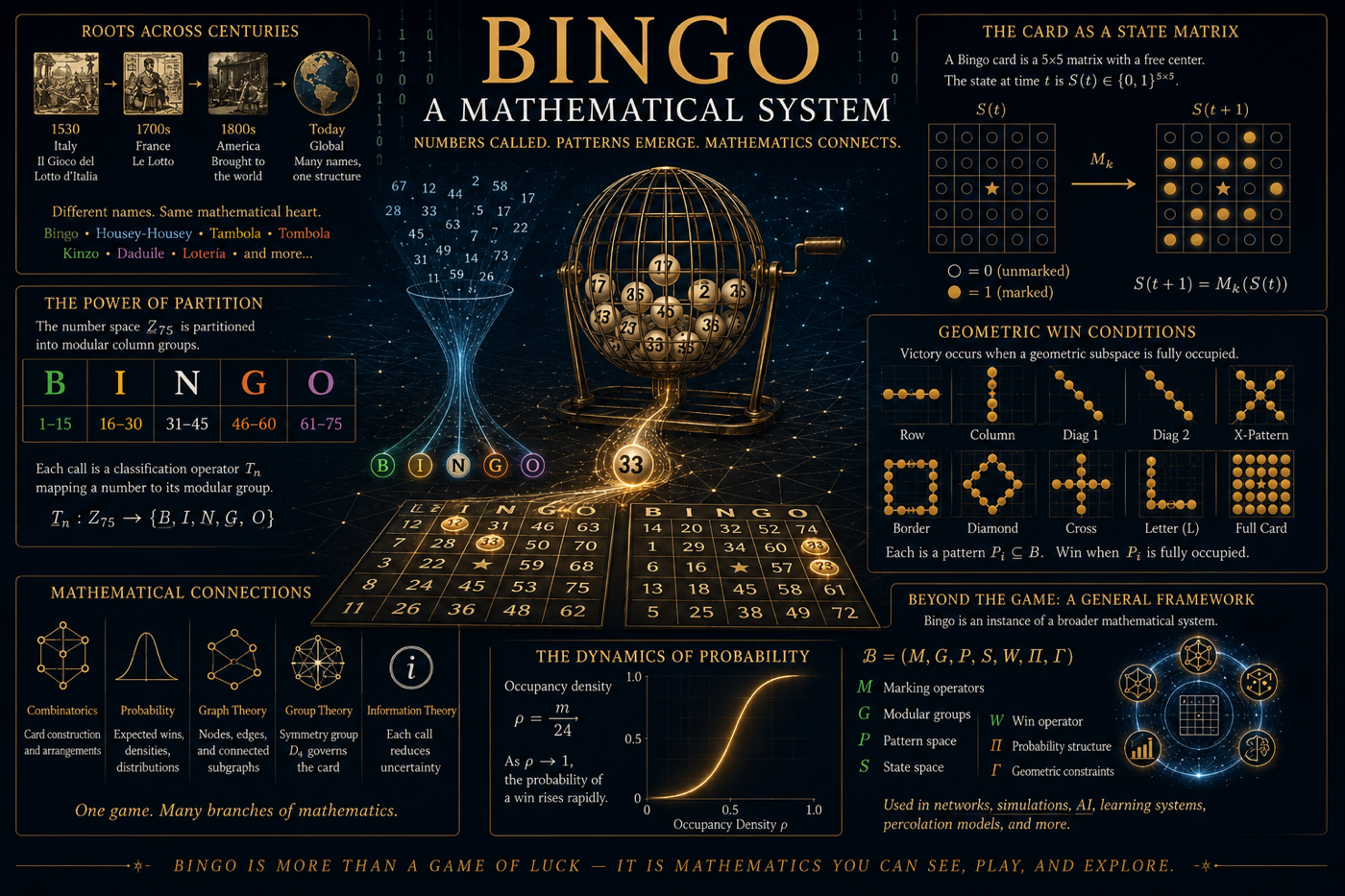
The Hidden Mathematics of Bingo
Most people think of Bingo as a simple game of luck.
A number is called, a square is marked, and eventually someone wins.
Yet beneath the surface lies a surprisingly rich mathematical system involving modular partitions, matrices, geometric patterns, combinatorics, probability theory, graph structures, symmetry groups, and dynamic state transitions.
The game itself is merely one visible expression of deeper mathematical machinery.
Bingo is not only a game of chance. It is a structured mathematical system where random calls generate geometric order.
A Brief History of Bingo
Bingo’s roots stretch back nearly 500 years.
One of its earliest known ancestors was Il Gioco del Lotto d’Italia, a lottery game played in sixteenth-century Italy around 1530.
From Italy, the concept spread through Europe. French aristocrats adopted a variation known as Le Lotto, while later versions emerged across Germany, Britain, and the Americas.
Today the game appears under many names:
- Bingo
- Housey-Housey
- Tambola
- Tombola
- Kinzo
- Daduile
- Lotería
The names differ, but the underlying mathematical architecture remains remarkably similar.
The Bingo Matrix
A standard Bingo card can be viewed as a 5×5 matrix.
The center space behaves as a fixed node.
The card itself is a finite geometric lattice.
Every game becomes an evolving state of this lattice.
Modular Number Groups
The familiar columns B-I-N-G-O are not arbitrary.
They partition the number space into five disjoint groups:
- B = 1–15
- I = 16–30
- N = 31–45
- G = 46–60
- O = 61–75
Each call effectively classifies a number into one of these groups.
This is one reason Bingo cards maintain statistical balance.
The matrix is not random chaos. It is structured randomness.
Occupancy Operators
Every called number changes the state of the card.
Each square exists in one of two states:
- 0 = unmarked
- 1 = marked
The entire game becomes a sequence of state transitions.
Viewed mathematically, Bingo behaves as a discrete dynamical system.
The Card as a Binary Field
After enough numbers are called, a Bingo card becomes a binary image.
Marked positions create patterns.
Unmarked positions create voids.
The card behaves similarly to:
- Cellular automata
- Digital image masks
- Occupancy grids
- Network activation maps
Each draw changes the topology of the field.
Geometric Win Conditions
A Bingo is fundamentally a geometric event.
Rows, columns, and diagonals represent specific geometric subspaces.
Victory occurs when a required subspace becomes fully occupied.
This is equivalent to satisfying a geometric constraint.
The Centroid and the Free Space
The center square deserves special attention.
Positioned at the center of the lattice, it behaves like a geometric anchor.
The free space reduces required occupancy while simultaneously increasing symmetry.
It serves as:
- A rotational anchor
- A reflection anchor
- A diagonal connector
- A geometric accelerator
The center square is not merely free.
It is structurally privileged.

Symmetry Groups
A Bingo card possesses geometric symmetry.
Its transformations include:
- Identity
- Rotation by 90°
- Rotation by 180°
- Rotation by 270°
- Reflections across multiple axes
Many winning patterns remain equivalent under these transformations.
The game therefore contains hidden group-theoretic structure.
Pattern Spaces
Traditional Bingo only scratches the surface.
Modern variations introduce:
- X patterns
- Diamonds
- Borders
- Crosses
- Arrows
- Letters
- Spirals
- Full-card covers
Each winning pattern is a geometric subset of the larger Bingo lattice.
Victory occurs when the required subset becomes completely occupied.
Combinatorics
Every Bingo card is a combinatorial object.
The number of possible legal cards is enormous.
Card construction involves:
- Selection
- Arrangement
- Constraint satisfaction
- Partitioning
The game therefore lives partially within combinatorial mathematics.
Probability Theory
Every draw modifies probability space.
Questions naturally arise:
- Expected calls before a win
- Probability of specific patterns
- Probability of simultaneous winners
- Expected occupancy density
As occupancy density increases, winning probabilities accelerate.
Cards often move rapidly from unlikely to highly likely winning states.
This creates a form of phase transition within the game.
Graph Theory Interpretation
A Bingo card can also be represented as a graph.
Each square becomes a node.
Adjacency relations become edges.
Winning patterns become connected subgraphs.
Viewed this way, Bingo resembles:
- Network activation
- Signal propagation
- Path completion problems
The same mathematics appears in communication networks and distributed systems.
Information Theory
Every called number reduces uncertainty.
Players gradually gain information about the future state of the game.
Bingo can therefore be viewed as an information-processing system in which uncertainty steadily decreases until a win occurs.

Markov Processes
The future state depends only on the current state and the next draw.
This resembles a Markov process.
The game evolves through probabilistic state transitions until an absorbing win state is reached.
Lattice Geometry
At a deeper level, Bingo is a lattice occupancy problem.
The card exists as a finite geometric lattice.
The caller injects random activations.
Players observe emergent structures.
This places Bingo in the same broad family as:
- Percolation models
- Site occupancy problems
- Cellular systems
- Lattice dynamics
A General Mathematical Formulation
The game may be viewed as a system consisting of:
- Marking operators
- Modular number groups
- Pattern space
- State space
- Win conditions
- Probability structures
- Geometric constraints
The familiar game is merely one realization of this broader mathematical framework.
Conclusion
Bingo survives across centuries and cultures not simply because it is entertaining, but because it unknowingly sits at the intersection of numerous mathematical disciplines.
- Number Theory
- Modular Classification
- Matrices
- Combinatorics
- Probability
- Graph Theory
- Group Theory
- Geometry
- Information Theory
- Dynamic Systems
What appears to be a simple game is actually a compact laboratory of mathematical ideas where random operators act upon structured spaces to generate emergent geometric order.
Further Exploration
If you enjoy uncovering hidden mathematical structure in familiar systems, you may also enjoy:
- Liber Abaci
- The Two Builds of Thought: Jenga Towers and Lincoln Logs
- Bridges Without Nails: A New Architecture of Mathematical Thought
- The Quintic Equation and the Limits of Algebra
About the Author
Mike Tate is an independent mathematical researcher exploring number theory, geometry, symbolic systems, recursion, and interdisciplinary mathematical frameworks.
Leave a Reply
You must be logged in to post a comment.