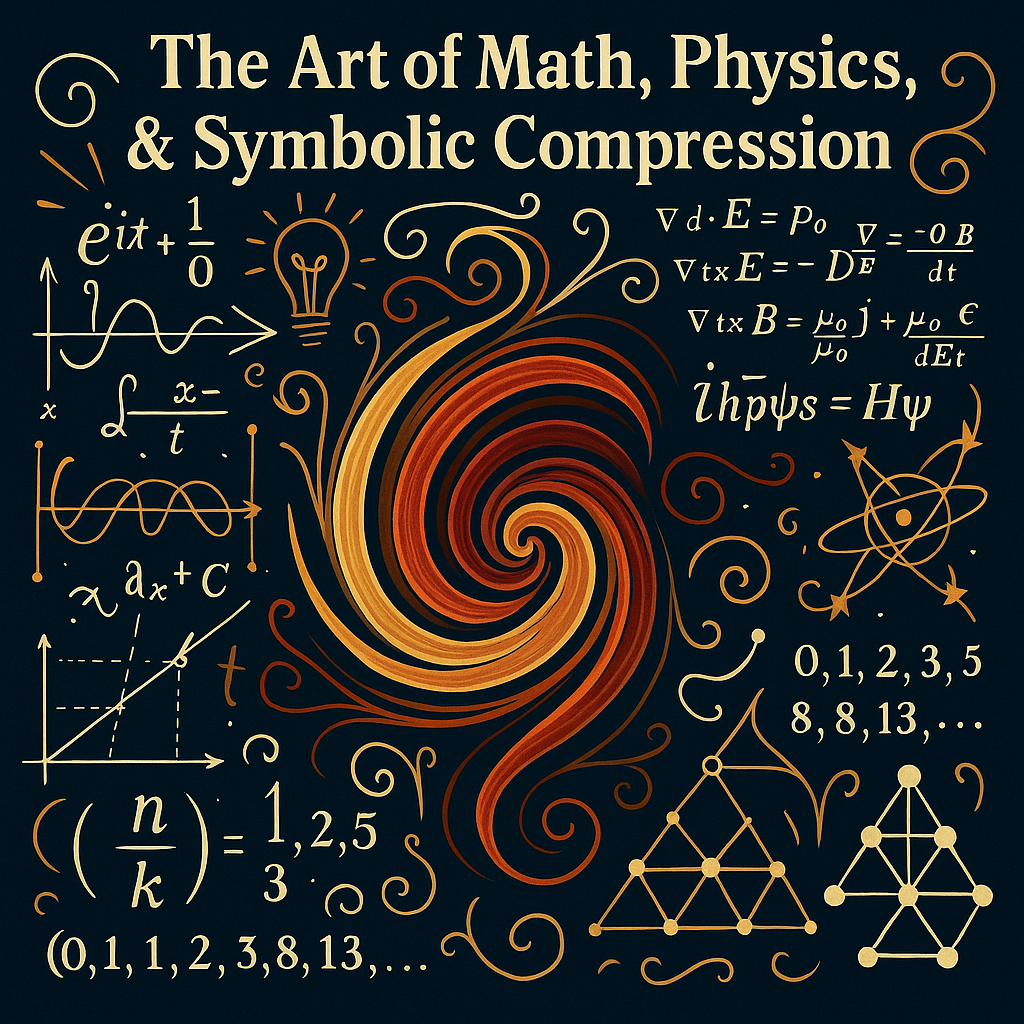

The Harmonic Compression Mapping Protocol: Encoding Concepts Through Symbolic Geometry
The GHAT system represents a transformative approach to encoding and compressing mathematical concepts into a symbolic language. This modular framework connects abstract mathematical fields with simple, interpretable symbols that preserve depth and allow for cross-domain synthesis. Below is an exploration of its key components, advantages, and applications.
What Is GHAT?
GHAT (Geometric-Harmonic Abstraction Tags) is a symbolic framework that links characters—letters, digits, and even emojis—to complex mathematical concepts. Each character is meticulously designed to hold modular, algebraic, geometric, or cognitive weight. This language facilitates the compression of intricate ideas into symbols that can be triangulated, recombined, and interpreted across various disciplines.
Example Encoding
- Signature:
c7gc: Combinatorics7: Digit root resonance or cyclic symmetryg: Galois field structure: Scientific modeling context
Each character within a GHAT signature conveys multiple layers of meaning, making it possible to encode complex theories with precision while maintaining a high level of semantic density.

Symbolic Mapping
The GHAT system uses a unique symbolic alphabet that assigns specific mathematical or cognitive meanings to letters, digits, and emojis. Below is a partial mapping that demonstrates how each element in the symbolic language connects to a key concept or structure:
Letters (a–z)
- a: algebra
- b: boolean logic
- c: combinatorics
- d: dynamical systems
- e: Euler’s number
- f: Feigenbaum constants
- g: geometry
- h: Hermitian spaces
- j: Jacobian structures
- k: Klein groups
- l: Lagrangian mechanics
- m: M-theory
- n: Noether’s theorem
- p: Pauli exclusion
- q: quantum theory
- r: Ricci flow
- s: scalar entropy
- t: topology
- v: vectors
- w: waveforms
- x: angular metrics
- y: Yang-Mills
- z: zeta functions
Digits (0–9)
- 0: null
- 1: identity
- 2: binary (duality)
- 3: trinity / resonance
- 4: cardinal directions
- 5: prime rhythm
- 6: modular pivot
- 7: GF(7), cyclic closure
- 8: GF(8), octonionic tie-in
- 9: mod 9 closure
Emojis
- : cognitive modeling
- : scientific modeling
- : pedagogical
- ⚖️: balance/symmetry
- : phase transition
- : recursion / spirals
Each symbol is chosen to embody both abstract concepts and contextual insights, enabling flexible cross-disciplinary interpretations.
GHAT Compression Protocol
The GHAT system is used to encode mathematical ideas systematically:
Step-by-Step Process:
- Select a Concept: Identify the concept to be encoded (e.g., “analytic continuation”).
- Decompose it: Break down the concept into relevant mathematical or cognitive domains (e.g., algebra, topology, zeta functions).
- Encode Using Symbolic Tags: Encode the concept by selecting relevant GHAT tags (e.g.,
actez3). - Store it in the GHAT Library: Each encoding is stored along with its label and meaning map, creating a digital or physical library for easy reference.
△ Triangular Synthesis
The real strength of GHAT lies in its ability to triangulate ideas from different domains. By selecting three different GHAT entries, one can interpret their intersection as a triangle of meaning:
Example Triangle:
actez3(analytic continuation)czr6(Cauchy’s residue theorem)thx3(Hopf fibration)
The centroid formed by these vertices represents a synthesis of the mathematical ideas. By spinning interpretations around this centroid, you can:
- Discover Overlapping Ideas: Gain insights where fields converge.
- Generate New Abstractions: Innovate by combining mathematical concepts.
- Build Transpositional Models: Create hybrid models that span multiple domains.
Through triangulation, GHAT encourages the creation of new concepts, improving both understanding and innovation.
⚛️ Why It Matters
GHAT is more than just a notation system; it’s a powerful tool for anyone involved in mathematical theory, scientific modeling, or cognitive exploration. It serves several purposes:
- Modular Language for Symbolic Compression: GHAT allows the complex to be reduced to a manageable, symbolic form, where the depth is preserved in a compact notation.
- Tool for Proof Synthesis: GHAT can be used to derive proofs by linking symbols across disciplines and discovering hidden relationships.
- Bridge Across Disciplines: Whether it’s topology, physics, or cognition, GHAT allows seamless translation between domains, fostering interdisciplinary innovation.
The framework’s recursive nature supports both composability and modularization, enabling it to serve as a potent analytical and creative tool for professionals, researchers, and even educators.
Conclusion
GHAT introduces a revolutionary symbolic framework that transforms complex mathematical ideas into compressed, translatable formats. With its modularity, triangulation capabilities, and synthesis potential, it serves as a bridge between abstract mathematical concepts, practical problem-solving, and interdisciplinary collaboration. Whether used for proof synthesis, theoretical exploration, or interdisciplinary synthesis, GHAT stands poised to become a fundamental tool for future research and innovation across mathematics and beyond.



You must be logged in to post a comment.