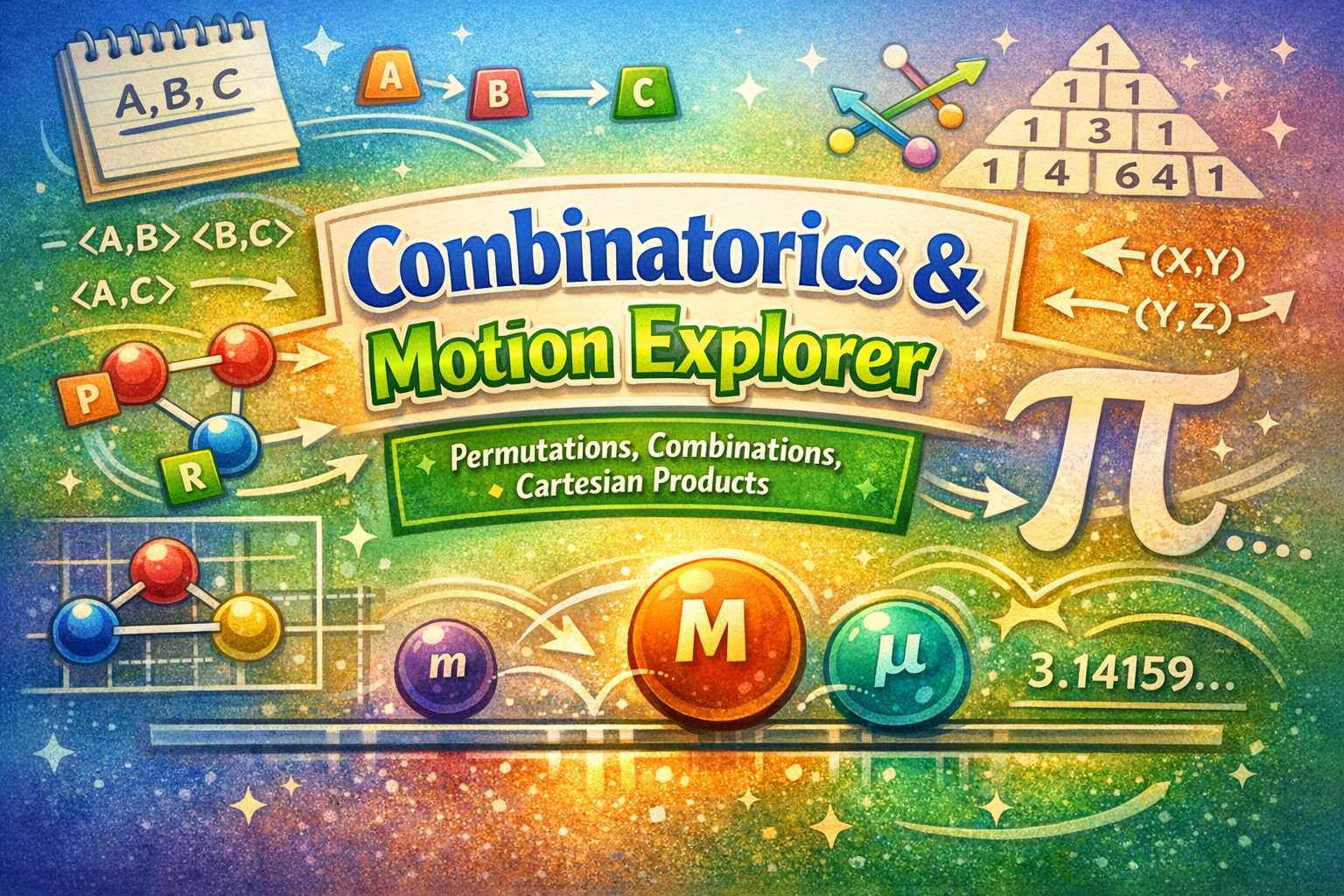
Combinatorics is the art of counting possibilities. It answers questions like:
How many different ways can we choose, arrange, or group items?
Two key tools:
Permutations (where order matters)
and Combinations (where it doesn’t).
How many ways to arrange 3 colored blocks?
Answer: 3! = 6
Choose 2 fruits from 4 (apple, banana, pear, mango).
Answer: 4C2 = 6
These ideas shape fields from probability to quantum state spaces—every selection matters.
π Emerges from Motion
Combinatorial thinking stretches back over a millennium. In ancient India, the scholar Pingala (c. 3rd–1st century BCE) used binary patterns to enumerate poetic meters — an early form of permutation counting.
Later, Middle Eastern mathematicians like al‑Khwarizmi and Omar Khayyam explored algebraic structures and implicit combinatorial principles when solving equations.
These early efforts laid the groundwork for systematic counting long before formal notation existed.
In 1654, Blaise Pascal popularized the triangle of binomial coefficients, now called Pascal’s Triangle. Each row mirrors the coefficients in expansions like \((a+b)^n\), revealing deep connections between algebra and combinatorial counting.
Pascal’s work helped formalize combinations and provided a foundation for later probability theories.
Example: The 5th row of Pascal’s Triangle (1 5 10 10 5 1) gives the number of ways to choose groups from 5 elements.
Jakob Bernoulli published Ars Conjectandi, the first comprehensive text linking combinatorial ideas with probability. Bernoulli systematically defined combinations, permutations, and introduced binomial probabilities.
His work enabled later advances in statistical inference and laid a theoretical basis for probability as a science.
In 1736, Leonhard Euler solved the famous Seven Bridges of Königsberg problem by applying counting and connectivity principles to bridges and landmasses.
This marked the beginning of graph theory, one of the most active areas of modern combinatorics, central to networks, algorithms, and discrete geometry.
British mathematician Alfred Young introduced what are now called Young tableaux, combinatorial objects used to understand symmetries and group representations.
These tools became vital in algebra, physics, and the study of symmetric functions.
Today, combinatorics drives algorithms, data structures, optimization, cryptography, and even machine learning. Problems once purely theoretical now guide computations at massive scales.
Techniques like dynamic programming, graph traversal, and counting complexity reflect centuries of combinatorial evolution.
Combinations: Groups where order doesn’t matter.
Cartesian Product: Every pairing between two sets.
Try changing k or elements to explore different counts.