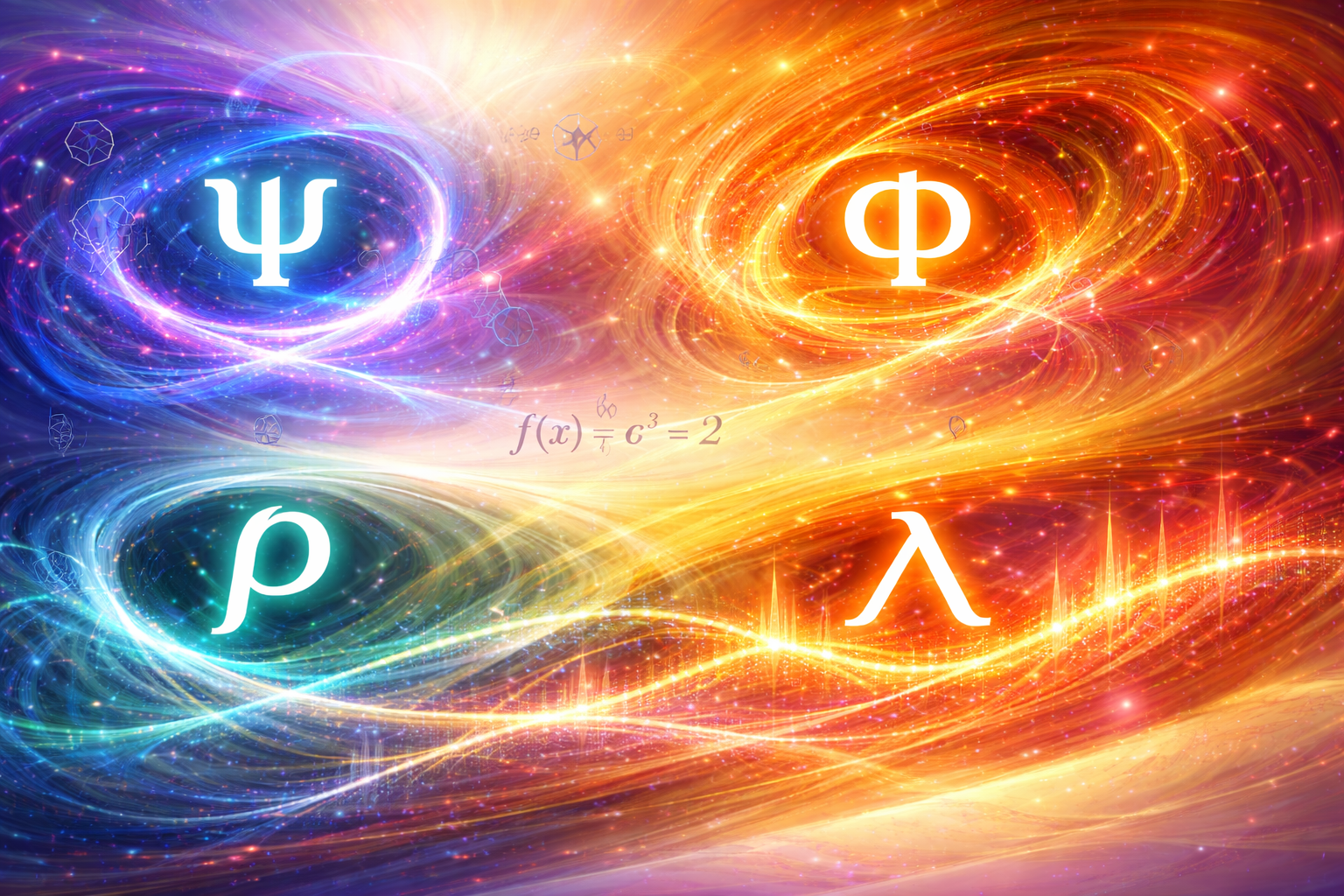
Ψ
Root Permutations
Discrete symmetries of polynomial roots (Sₙ group)
Φ
Path Morphs
Interpolated transitions between permutation states
ρ
Lie Flow
Continuous motion under Lie group evolution (e.g. SU(2))
Λ
Prime Weighting
Von Mangoldt spikes encoding prime power density
Symbolic Explainers
Ψ — Root Permutations (Discrete Symmetry)
Ψ encodes discrete algebraic symmetry — like the Galois group of \( x^3 – 2 \), where roots are permuted without changing the structure. These form groups like \( S_3 \), foundational to modern algebra.
Φ — Path Morphs (Interpolated Deformations)
Φ reflects continuous morphing between discrete outcomes. In our simulations, it corresponds to flowing transitions between permutation states — connecting Ψ via geometry and homotopy.
ρ — Lie Flow (Continuous Symmetry)
ρ expresses smooth symmetries — governed by Lie groups (like SU(2)). These flows act on roots as rotations or evolutions, contrasting with Ψ’s discrete jumps. They’re geometric, topological, and physical.
Λ — Von Mangoldt Function (Prime Encoding)
Λ(n) injects arithmetic into the system — spiking only at prime powers. It’s a core part of the explicit formulas that connect prime distribution to complex function theory, like ζ(s).
🧠 Unified Symbolic Framework
The four symbolic operators form a dynamic grammar of mathematical motion:
- Ψ — Permutations of algebraic roots (symmetric group structures)
- Φ — Morphs and deformations between states (interpolated flows)
- ρ — Continuous Lie group actions (orbiting flows on root space)
- Λ — Encoded prime density via Von Mangoldt (discrete arithmetic spikes)
Together, they act as operators in a symbolic dynamics: **Ψ** defines state space, **Φ** connects states, **ρ** flows over them, and **Λ** seeds the entire field with number-theoretic resonance.