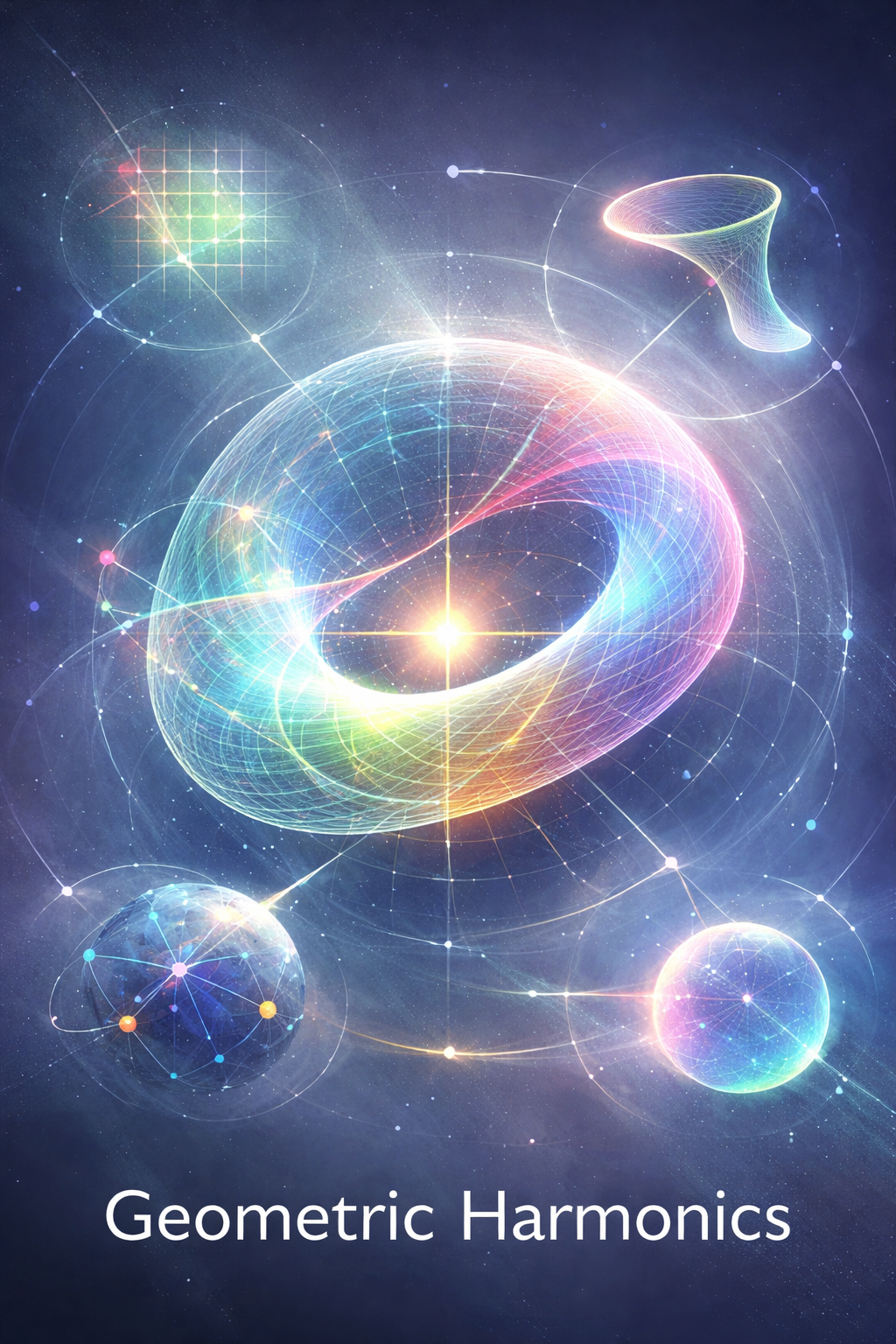
Geometric harmonics describe how shape, curvature, and structure evolve under smooth, rule-governed flows. Rather than tracking points, the geometry itself becomes dynamic.
These systems reveal how form stabilizes, diffuses, or reorganizes under intrinsic constraints.
As harmonic functions describe resonant modes of vibration, geometric harmonics describe preferred modes of structural evolution.
Curvature, metrics, and topology interact like coupled oscillators, seeking symmetry, balance, or minimal energy.
Ricci Flow smooths curvature irregularities, reshaping geometry toward canonical forms.
Tensor Flow evolves metrics and inner products across space.
Heat Flow diffuses curvature and scalar quantities.
Mean Curvature Flow drives surfaces toward minimal configurations.
Poincaré Flow links dynamics with topological classification.
Many geometric flows converge toward attractors — stable configurations insensitive to initial noise.
This recursive convergence mirrors your broader framework: iteration → simplification → invariance.
- Perelman’s resolution of the Poincaré conjecture
- Modern geometric analysis
- Shape optimization & physical modeling
- Recursive, harmonic views of structure