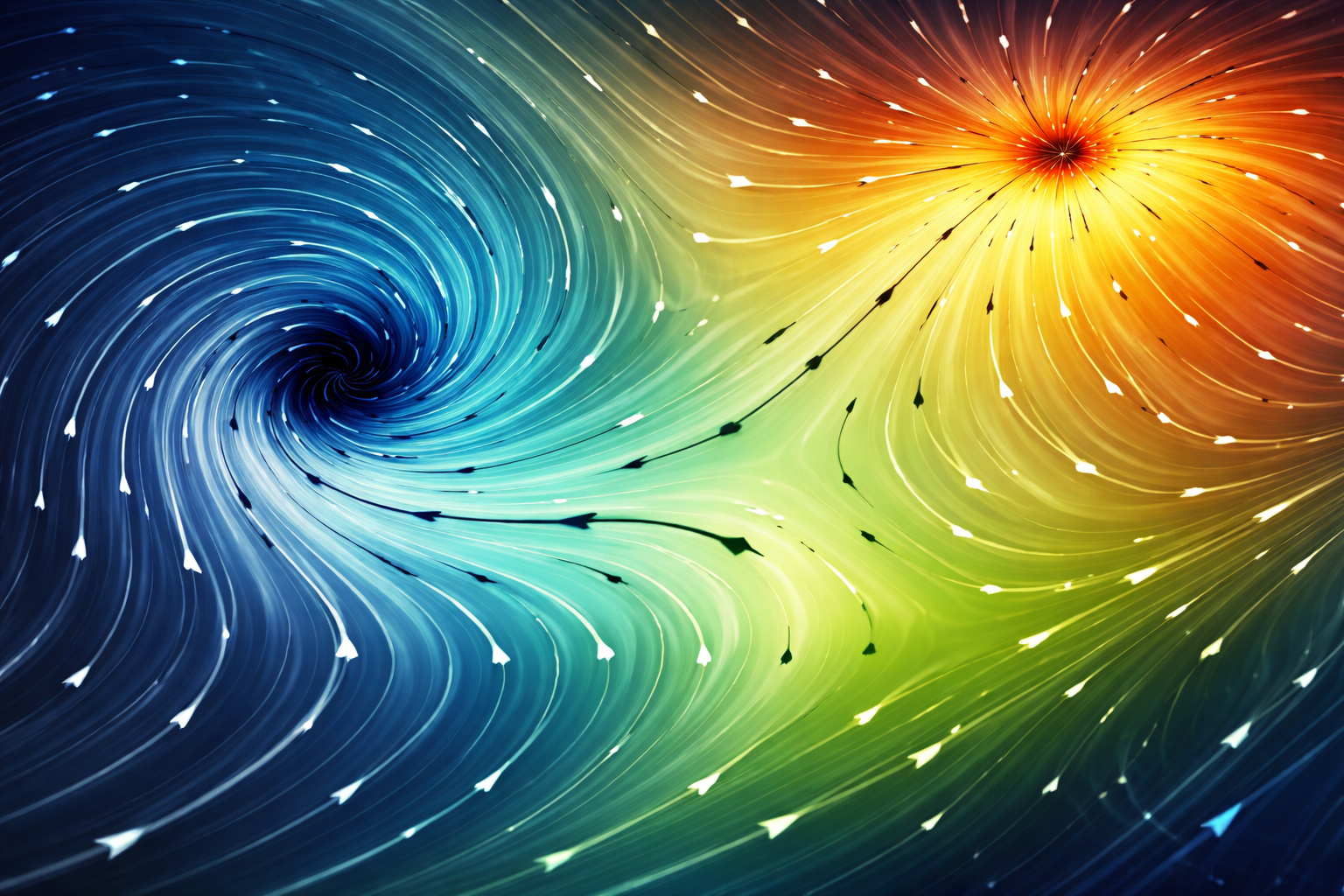
Phase–Curvature Field (720°)
🌀 How to Read the Phase–Curvature Fields
These simulations visualize a phase-driven vector field in which motion arises from periodicity and curvature, not force or optimization. Particles act as probes revealing the geometry of the field.
The 360° Phase–Curvature Field
In the standard field, phase completes a single cycle 0 → 2π. After one full rotation, the system closes and repeats.
Color encodes local curvature intensity and flow speed:
- Baby Blue — low curvature, stable laminar flow
- Goldenrod — transitional regions, curvature gradients
- Candy Apple — high curvature, rapid phase change
- Black — structural boundary and invariant scaffold
This regime models systems where orientation is identified after one turn. Repetition is exact, and attractors stabilize quickly.
The 720° Double-Loop Variant
The 720° field extends phase through 0 → 4π. After the first rotation, the field does not return to its initial state. Closure occurs only after a second full cycle.
In this version, color marks phase strata across the double loop:
- Grape — latent phase (pre-orientation)
- Orange — active phase transition
- Green Apple — stabilized but non-closed flow
- Cherry — torsion-dense regions
- Banana — true closure boundary (4π)
What the comparison reveals
The 360° field shows periodic motion. The 720° field exposes topological memory.
Both follow the same equations — only the phase domain changes. The difference is not aesthetic; it is structural.
Dynamic Vector Field
➿ How to Read the Dynamic Vector Field
This simulation shows a vector field generated from a scalar potential. Every arrow indicates the direction and relative strength of motion that a particle would experience at that location.
What drives the motion
The background colors come from a smoothly varying scalar potential. The arrows are derived from its local change — not by force rules, but by geometric variation.
Regions where the potential rises or falls rapidly generate longer vectors. Where change is gentle, motion slows and circulates.
Why rotation and convergence coexist
The field intentionally blends:
- Curl — rotational motion
- Sink / Source — convergence and escape
This creates persistent flow structures — channels, vortices, and separatrices that remain even as the field evolves.
Symbolic view (micro-animation)
Below, mathematical symbols drift through a simplified vector flow. They are not labels — they act as tracers, revealing how abstract quantities are carried by structure.