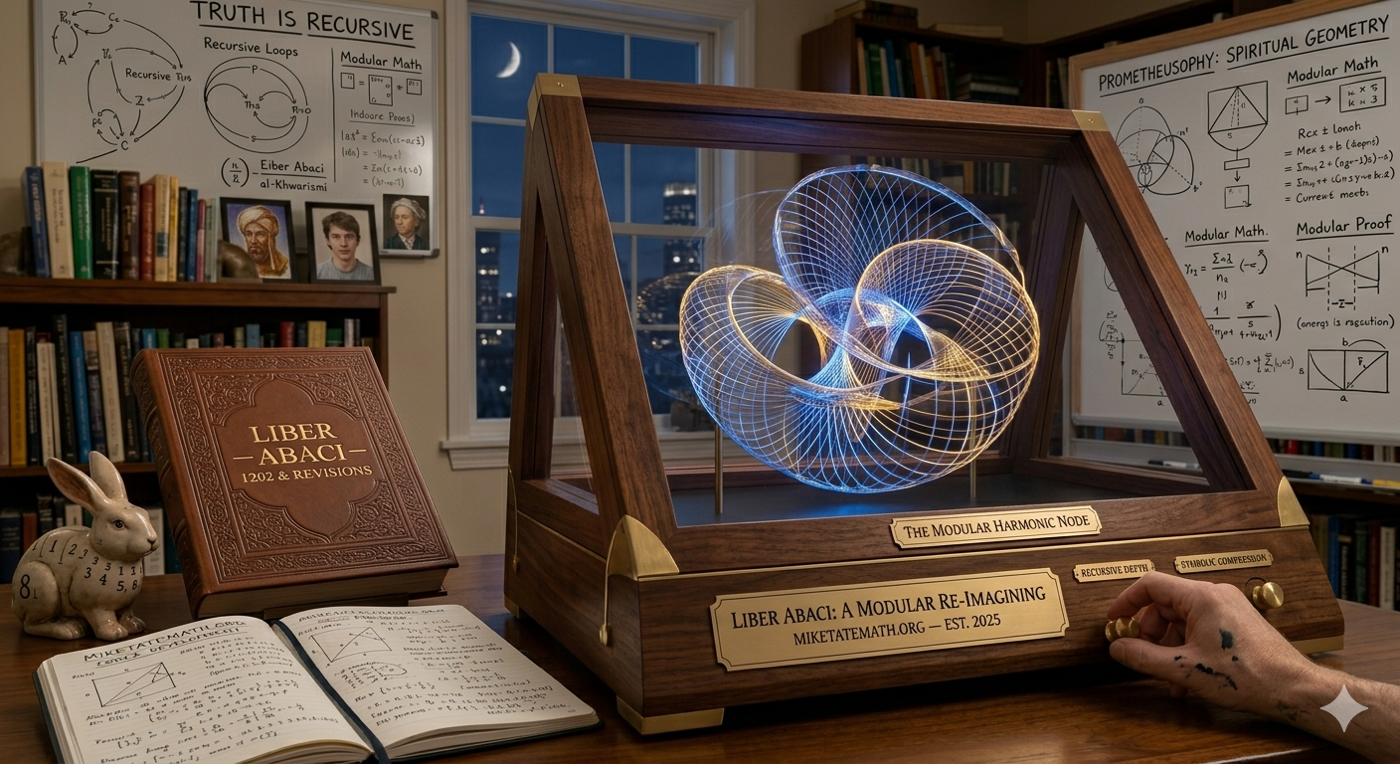
Liber Abaci
Fibonacci’s invitation to discovery · Recursion · Harmonics · The Cartan Tartan
The Problem with “The Fibonacci Sequence”
Most people who know Liber Abaci know it for one thing: the Fibonacci sequence. A single page, a single problem about rabbits, extracted from a 600-page mathematical treatise and repeated until it became a cultural artifact.
But if you actually open Liber Abaci—or sit with its structure and intent—you find something far more radical. You find a book that does not teach math the way we teach math now. And that makes it a fascinating object when viewed through the lens of genuine mathematical inquiry.
The reduction of Liber Abaci to “that book with the rabbit problem” is a perfect example of what happens when mathematics is flattened into memorizable trivia. Fibonacci did not discover the sequence in the sense of stumbling upon a curiosity. He encountered it as a model—a way of thinking about growth, reproduction, and recurrence that emerged naturally from a concrete problem.
The sequence was not the point. The method was the point. In modern math education, we often present the Fibonacci sequence as a fact to be recited, or at most a pattern to be extended. But in Liber Abaci, it was an invitation: Here is a situation. How would you describe it mathematically? What patterns emerge?
This is the difference between learning about math and doing math.
What Liber Abaci Actually Does
When you look at the full work, you find something closer to an interactive exploration than a modern textbook.
Hundreds of trade calculations, currency conversions, profit-sharing arrangements, geometric puzzles. You learn by wrestling with situations.
Fibonacci embedded the Hindu-Arabic numeral system in mercantile contexts—math where it lives.
Multiple approaches, generalizations, room for “what if” variations. Mathematics as explorable terrain.
Not a passive text. The book assumes you’re working alongside Fibonacci—checking, trying variations, extending methods.
The Cartan Tartan: Recursion Woven Over Harmonics
Fibonacci’s rabbit problem introduced a Western audience to recursive modeling. But recursion doesn’t stop at population growth. When you combine recursion with harmonic analysis and geometric structure, you get something like the Cartan Tartan—a recursive grid woven over dynamic Fourier harmonics.
The Cartan Tartan is a visualization that emerges from the intersection of:
- Recursive subdivision (a grid that generates itself at multiple scales)
- Fourier harmonics (sinusoidal components that layer over the grid)
- Geometric construction (rules that determine where lines fall and how they interact)
What you see is a pattern that feels simultaneously ancient (tartan is a weaving tradition thousands of years old) and deeply modern (Fourier analysis, recursive algorithms, dynamic interaction).
✨ Recursive depth & Fourier harmonics interplay — dynamic tartan weave ✨
💎 Like Fibonacci’s rabbits, the Cartan Tartan starts with a simple generative rule. But the patterns that emerge—the interactions between recursion and harmonics—reveal a richness that no static equation can capture. You have to tinker with it to understand it.
Growth as Discovery: Idle Research & RPG Toolkit
Fibonacci didn’t just present the rabbit problem and move on. He invited the reader to tinker. The tools below operate on the same principle.
What Liber Abaci Can Teach Us About Mathematical Exploration Today
- Teach the procedure, then practice it
- Isolate the math from context
- One correct method
- The text transmits knowledge
- Assess with identical problems
- Math is a set of answers
- Present a situation, let the math emerge
- Embed math in real (mercantile) contexts
- Multiple approaches, room for discovery
- Invites participation
- Assess through variation and adaptation
- Math is a way of questioning
⚙️ This site embodies Fibonacci’s spirit: simulations that invite “what if”, tools that let you vary parameters, games where math is the key to progress.
Recursive Truth & The Scroll of Many Truths
One of the deeper threads in Liber Abaci is its recursive structure: problems that build on previous problems, methods that generalize, patterns that echo across domains. This is the theme I explore in The Scroll of Many Truths and the broader Truth is Recursive framework.
Recursion isn’t just a mathematical technique. It’s a way of seeing the world: simple rules, iterated, generating infinite complexity. Fibonacci’s rabbits. The Cartan Tartan. The Mandelbrot set. The structure of proofs. The architecture of understanding itself.
Try It Yourself
Fibonacci would have wanted you to use this material, not just read about it. Step into the workshop:
“Welcome. Pull up a problem. See what you discover.”
— Mike Tate
Related Content
📐 The Principle of Least Action in Proof · 🔄 Truth is Recursive · 🎮 All Simulations · 📚 Codex
Leave a Reply