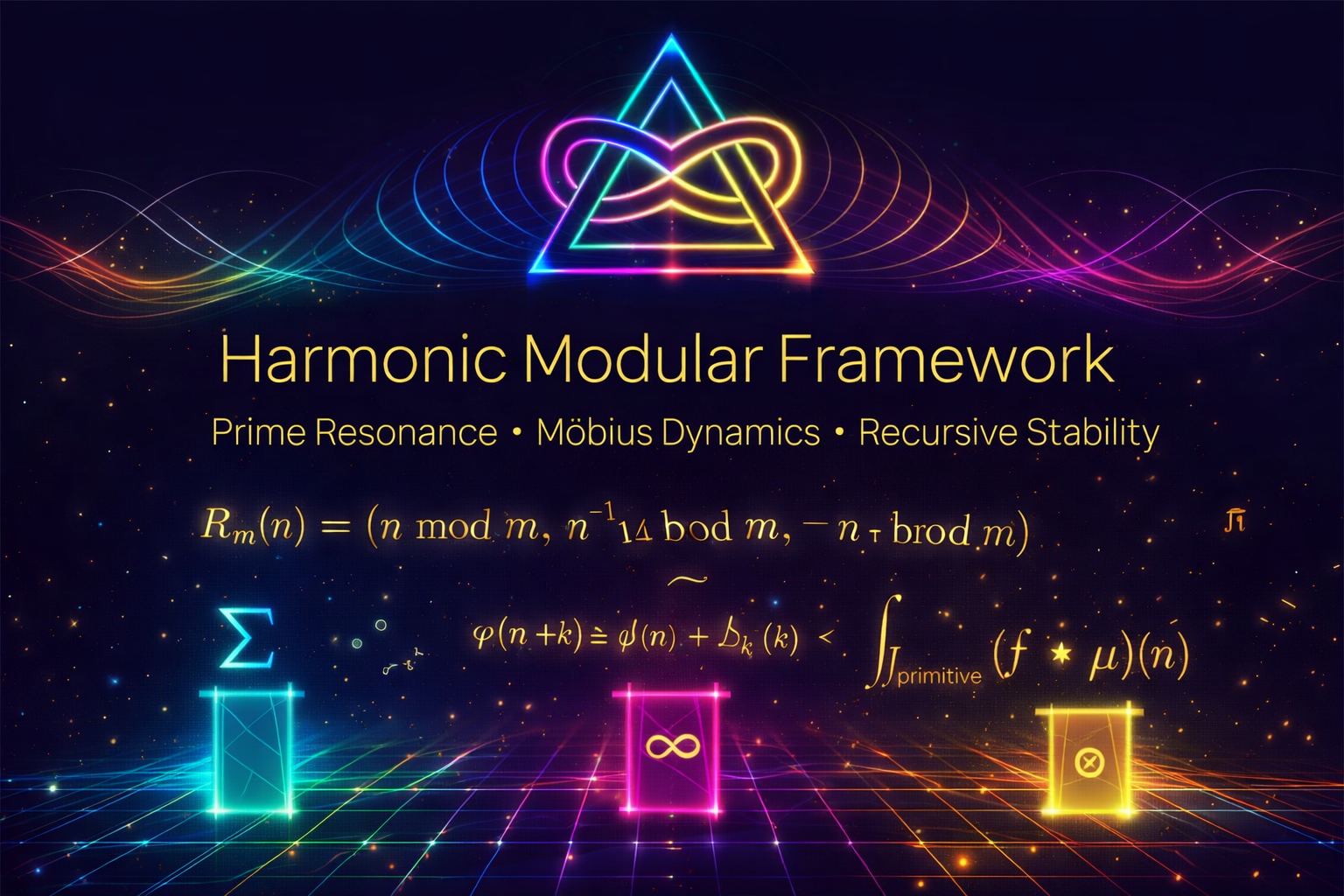
Harmonic Modular Framework
Prime Resonance • Möbius Dynamics • Recursive Stability
∑ Modular Residue Geometry
The central geometric object is the residue triad:
\[ R_m(n) = (n \bmod m,\; n^{-1} \bmod m,\; -n \bmod m) \]
These three residues form a minimal harmonic set generating the entire modular action. Their interplay produces:
- spiral residue rotation (as \( n \rightarrow n + k \))
- Möbius-style inversion when crossing prime boundaries
- triadic resonance cycles when \( m \) contains multiple prime factors
∞ Recursive Totient Dynamics
Euler’s totient function \( \varphi(n) \) expresses modular recursion:
\[ \varphi(n+k) \equiv \varphi(n) + \Delta_k(n) \pmod{n} \]
Where:
\[ \Delta_k(n) = \sum_{p \mid n} \left(\varphi(p^{v_p(n)}) – \varphi(p^{v_p(n+k)})\right) \]
⊗ Möbius Harmonic Compression
Möbius transformation extracts primitive signal:
\[ f_{\text{primitive}}(n) = (f * \mu)(n) \]
It isolates the core modular phase geometry by deleting composite residue layers.
🔷 Recursive Modular Learning System
Select a module to run:
Module output and math info appears here…
Mathematics is not a frozen archive of symbols — it is a recursive mirror of reality. Here, equations behave as kinetic particles inside a living lattice of perception.
Want to go deeper?
Modular arithmetic binds systems via residue spaces. Prime modulations act like harmonic scaffolding,
enforcing structure without rigidity.
Curious about physical links?
Eigenvector transformations, Möbius mappings, and wave equations encode physical symmetries
shared across mathematics and quantum systems.
How does recursion reveal form?
Recursive structures compress infinite processes into finite descriptions,
mirroring cognition, memory, and symbolic abstraction.