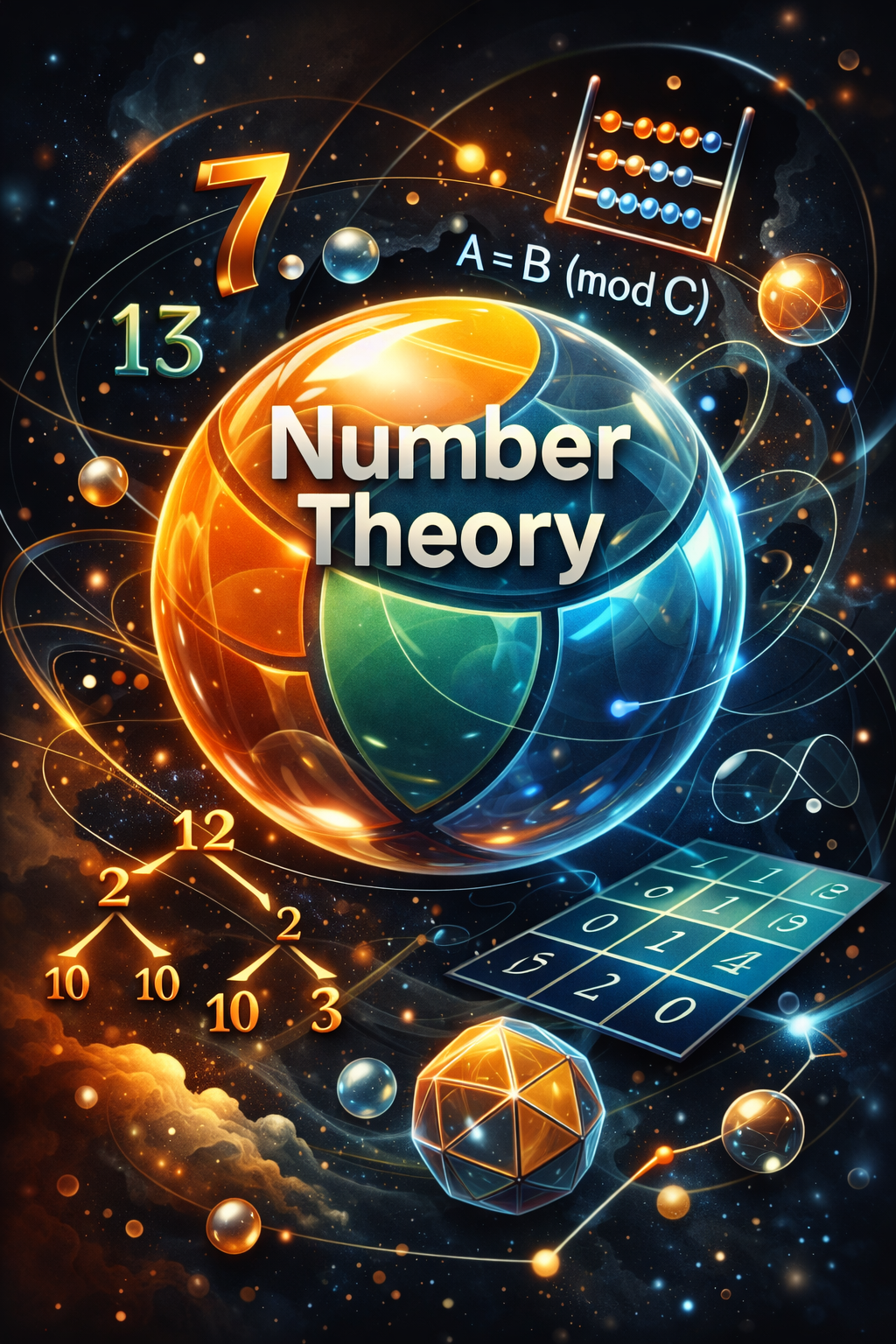
📘 What Is Number Theory, Really?
Number theory studies the internal structure of integers — not as quantities, but as objects with symmetry, constraints, and hidden order.
Divisibility is the first lens. Every integer carries a unique fingerprint: how it factors, how it repeats under modular cycles, and how it resists decomposition when it is prime.
What begins with simple questions — Which numbers divide this one? — grows into deep frameworks: modular arithmetic, Diophantine equations, zeta functions, and cryptography.
This page treats numbers not as symbols, but as structured systems. What you see above is symmetry made visible.
Divisor Geometry 🧮
Integers reveal structure through symmetry. Divisors are the visible trace.
🧩 Major Subfields of Number Theory 🧮
Number theory branches naturally into several interlocking domains. Each focuses on a different structural lens — arithmetic, symmetry, geometry, or analysis — yet all speak the same underlying language.
-
Elementary Number Theory
Divisors, primes, congruences, and classical results. -
Algebraic Number Theory
Integers generalized to number fields and rings. -
Analytic Number Theory
Primes studied via limits, series, and complex analysis. -
Geometric & Modular Methods
Shapes, symmetries, and modular spaces encoding arithmetic.
These are not separate silos. Most modern results arise where multiple subfields intersect.