Mathematical Visualizations
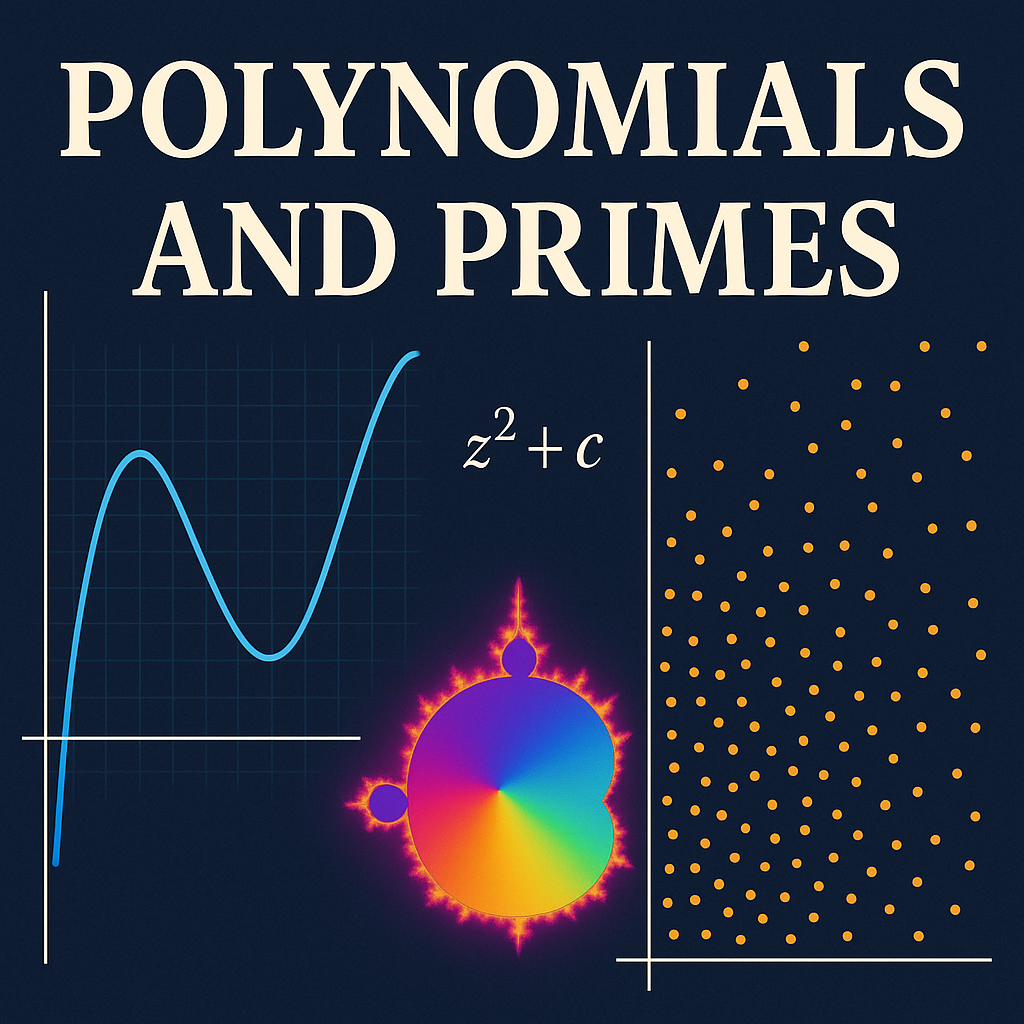
These simulations treat mathematics as structured motion rather than inert notation. Prime numbers, polynomial families, gradients, and recurrence-linked forms are rendered as evolving patterns so the reader can see how algebraic rules generate visible order.
The point is not to replace proof with spectacle. It is to give structure a shape: prime distributions become resonant fields, polynomial families become distinct curvatures, and hidden arithmetic regularities become easier to grasp before formal analysis begins.
Prime Resonance Field
Each prime spawns a pulsing node whose motion is modulated by Euler’s totient function. The golden angle distributes the points in a sunflower-like spread, while oscillating rings suggest harmonic phase and residue-like recurrence.
What you are seeing is not a literal theorem diagram, but a structural interpretation. Primes are treated as indexed sources of rhythm, while the totient function scales the pulse. The result is a field picture in which arithmetic discreteness appears as resonance.
What the prime field is expressing
Prime indexing
The primes act as the discrete backbone of the simulation, each one anchoring a distinct oscillatory node.
Totient modulation
Euler’s totient function adjusts the pulse rate and radius, turning arithmetic data into visible variation.
Golden-angle layout
The sunflower spread avoids clumping and gives the prime field a natural radial balance.
Polynomial Families Illustrated
This viewer draws different polynomial families in the same coordinate frame so their curvature, roots, and general behavior can be compared directly. The hidden panel reveals discriminant and derivative context.
As the family changes, so do the turning points, root structures, and curvature profile. The goal is to see that degree is not just a label. It changes the geometry of the entire expression.
How to read the polynomial viewer
Each family encodes a different kind of algebraic behavior. Quadratics emphasize simple turning structure. Cubics introduce inflection. Quartics and quintics begin to show richer folding. Chebyshev and Hermite polynomials connect the graph to orthogonality, recurrence, and special-function theory. The Pisano option points back toward recurrence relations and Fibonacci-style characteristic structure.
Discriminant
The discriminant indicates how roots separate, merge, or move into complex structure.
First derivative
The first derivative tracks slope, direction, and the locations of local maxima and minima.
Second derivative
The second derivative measures curvature, indicating how the graph bends and where inflection emerges.
Prime-Activated Sphere Field
This simulation maps a polynomial-gradient field onto a rotating sphere. At positions indexed by primes, the field brightens, turning hidden arithmetic selection into visible energy nodes.
The sphere is not a literal model of prime distribution in space. It is a visual allegory: gradient flow supplies the surface dynamics, while prime-indexed activation marks discrete points of arithmetic emphasis.
Why these visuals matter
A good mathematical image does not replace formal reasoning. It prepares the mind for it. These visualizers help the reader notice periodicity, recurrence, curvature, and discrete structure before the symbolic proof arrives. That makes the later theorem feel less like a jump and more like a clarification of something already glimpsed.