Each prime spawns a pulsing wave, its rhythm scaled by Euler’s totient function φ(n).
Primes are arranged using the golden angle (137.5°), forming a sunflower-like spread.
Colors shift over time to show resonance phases.
You see pulsing rings like a cymatic field — the primes “sing” in harmony.
This interactive visualization shows how polynomial families evolve from Quadratic through to the Septic fold. Each degree forms a constellation of curves and nodes, rotating in color-shifting harmony. As the sequence progresses, the structures grow more intricate, with subtle chords suggesting hidden Galois symmetries. By the time it reaches degree 7, the shapes begin to strain and fold into new patterns—hinting at the deep thresholds of solvability and the beauty of mathematical symmetry at its limits.
🧠 Symbolic Copilot
This simulation shows a rotating mathematical sphere where algebra and prime numbers meet. The swirling streaks come from a polynomial gradient function mapped onto the sphere, creating currents like winds around a globe. At special points tied to prime numbers, the patterns light up more brightly—turning the hidden structure of primes into visible energy nodes. It’s a way of watching how deep mathematics can shape flow, rhythm, and symmetry in a living, cosmic form.
Polynomial families illustrated
roots, curvature & discriminants
Show Δ, f′, f″
Δ:
f′(x):
f″(x):
Tap to Reveal the MeaningΘ
What You're Seeing
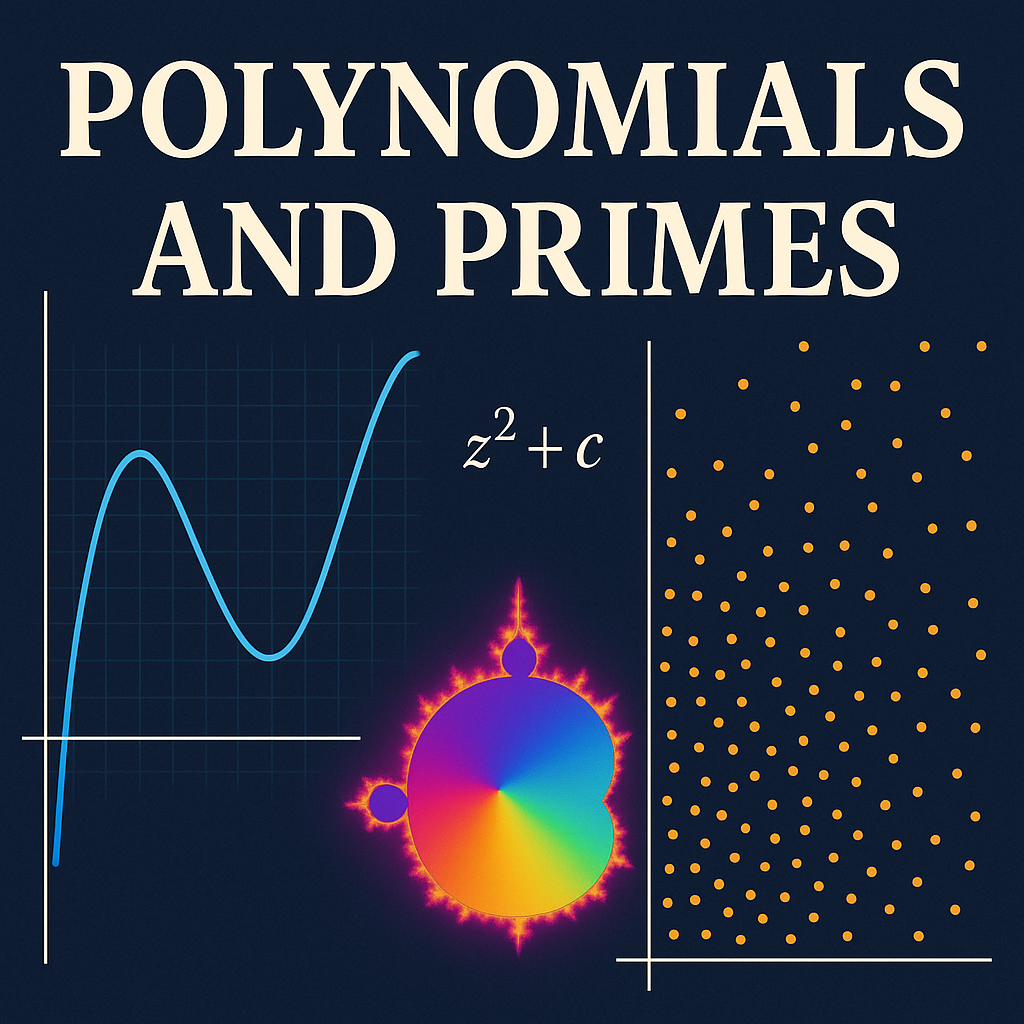
1. The Polynomial Curve
The graph above draws a real polynomial from one of seven families:
Quadratic, Cubic, Quartic, Quintic, Chebyshev, Hermite, or Pisano.
Each uses the same coordinate frame: the origin is centered,
and the vertical scale compresses large values so curvature is visible rather than exploding off-screen.
2. The Algebraic Identity
Every polynomial is an encoded statement about change:
f(x) = 0
marks its roots (crossings), while
f′(x)
reveals slopes, inflection behavior, and turning points.
3. Discriminant (Δ)
Δ measures how “split apart” the roots are and whether
a polynomial contains real intersections or purely complex structure.
Δ > 0 → {distinct real roots}Δ = 0 → {merged / repeated root}Δ < 0 → {complex conjugate roots}
Like an alchemical reagent, Δ reveals the internal phase of the polynomial.
4. Derivatives: f′ and f″
f′(x)
uncovers momentum, direction, and extremal points.
f″(x)
describes curvature — the “bend” of the function —
showing where the graph transitions from convex to concave.
5. Hermetic Interpretation
In alchemical symbolism:
{Solve → Coagula}
corresponds to:
• separate the function into its structural components (roots, curvature),
• then recombine insight into a unified form.
The panel above embodies this: you select a polynomial, observe its behavior, then reveal its hidden numerical anatomy.
6. The Spiral Border
Its conic threading references the Pisano period and recursive modularity—
suggesting that polynomials, too, arise from periodic symmetries written in number.