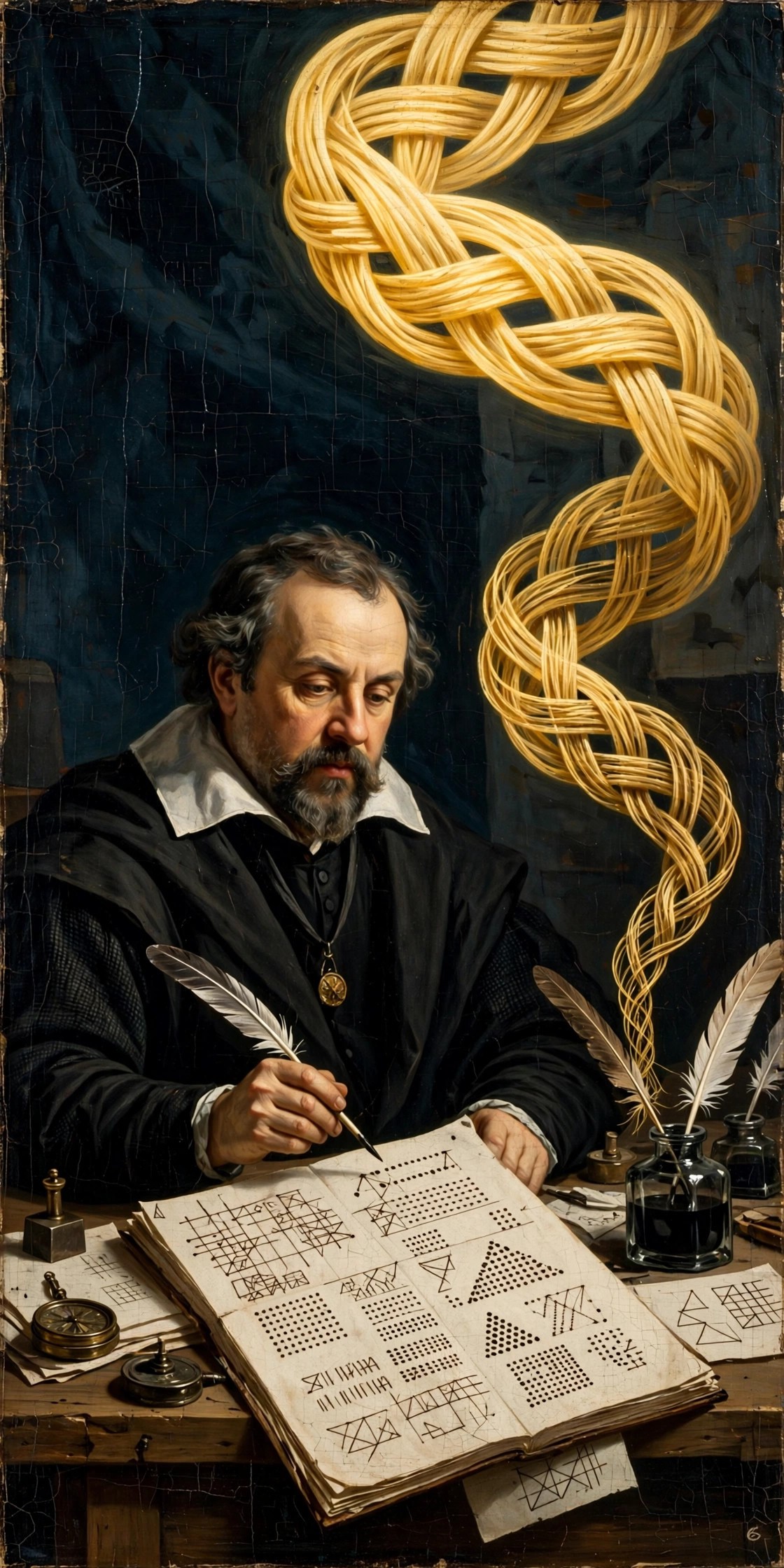
The operator is ACCUMULATE: add the powers, then add the sums, then add the sums of the sums — and watch the pile itself become a polynomial, a period, a memory.
Johann Faulhaber was born in Ulm on 5 May 1580, the seventh child of a weaver, and he was trained at the loom himself. He became instead the Great Arithmetician of Ulm: a Rechenmeister, a master of reckoning, who opened a school for engineers in 1600, surveyed and fortified cities, corresponded with Kepler, and in 1620 taught for a time the young René Descartes. He spent his whole life in Ulm, and he spent most of it doing one thing — adding up powers, further than anyone alive.
I. The sums, to the seventeenth power
Everyone who has added consecutive integers knows the first of his formulas, whether or not they know his name:
1 + 2 + … + n = n(n+1)/2
1² + 2² + … + n² = n(n+1)(2n+1)/6
1³ + 2³ + … + n³ = (n(n+1)/2)²
The third is the marvel in miniature: the sum of the cubes is the square of the sum of the numbers. Faulhaber published formulas to the seventh power in 1614, to the twelfth in 1617, and in his Academia Algebrae of 1631 — written in German, despite the Latin title, when he was fifty-one — he gave the sums from the thirteenth to the seventeenth power. These are not short formulas. The thirteenth-power sum, as printed there, runs to eight terms over a denominator of 420, with coefficients in the thousands. He computed them by hand.
II. One coordinate carries the odd powers
Look again at the quantity n(n+1)/2 — the triangular number T, the sum itself. Faulhaber’s deepest observation was that every odd power sum is a polynomial in T alone. The cubes are T². The fifth powers are:
1⁵ + 2⁵ + … + n⁵ = (4T³ − T²)/3
No n survives in the formula except through T. One coordinate — the accumulated sum of the numbers themselves — carries the accumulation of every odd power. He stated that such polynomials exist for every odd power; he did not prove it. Jacobi proved it in 1834, two hundred and three years later.
There is a symmetry underneath. T does not change if you replace n by −n−1: the coordinate is a reflection invariant, a folded coordinate, and the odd sums live naturally on the fold. Faulhaber’s modern readers — Donald Knuth above all, in his 1993 paper Johann Faulhaber and Sums of Powers — found the same fold at every depth of his work.
III. Accumulation upon accumulation
Faulhaber did not stop at summing once. The Academia Algebrae also gives formulas for sums of sums — repeated, or m-fold, accumulation — including a polynomial for the elevenfold sum of sixth powers: add the sixth powers, add those running totals, and add again, eleven deep, and the result is still one polynomial.
Written in modern form, repeated summation has an exact memory structure. The r-fold sum of k^p is:
F(n) = Σₖ C(n−k+r−1, r−1) · k^p
Each earlier term is weighted by a binomial coefficient that depends only on its distance from the present index. At depth two the weights are (n−k+1): a term k steps back is counted once for every partial sum it has lived through. At depth three the weights grow quadratically. Accumulation, done repeatedly, is a memory operator with an exact kernel — the past is not merely stored, it is weighted by how long it has been carried. And the fold persists at depth: Knuth showed that the r-fold sum of an odd power is governed by the coordinate n(n+r), the same reflection fold as T, widened by the depth. The coordinate remembers the symmetry at every level.
IV. The code at the back of the book
At the end of the Academia Algebrae, Faulhaber announced that he had in fact computed the power sums as far as the twenty-fifth — and he printed them in a secret code, as mathematicians of his day did when a result was a livelihood. The formulas to the seventeenth power were the advertisement; the code was the proof of priority, addressed to posterity.
Posterity took three hundred and sixty-two years to answer. In 1993 Knuth decoded the ciphers and reconstructed how the sums were probably found. His verdict is the most human sentence in the whole story: the coded formulas are correct through the twenty-third power — and the twenty-fourth and twenty-fifth are wrong. The code had outrun the arithmetic. Eighty years after the Academia, Jacob Bernoulli had already taken the public formulas further than Faulhaber: in the Ars Conjectandi of 1713 he cites Faulhaber and rebuilds the whole family from a single sequence, the Bernoulli numbers, in the closed form S_p(n) = (B_{p+1}(n+1) − B_{p+1}(0))/(p+1). One compact mechanism generating every sum Faulhaber had braided by hand.
A sidebar the man insists on: Faulhaber highlighted the number 666 in all of his books, mathematical and religious alike. His Miracula Arithmetica of 1622 is replete with it; studying it, he found a three-dimensional analogue of Pythagoras’s theorem, a² + b² + c² = d². He believed his readings of the Bible’s numbers were divinely inspired, predicted the Last Judgment for the end of 1606, and was briefly imprisoned for it. It is worth one computed remark: 666 is itself a triangular number, T₃₆ = 36·37/2. The number he stamped on everything already lived in his own coordinate.
V. The modular turn
Here the Archive takes up his instrument. Reduce the accumulation modulo m, and the infinite sum becomes a finite-state machine. The key fact is exact and elementary: advancing the sum by one full block of m consecutive terms always adds the same residue, A = (1^p + … + m^p) mod m. So the sequence of partial sums is periodic, and its period divides m²/gcd(m, A) — an exact bound, computable before you sum anything.
For a prime modulus the bound collapses into a clean dichotomy. The block sum A is −1 when p is a multiple of q−1, and 0 otherwise. If A = 0, the accumulation closes after a single cycle of length q. If A = −1, every block advances the total by −1, and the least period is exactly q². Modulo 5, the accumulated squares run 0, 1, 0, 4, 0 and repeat with period 5 — but the accumulated fourth powers need the full 25, because 4 is a multiple of 5−1. Change nothing but the exponent, and the period of the accumulation multiplies by five. Modulo 7 the same law gives cubes period 7 and sixth powers period 49.
That is the Faulhaber machine, still running: exact polynomial structure above, exact period structure below, and between them the question his whole life poses to ours — when a process accumulates, what survives the accumulation? He answered with a coordinate. We are still answering.
— Mike Tate, MikeTateMath
Sources and checks: Knuth, “Johann Faulhaber and Sums of Powers,” Mathematics of Computation 61 (1993); MacTutor biography of Faulhaber (Strick); Beery, “Sums of Powers of Positive Integers,” MAA Convergence; MAA Mathematical Treasures, Academia Algebrae. Every formula and period in sections II, III, and V is verified by direct computation in the pack’s work/verify_numbers.py (23 checks, all passing).