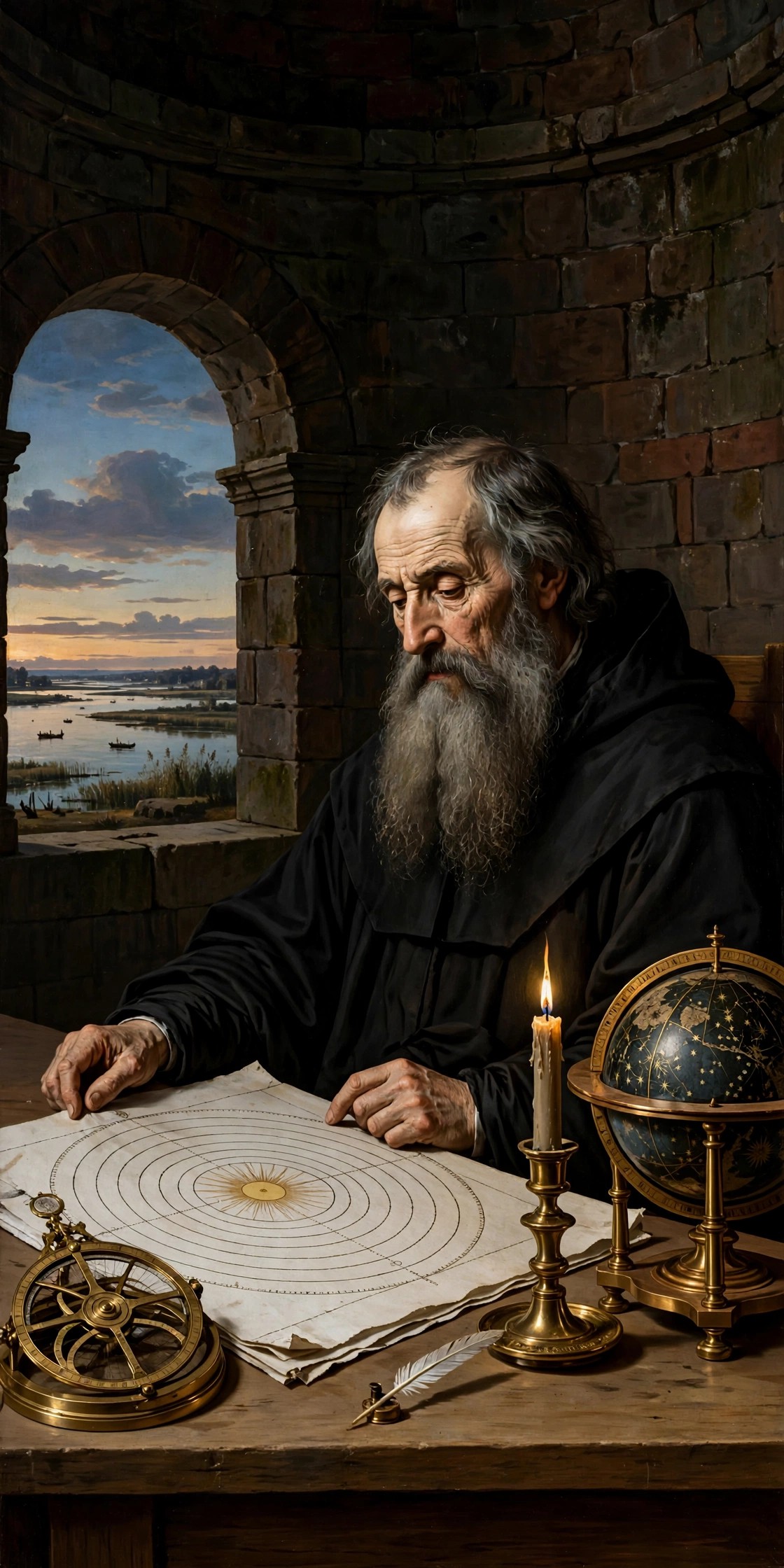
The operator is RECENTER: lift the whole machinery off the Earth and set it on the Sun — and watch angles become distances, loops become perspective, and a filing system become an architecture.
Nicolaus Copernicus was born in Toruń on 19 February 1473 and spent his working life as a canon of the cathedral chapter at Frombork — an administrator, not a priest. He managed the chapter’s estates, organized the defense of Allenstein when the Teutonic Knights came in 1521, practiced medicine, and wrote a treatise on coinage that states, ahead of Gresham, that bad money drives out good. He took his doctorate in canon law at Ferrara in 1503. The astronomy was done in the margins of that life, over some thirty years, in a room above the Vistula lagoon. He died on 24 May 1543, aged seventy — the year his book appeared.
I. The offense was the equant
Ptolemy’s system predicted. That was never the problem. The problem was what the predictions cost. At the heart of the machinery sat the equant: a point, empty of anything, about which a planet’s motion was uniform — not about the center of its own circle, and not about the Earth. Motion was regular about a place where nothing is. Copernicus’s complaint in his preface is that the astronomers, assembling their system from mismatched parts, had produced something like a portrait built from the hands, feet, and head of different models — “a monster rather than a man.” They could not even agree among themselves on the order of the spheres, and each planet’s model carried a private scale: a deferent of sixty units here, another there, the distances between the shells a matter of convention. The old system filed angles beautifully. It described no single architecture, because there was no single center from which to describe one.
II. The sketch: seven assumptions, thirty-four circles
Before May 1514 — a Kraków professor’s book catalogue of that year already lists “a manuscript of six leaves expounding the theory that the Earth moves while the Sun stands still” — Copernicus circulated a short handwritten sketch, the Commentariolus. It lays down seven assumptions. There is no single center of all the celestial circles. The Earth is the center only of its own gravity and of the Moon’s orbit. All the spheres revolve about the Sun. The heavens’ daily wheel is the Earth’s rotation. And the sentence the whole system turns on: “the apparent retrograde and direct motion of the planets arises not from their motion but from the Earth’s.”
He closes the sketch by counting his machinery: Mercury runs on seven circles, Venus on five, the Earth on three and the Moon about it on four, Mars, Jupiter, and Saturn on five each — “altogether, therefore, thirty-four circles suffice to explain the entire structure of the universe.” Hold that number honestly: the victory was never a smaller machine. It was one machine, hung on one center.
III. What the recentering buys
Three things, and each of them can be computed.
First, retrograde becomes a rhythm instead of a fitting exercise. If the Earth moves faster than the outer planets, it laps them, and from a lapping platform each of them must appear to halt, back up, and resume — always at opposition, when the Earth passes between the planet and the Sun. The rhythm falls straight out of the periods: Mars is lapped every 780 days, Jupiter every 399, Saturn every 378. Run the same arithmetic on Copernicus’s own published periods — 687 days for Mars, twelve years for Jupiter, thirty for Saturn — and the same three numbers come back within a day. In Ptolemy, each loop was a wheel sized planet by planet. Here one fact generates all of them: we move, and we move faster.
Second, an angle becomes a measurement. Venus never strays more than about 46 degrees from the Sun. In the geocentric filing system that is a curiosity to be recorded. In the recentered geometry it is the side of a right triangle: the sine of 46 degrees is 0.719, and 0.719 is Venus’s distance from the Sun in units of the Earth–Sun distance. The elongation was always in the sky. Recentering turned it into a tape measure.
Third, the order of the planets stops being a choice. Period increases with distance along a single ladder — Mercury, Venus, Earth, Mars, Jupiter, Saturn — and every rung is measured in the same units. Copernicus’s table reads 0.376, 0.719, 1, 1.520, 5.219, 9.174. The modern values read 0.387, 0.723, 1, 1.524, 5.203, 9.539. Every planet within four percent; Venus, Mars, and Jupiter within one. In the old system these numbers could not even be asked for in one breath, because there was no common measure to ask in.
IV. The price: a thousandfold deeper sky
A moving Earth should swing the stars. As we cross from one side of our orbit to the other, the nearer stars ought to shift against the farther ones — parallax. None was seen, by Copernicus or by anyone for three more centuries. His answer is already in the sketch, and it is stated as an inequality: the Earth–Sun distance stands to the Sun’s distance from the stars as the Earth’s radius stands to the Earth–Sun distance. On his own scale, where the Earth–Sun distance runs to 1,142 Earth radii, that inequality pushes the sphere of the fixed stars beyond some 1.3 million Earth radii — more than eleven hundred times farther than the Sun. Moving the Earth cost a universe a thousand times deeper, payable immediately, and he paid it in the same six leaves.
One demotion carries a promotion inside it. The Moon still circles the Earth — the only moon in his entire system. The Earth is the center of nothing but its own gravity and one satellite: a planet that happens to carry a moon. And the idea itself was eighteen centuries old. Aristarchus of Samos had set the Earth moving around 270 BC; Copernicus knew it, and in his own manuscript a sentence names Aristarchus among the ancients who had moved the Earth. Before the book went to print, he struck the name out. The recentering was a revival — with a machine attached.
V. The long fuse
The sketch was out by 1514. The book, De revolutionibus orbium coelestium, appeared in 1543 — twenty-nine years later. What finally moved it was a visitor. In 1539 Georg Joachim Rheticus, a twenty-five-year-old professor from Wittenberg, arrived at Frombork, stayed two years, and in 1540 published the Narratio prima, the first printed account of the system. Then the book itself: printed at Nuremberg, dedicated to Pope Paul III, with the working rule laid down in the dedication — mathematics is written for mathematicians. By the tradition, a copy reached Copernicus on the day he died.
It also reached the world wearing a frame he never wrote. Andreas Osiander, who saw the book through the press, inserted an unsigned preface assuring readers that the hypotheses “need not be true, nor even probable” — enough if the calculations agree with observation. The claim arrived pre-softened into a calculating device. Posterity read through the frame anyway. Eight years later, Erasmus Reinhold’s Prutenic Tables of 1551 were computed on Copernicus’s system; within four decades, the men who reformed the calendar in 1582 were working from tables his machinery had produced. Copernicus never lived in a Copernican world. He performed the coordinate change, in a tower room, in the margins of an administrator’s life — and left everyone after him to live in it.
— Mike Tate, MikeTateMath
Sources and checks: Gingerich, “The Astronomy and Cosmology of Copernicus”; Swerdlow & Neugebauer, Mathematical Astronomy in Copernicus’s De Revolutionibus (for the terrestrial-radii scale); Dictionary of Scientific Biography, “Copernicus”; Ohio State lecture notes (distance table cross-check); MacTutor biography. Every number in sections III and IV — the distance table and its errors, the 46-degree elongation, the 780/399/378-day retrograde rhythm from both modern and Copernicus’s own periods, and the stellar-distance bound — is verified by direct computation in the pack’s work/verify_numbers.py (35 checks, all passing).