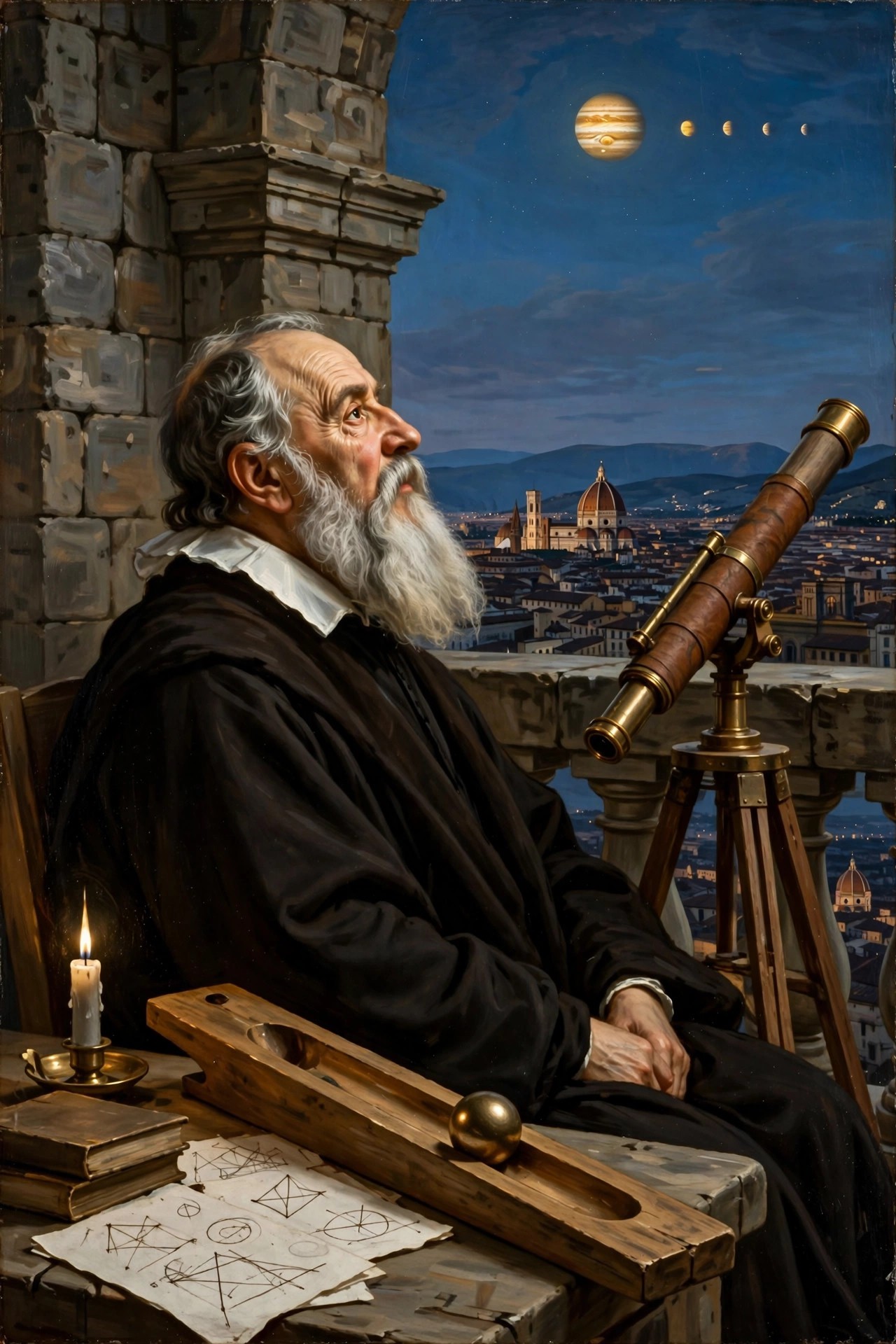
A Padua professor slowed falling bodies down until a water clock could time them — and the numbers he got back, from falling bronze and from Jupiter's moons, outlasted the court that silenced him.
Al-Kindi decoded what men had hidden. Galileo Galilei faced a pattern hidden by something simpler than any cipher: speed. Aristotle had ruled that a heavy body falls faster than a light one, in proportion to its weight, and for two thousand years the ruling stood — because nobody could check it. A stone dropped from a tower crosses its fall in a breath. There was nothing to count, so there was nothing to argue with.
Aristotle's operator was SORT. Nicomachus's was SHAPE. Proclus's was COMMENT, Boethius's CARRY, al-Kindi's DECODE. Galileo's is MEASURE: if a thing moves too fast to time, do not argue about it — slow it down until it can be timed, and then let the timings outvote the authorities.
I. The professor at Padua
Galileo was born in Pisa in 1564, the son of Vincenzo Galilei, a music theorist who measured the ratios of stretched strings — measurement ran in the family trade. He took a mathematics chair at Pisa in 1589 and moved in 1592 to Padua, where he stayed eighteen years, the stretch he later called the happiest of his life.
The famous stories belong to this period, and they need their labels. The tale of weights dropped from the Leaning Tower of Pisa comes from his first biographer, Vincenzo Viviani, writing decades later; it is tradition, not a documented event. The swinging cathedral lamp that supposedly taught him the pendulum's rhythm is Viviani's too. What is documented is the practice underneath both tales: a man timing swings against his own pulse, and finding that a pendulum keeps its period as its swing dies down — wide arc or narrow, the beat holds. Nature, it turned out, owned a clock. The question was how to make falling keep time with it.
II. Diluting gravity
His answer was a machine for slowing the unslowable: an inclined plane. Take a long wooden beam, cut a straight groove down its length, polish the groove smooth, and tilt the beam — a little. A bronze ball released in the groove still falls, but the tilt dilutes gravity: only a small share of the pull acts along the slope, and the fall that nature finishes in a second now takes long enough to time. For a clock he used water — a vessel draining through a thin pipe while the ball rolled, the water caught and weighed on a fine balance, so that weights of water stood in for lengths of time. Run the ball, weigh the water. Run it again. He repeated the trials until the runs agreed, a full hundred times by his account.
Then the counts spoke, and they spoke in the cleanest pattern in this whole line of posts. Mark the distances the ball covers in successive equal times and they grow as the odd numbers: 1, 3, 5, 7. Add them as you go and the totals are the squares: 1, 4, 9, 16. Distance grows as the square of the time; speed grows in plain proportion to the time. That is the law of fall, and it does not care what the ball is made of — the pattern is in the timing, not the material.
Lay two motions on top of each other and a second pattern falls out. A projectile moves forward uniformly, as a thrown stone would if nothing pulled it, and downward with the fall law's acceleration, both at once. Compose the two and the path is a parabola: the arc of every cannonball, drawn by two measurements nobody had thought to add together.
III. The tube pointed up
In 1609 word reached Padua of a Dutch toy: two lenses in a tube that pulled distant things near. Galileo rebuilt it from the rumor, ground his own lenses, and pushed the magnification past twenty. Then he did the thing the toy's makers had not thought to do. He pointed it at the sky.
The Moon came first, and it was not Aristotle's perfect sphere. The line between its light and dark was ragged, and bright points stood out in the darkness beyond it, widening as the sun rose over them — mountaintops catching the light before the valleys. From the geometry of those shadows he reckoned the highest lunar mountains at more than four miles. The heavens had terrain, and terrain can be measured.
In January 1610 he found Jupiter attended by little stars in a straight line — three, then four — trading places night after night, now east, now west, never leaving the planet's side. They were moons, circling Jupiter in periods he could time: the innermost in under two days, the outermost in nearly seventeen. He named them the Medicean stars, after his patrons the Medici — and here was a second center of motion in the sky, visible proof that not everything circles the Earth. The Milky Way, under the tube, dissolved into stars beyond counting. And by the end of 1610 Venus had shown him her phases — the full set, crescent swelling through gibbous to full. In Ptolemy's arrangement Venus rides forever between the Earth and the Sun and can never turn a full face to us. The tube showed the full face.
He published at speed. Sidereus Nuncius — The Starry Messenger — appeared in March 1610, and its author, forty-six years old, was famous across Europe in a single season.
IV. The ship’s cabin
Twenty-two years later, in the Dialogue Concerning the Two Chief World Systems, he set down the deepest of his measurements — one that measures nothing at all. Shut yourself below deck, says his spokesman Salviati, in the cabin of a great ship. Bring fish in a bowl of water, butterflies, a bottle dripping into a basin, a friend to throw a ball to. Now let the ship glide forward, smoothly, at any speed you like, so long as the motion is uniform. The drops fall straight into the basin, exactly as they did in port. The fish swim indifferently in every direction. The butterflies wander the same air. The ball flies as far one way as the other. No experiment you can perform inside the cabin tells you whether the ship moves or rests — only a lurch, a change of motion, announces itself.
That is Galilean relativity, stated in 1632: uniform motion, from inside, is physically undetectable. Rest and steady motion are the same condition wearing two names, and three centuries of physics would be built on the distinction he drew between motion and its changes.
V. The court, and the book that escaped
The collision course was set in 1616, when Galileo was enjoined by the Church not to hold or defend the Copernican doctrine. The Dialogue of 1632 was licensed and printed in Florence, and it argues in form between three voices: Salviati for the new astronomy, Sagredo the intelligent amateur, Simplicio carrying the old philosophy. But the argument Pope Urban VIII counted his own — that divine omnipotence could arrange the world by any means whatever — was given to Simplicio to close the book, and Rome read the placement as mockery. The proceedings that followed turned on the injunction of 1616 and on obedience. Summoned to Rome, Galileo abjured the Copernican doctrine on his knees on June 22, 1633. The defiant mutter the legend hands him — eppur si muove, and yet it moves — has no contemporary record. What has a record is the sentence: imprisonment commuted to house arrest for life, served first at Siena and then in his own villa at Arcetri, above Florence.
There, under guard, in his seventies, he went back to the Padua work — the plane, the ball, the water clock. The manuscript of the Discourses and Mathematical Demonstrations Relating to Two New Sciences was carried out of Italy and printed at Leiden in 1638, when he was seventy-four. The kinematics of the inclined plane, measured in his prime, reached print only at the end, from confinement. By then the eyes that had measured the Moon's mountains were going dark; he was blind in his last years, and he died at Arcetri on January 8, 1642, aged seventy-seven.
Every operator in this line so far worked on something men had made: a world to sort, a number to shape, a text to comment on, a cargo to carry, a cipher to decode. MEASURE works on the world itself, and its method is a refusal: where a phenomenon is too fast, too far, or too forbidden to read directly, build the instrument that slows it, reaches it, or carries the result out past the guards.
A motion too fast to judge is a pattern whose times you haven't taken yet.
— Mike Tate, MikeTateMath