Vector Field Flow
🧭 How to Read a Vector Field
A vector field assigns a direction and magnitude to every point in space. Unlike scalars, vectors don’t just say how much — they say which way.
What the arrows mean
Each arrow represents a vector:
Direction shows where motion would flow Length shows strength or intensity Color encodes semantic role (source, rotation, constraint)
Flow vs force
This visualization is not pushing particles. It shows the geometry of possible motion. If something were released here, it would naturally follow these paths.
Patterns to notice
- Sources & sinks — where vectors emerge or collapse
- Circulation — rotational structure (curl)
- Alignment — regions of coherent flow
Why vector fields matter
Vector fields are the language of:
Fluid flow Electromagnetism Phase space Control systems Geometry
Vector Flow & Attractor Field
🧭 What This Vector Flow Is Showing
A vector field does not describe objects — it describes how motion is permitted at every point in space.
In this simulation, particles are released into a continuous direction field. Their paths are not chosen — they are forced by the geometry of the field itself.
Key ideas encoded here
Vector field A rule assigning a velocity to each point in space.
Integral curve The path traced by following that rule through time.
Attractor A region where trajectories converge regardless of starting point.
Vortex Rotational flow that preserves motion while redistributing position.
Why this matters
Arrows on a grid show direction. Flow lines show consequence.
When vectors are integrated over time, structure appears: spirals, sinks, invariant cores, and entropy wells. These are not drawn — they emerge.
Orthonormal Frame Field
🧭 What This Vector Geometry Is Actually Showing
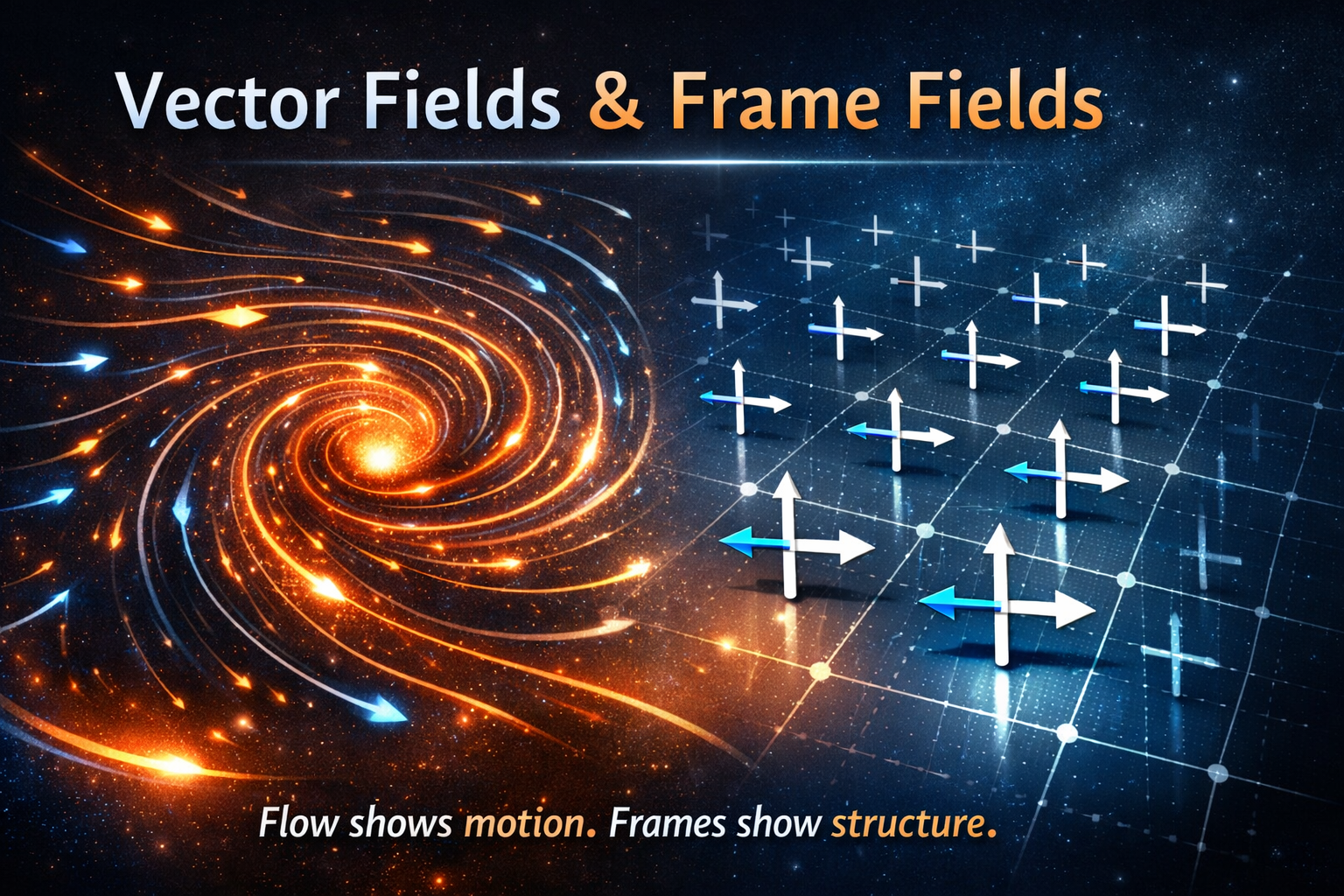
This page separates two ideas that are often conflated: motion and structure.
Vector fields
A vector field assigns a direction and magnitude to every point in space. It answers the question: “If something were placed here, how would it move?”
Flow lines, spirals, vortices, and sinks emerge when vectors are followed through space.
Frame fields
A frame field does something subtler. Instead of telling objects how to move, it assigns a local coordinate system to each point.
Every cross you see is an orthonormal basis: two perpendicular unit vectors defining orientation, not motion.
Why this distinction matters
Motion can exist without structure. Structure can exist without motion.
- Vector fields describe transport
- Frame fields describe geometry
- Together they define space with meaning
What changes over time here
The slow evolution you see is not particles moving — it is the orientation of space itself changing smoothly.
Orthogonal Memory Knot
Direction varies; the underlying frame persists.