Ψ λ
Mike Tate Mathematics

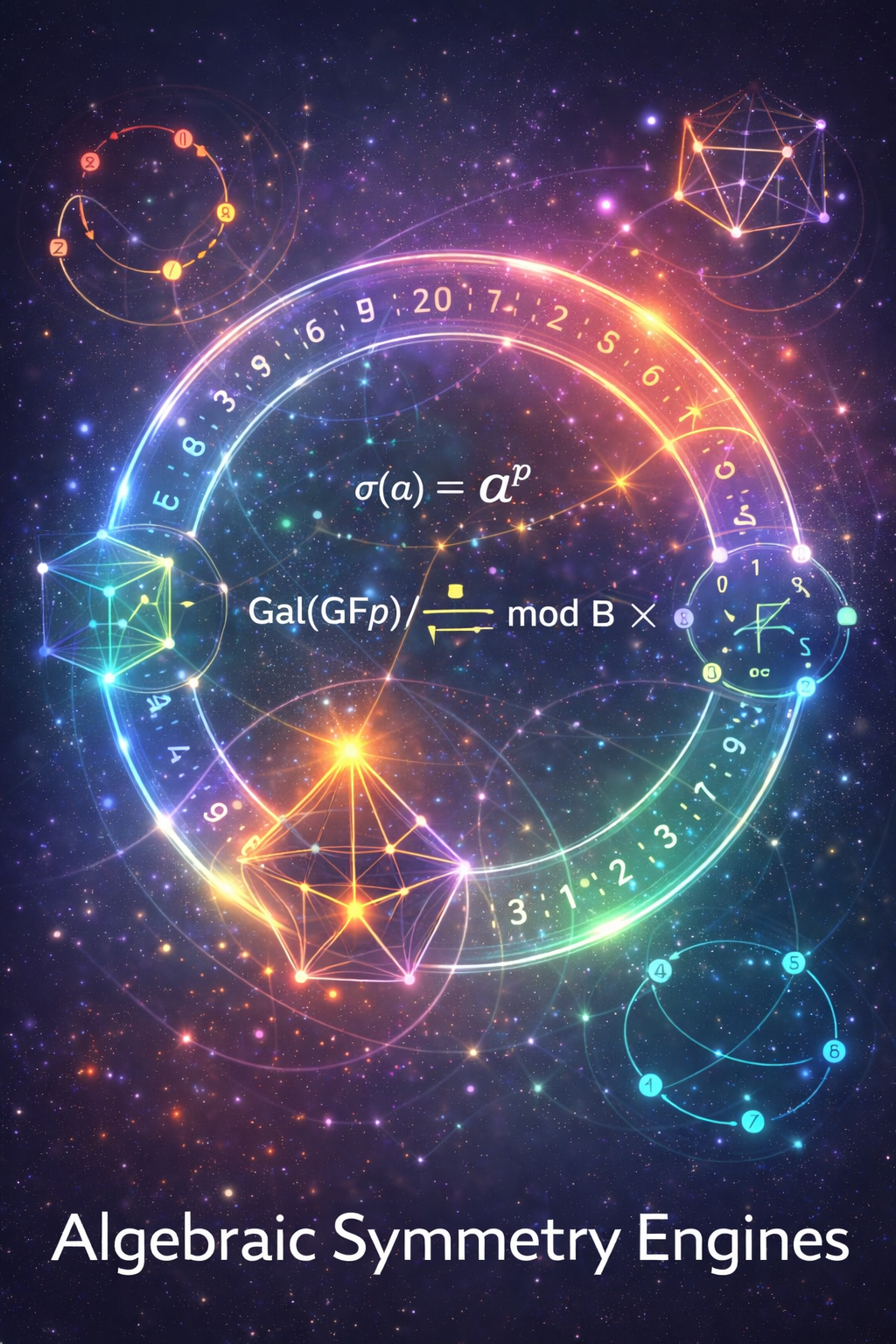
Algebraic Symmetry Engines

GF(pⁿ) Automorphism Visualizer

Frobenius Action • σ(a)=aᵖ • Galois Cycles in Extension Fields

🧭 What structure do both of these visualizers explore?
Both modules study how algebraic structure evolves under repeated transformation.

Whether the transformation is:
  • Raising elements to the p-th power (Frobenius automorphism), or
  • Multiplying residues by a fixed generator modulo a prime,
the core object is the same: a finite set with a symmetry action.
Iteration ⇒ cycles ⇒ invariants
🔄 What is a cycle, mathematically?
A cycle is the orbit of an element under repeated application of a function.

In both modules, we apply a function repeatedly until the starting element reappears.
a → f(a) → f²(a) → … → a
The length of this loop encodes deep arithmetic information:
  • Order of an element
  • Structure of the automorphism group
  • Field or residue decomposition
🔐 How is this related to Galois theory?
Galois theory studies symmetries of algebraic structures.

In the GF(pⁿ) module, the Frobenius map generates the full Galois group:
Gal(GF(pⁿ)/GF(p)) = ⟨ σ : a ↦ aᵖ ⟩
In the prime–residue module, multiplication modulo a prime reveals cyclic subgroups of the multiplicative group ℤ/pℤ.

Both are different faces of the same idea: structure revealed through symmetry.
🧠 Why visualize this instead of just proving it?
Proofs tell us that something is true. Visualization shows us how it behaves.

Seeing cycles:
  • Builds intuition for generators and fixed points
  • Makes abstract group actions concrete
  • Reveals hidden regularity instantly
These visualizers act as structural microscopes for finite algebra.

Prime–Galois Transform Engine

Modular Symmetry • Cycle Extraction • Residue Morphisms
Results