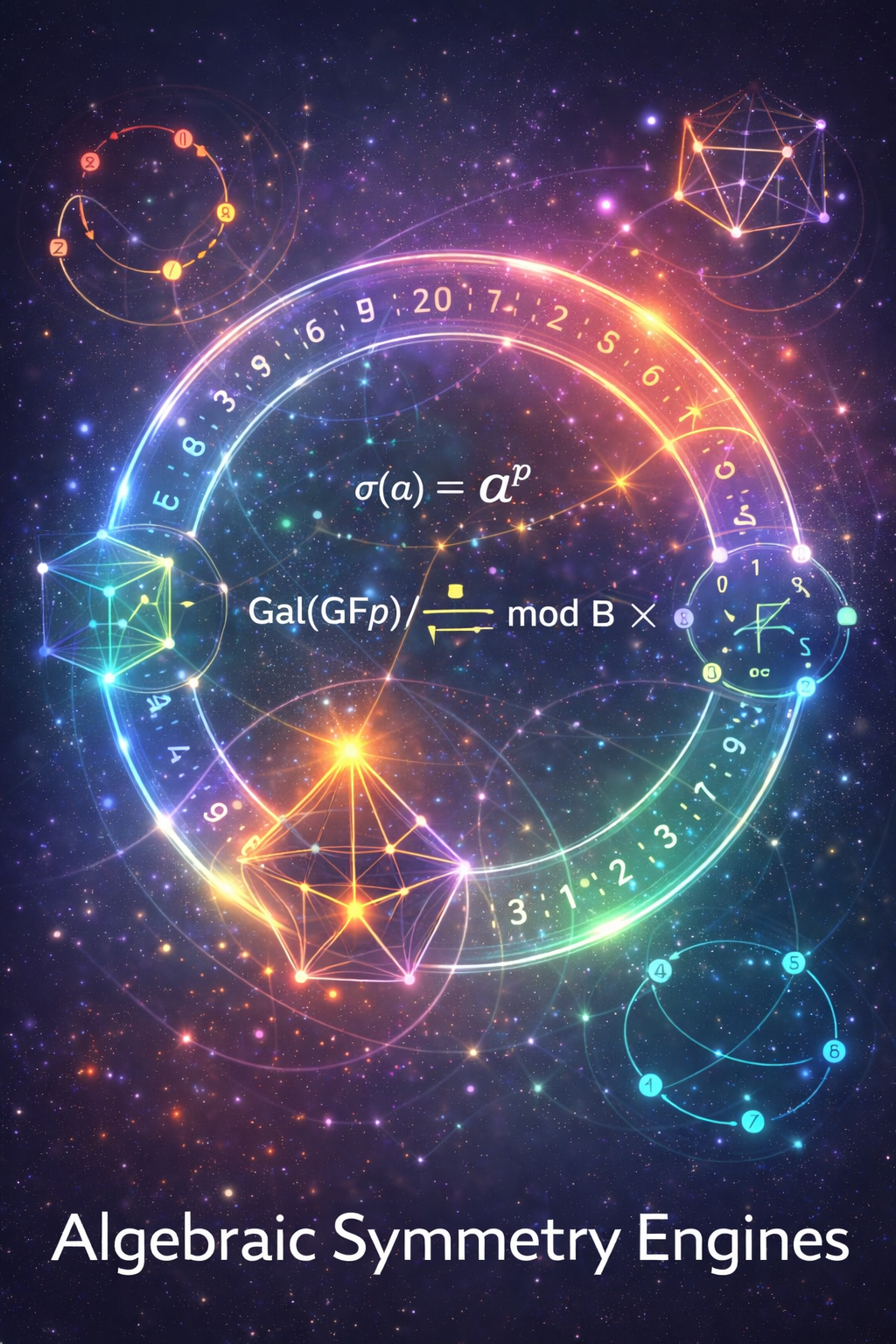
Frobenius Action and Galois Cycles
This page explores how repeated algebraic action becomes visible as orbit structure. In the upper module, the Frobenius automorphism acts on elements of finite field extensions. In the lower module, repeated multiplication acts on residues modulo a prime.
Both modules are built around the same idea: once a lawful transformation is applied again and again, hidden structure becomes legible as return, symmetry, and cycle length.
How to use the examples
Each button loads a prepared case instantly. The selected example is explained directly below the buttons, then rendered in the visualizer. The upper presets are chosen to force four distinct Frobenius geometries: a fixed point, a 2-cycle, a 3-cycle, and a 4-cycle.
- Upper module: finite field Frobenius action.
- Lower module: modular multiplication cycles.
- Orbit length: how many distinct states appear before return.
- Cycle closure: where repetition becomes visible symmetry.
GF(pⁿ) Automorphism Visualizer
These four presets are chosen to produce orbit lengths 1, 2, 3, and 4 under Frobenius action. That makes the geometric distinction immediate: a fixed point, a 2-cycle, a triangle, and a square.
Selected example
The nodes are successive Frobenius images of the chosen element. Each edge is one application of
σ(a)=ap. The orbit closes when the element returns to its starting state.
What the upper module is showing
In a finite field extension, Frobenius raises each element to the p-th power. Because the field is finite, the process cannot continue indefinitely without repetition. That repetition organizes the element into an orbit. The orbit length must divide the extension degree, which is why the examples above can be chosen to display distinct cycle shapes.
Fixed point
A length-1 orbit means the element is already unchanged by Frobenius.
Short cycle
A length-2 orbit shows a quick alternation between two Frobenius images.
Longer return
Length-3 and length-4 orbits show broader movement before the element closes back on itself.
Prime–Galois Transform Engine
These examples study repeated multiplication by a fixed residue modulo a prime. Different choices of modulus and multiplier produce different cycle decompositions.
Selected example
Each colored polygon is a cycle under repeated multiplication. Some examples break the residues into several loops, while others produce broader sweeps through the multiplicative structure.
What the lower module is showing
Modular multiplication also produces orbit structure. Starting from a residue and multiplying by a fixed value again and again yields a sequence that eventually repeats. Drawing those returns as polygons makes multiplicative order and subgroup decomposition easier to see at a glance.
Residue map
The text list shows exactly where each residue moves in a single multiplication step.
Cycle decomposition
The canvas shows how the nonzero residues split into one or more closed loops.
Structural meaning
This is a concrete visual entry point into multiplicative order and modular symmetry.