The Hidden Mathematics of Language
There is a pattern hiding inside every language you have ever spoken, and it has nothing to do with vocabulary or grammar. It is older than any particular tongue, and it shows up — quietly — in the structure of how languages are built, how they change, and how the human mind holds them.
This is not a metaphor. The mathematics is actually there.
1 · The Symmetry Beneath
When children acquire language, the input is too sparse to explain the output. Something else is doing the work. That something is structure: deep, invariant, apparently universal architecture that every human language shares beneath its surface differences.
In algebra, when you find this kind of deep invariance, you are looking at a symmetry group. Moving from Spanish to Arabic is less like learning separate systems and more like viewing the same structure from different angles—what mathematicians call automorphisms.
2 · The 24-Step Cycle
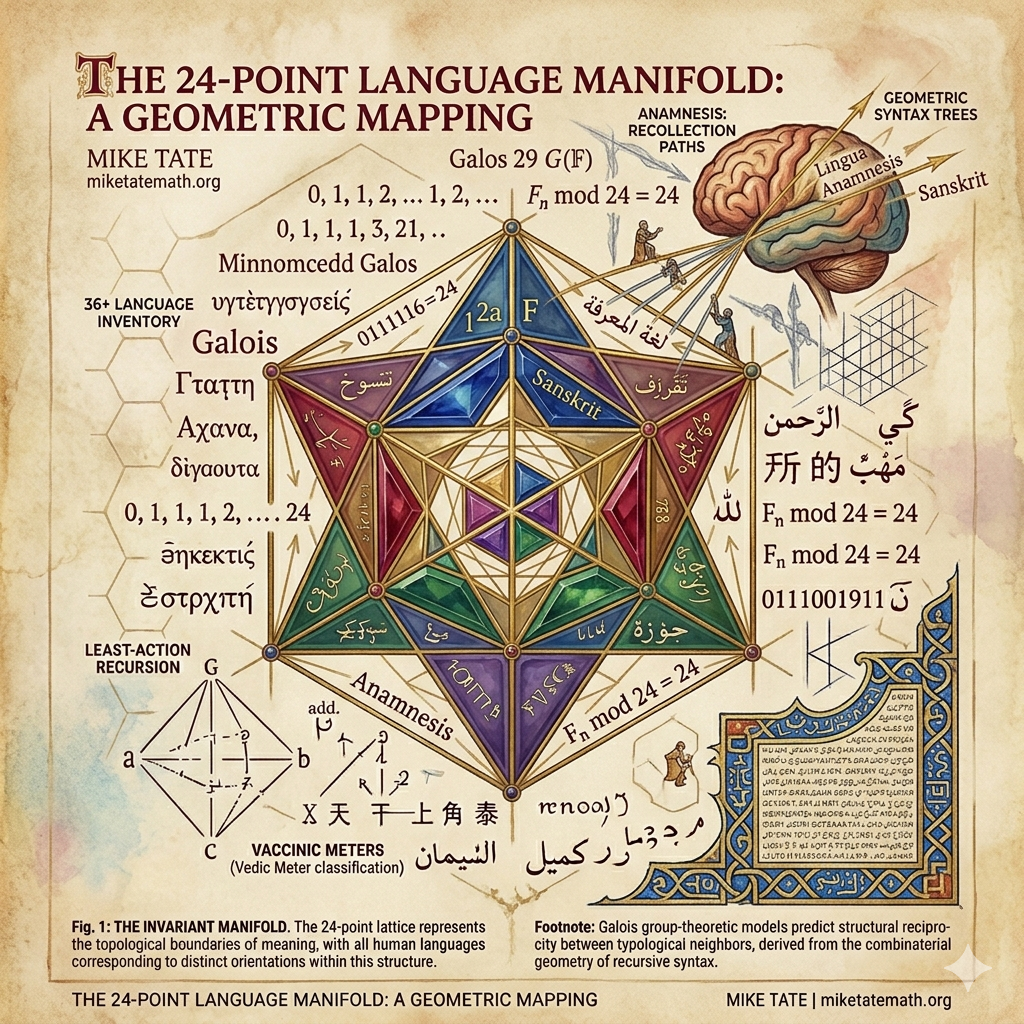
Take the Fibonacci sequence and divide every term by 24. What you get is a sequence that repeats perfectly every 24 steps. This Pisano period for 24 lands precisely because 24 sits at the confluence of the integers’ multiplicative structure and the symmetry groups of the foundations of algebra.
3 · Structural Reciprocity
Gauss called the law of quadratic reciprocity his theorema aureum. It describes a symmetry between pairs of prime numbers. Language contact works the same way: borrowing is not random. It is predictable from the typological distance between the languages.
4 · Anamnesis
Learning is not the acquisition of new knowledge, but the recollection of knowledge the soul already possessed. The mathematics was always already there, latent in the structure of what it means for a finite mind to generate an infinite range of meaning.
Lingua Anamnesis · Recursive Harmonic Method
miketatemath.org