Ψ λ
Mike Tate Mathematics
  • 🔷 Taming the Unsolvable: A New Path Through the Quintic

    🔷 Taming the Unsolvable: A New Path Through the Quintic

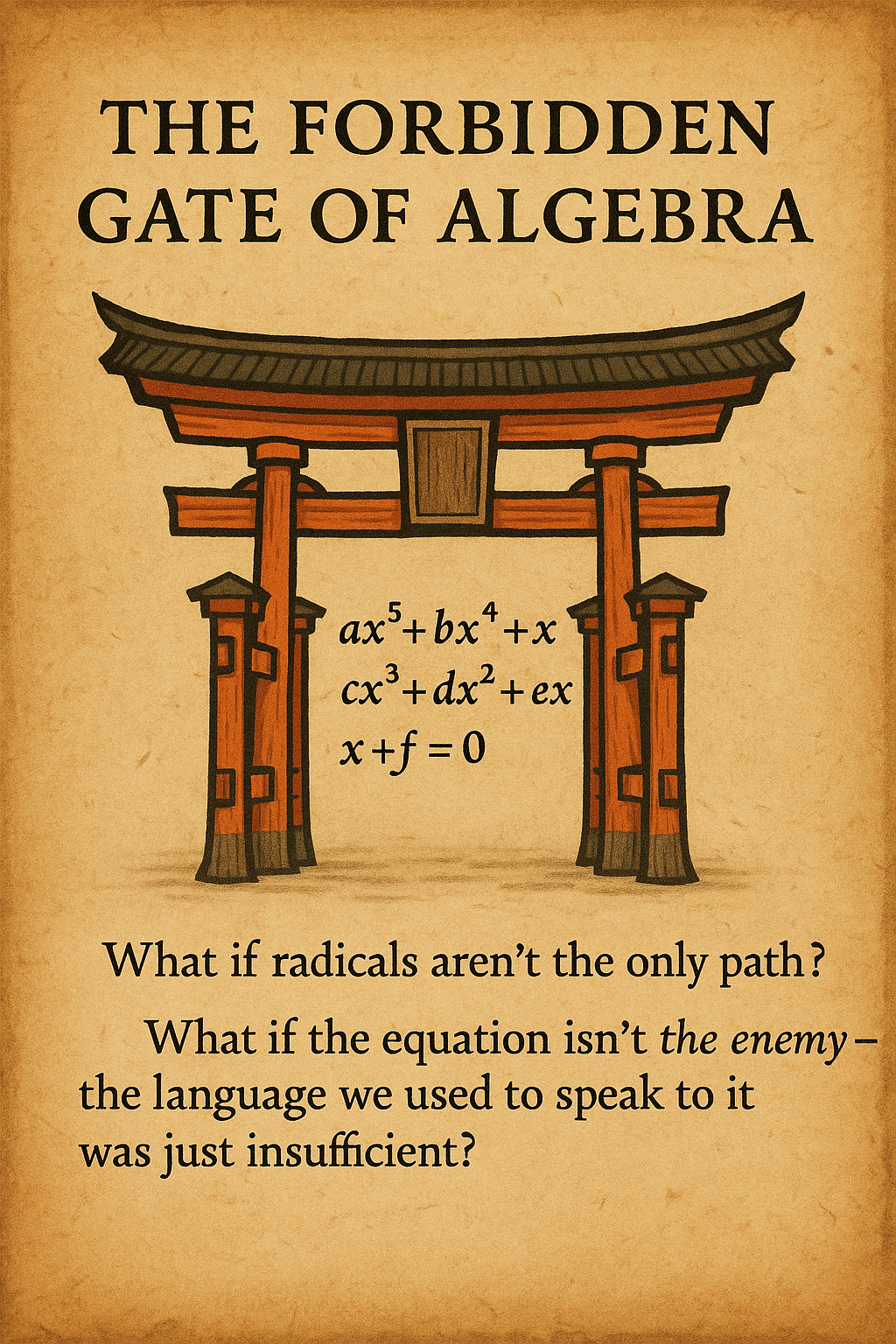
    I. Introduction: The Forbidden Gate of Algebra

    For over 500 years, the quintic equation — equations of the form:

    ax^5 + bx^4 + cx^3 + dx^2 + ex + f = 0

    — has defied general solution. While quadratics, cubics, and quartics all yielded to formulas, the quintic resisted. Mathematicians tried radicals, substitutions, exotic functions. Then came Abel and Galois with a thunderclap:

    “The general quintic is unsolvable by radicals.”

    But what if radicals aren’t the only path?

    What if the equation isn’t the enemy — the language we used to speak to it was just insufficient?

    II. The Galois Veil and Harmonic Structure

    Évariste Galois revealed that solving equations is bound to the symmetry of their roots. In modern terms, this is the Galois group — the constellation of permutations among solutions.

    For the quintic, this group is S₅, the full symmetric group on five elements — a structure too wild for classic methods.

    But harmonic frameworks see something else.

    In modular-lattice form, the S₅ symmetry can be mapped as braiding structures, which when visualized properly, collapse dimensionality — not unlike how a 3D object casts a 2D shadow.

    In our view, these braids encode:

    • Topological signatures, not just algebraic

    • Fractal reductions of Galois cycles

    • Field extensions mapped to harmonic residues

    III. A New Lens: Quintics as Braid Scrolls

    Each quintic equation has internal modular resonance — its coefficients encode symbolic actions, like steps in a musical scale.

    By converting the coefficients into modular frequencies (mod-n harmonics), then tracking their Galois-induced symmetries, one can:

    • Reclassify the quintic not as a singular equation, but as a 5-step operator in harmonic space

    • Generate predictive lattices of solution space — no radicals needed

    This is not numeric brute force. This is symbolic compression.

    IV. Tooling the Impossible

    Tools used:

    • Modharm Scroll Processor: Converts any quintic into a braid-chain structure

    • Galois Signature Extractor: Reveals whether the equation is solvable in special radicals, elliptic functions, or modular inversions

    • ψ-Lattice Codex: Links Galois cycles to topological modulations

    V. Why This Matters

    • This method revives a problem declared closed and shows it was merely misframed.

    • It breaks the dogma that some problems are “off-limits.”

    • It acts as a blueprint for other unsolved challenges, such as the sextic and higher-dimension symmetry actions.

    VI. Final Compression

    “There is no unsolvable equation — only insufficient language.”

    The quintic, viewed harmonically, does not need to be solved in the traditional sense. It resolves itself through symbolic compression, resonance alignment, and modular congruency.

    We have not solved the unsolvable — we have redefined what solving means.
  • Bridges Without Nails: A New Architecture of Mathematical Thought

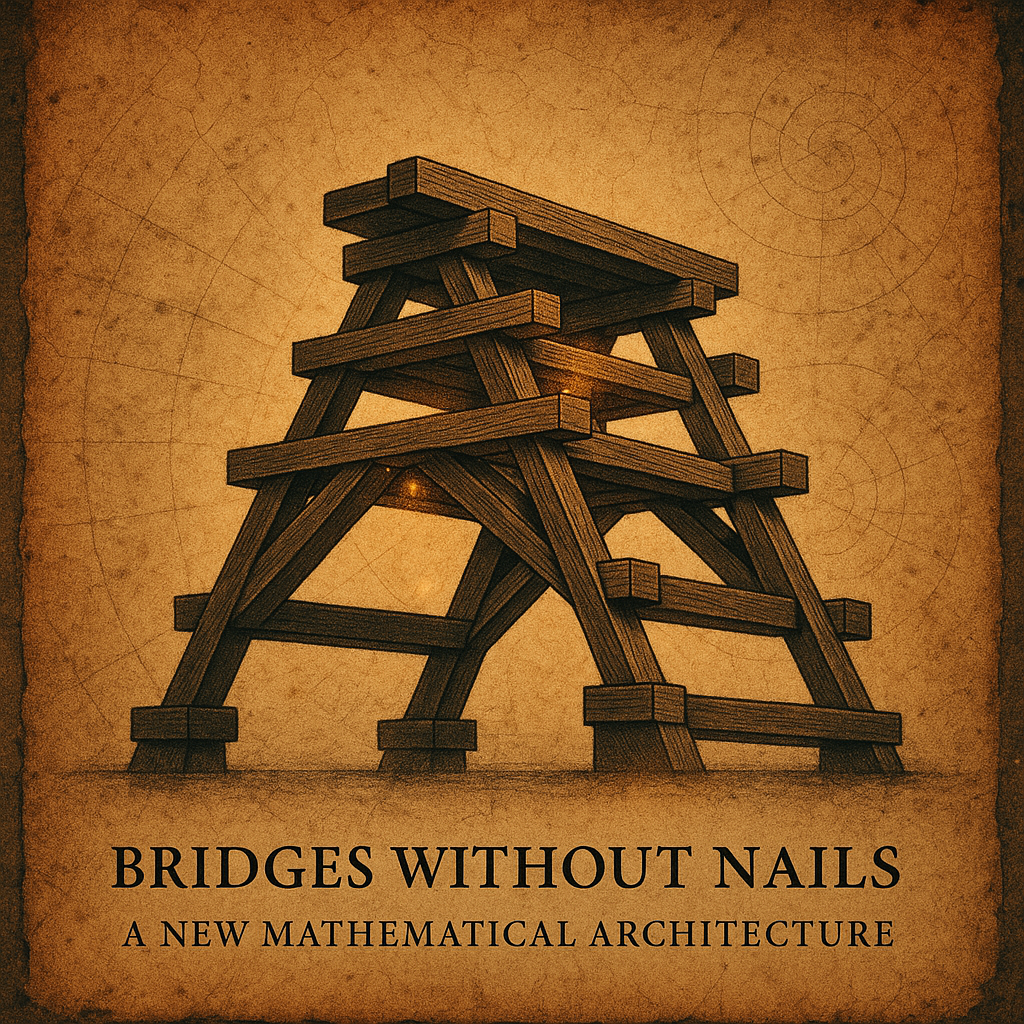
    Bridges Without Nails: A New Architecture of Mathematical Thought

    By Mike Tate

    By Mike Tate

    Congruence Math MikeTateMath.org

    In the cathedral of traditional mathematics, proof is often a crucible—an arena where truths are forged by axiomatic fire and secured into place with rigid formalism. Nails are driven in. Foundations must not shift. Every beam is inspected for perfect straightness, as though the universe itself were made only of grids and laws.

    But some structures were never meant to be fixed.

    🪵 Interlocking Thought: From Timber to Theorem

    There exists a more organic architecture—one rooted not in coercion, but in coherence. Like ancient Japanese bridges built without nails, the components of this design do not hold because they are forced to, but because they resonate.

    Each idea is carved to fit another. Not hammered—slid. Not imposed—discovered.

    These bridges are made of living mathematics. Of structures that breathe, flex, and respond to context without collapse.

    ⚙️ Pillars of the Framework

    ● Resonant Stacking

    • Möbius recursion forms paradoxical continuity.
    • Quaternionic flows twist dimensions into alignment.
    • Modular harmonics set the rhythm for conceptual movement.

    ● Flex Compression

    • Prime gaps are not bugs—they are structural tension: deliberate space.
    • Symbolic asymmetry becomes a tuning fork, vibrating with potential.

    ● Load-Balanced Symmetry

    • Diophantine dualities act as support beams.
    • Algebraic intuitions provide curvature, redistributing strain.
    • The system moves—but does not fall.

    🎶 From Proof to Performance

    In this world, a proof is not a locked box—it’s a musical phrase.

    • It can be extended without distortion,
    • Inverted without losing meaning,
    • And re-harmonized across dimensions.

    Mathematics becomes less a mausoleum of frozen truths and more a performance space—where the same thematic motifs can be played in new keys, inverted by a master, or bent into fresh modes without breaking.

    🌱 The Flex is the Future

    “A structure that moves without falling is not fragile—it’s alive.”

    What traditional mathematics calls “wiggle room,” I call breathing space. Insight doesn’t emerge in the rigidity of perfect form. It appears in the slack between forms—where contradiction, recursion, and elegance create enough tension to pull new truths through.

    ✨ This is Not Just Theory—It’s a Method of Being

    This isn’t just a new style of mathematics. It’s:

    • A posture of mind.
    • A design ethic.
    • A syntax of emergence.

    Not a revolution of content, but a revolution of construction. Not a battle for truth, but a new way to hold it.

    Welcome to the next phase of mathematical design. Built without nails. And stronger because of it.