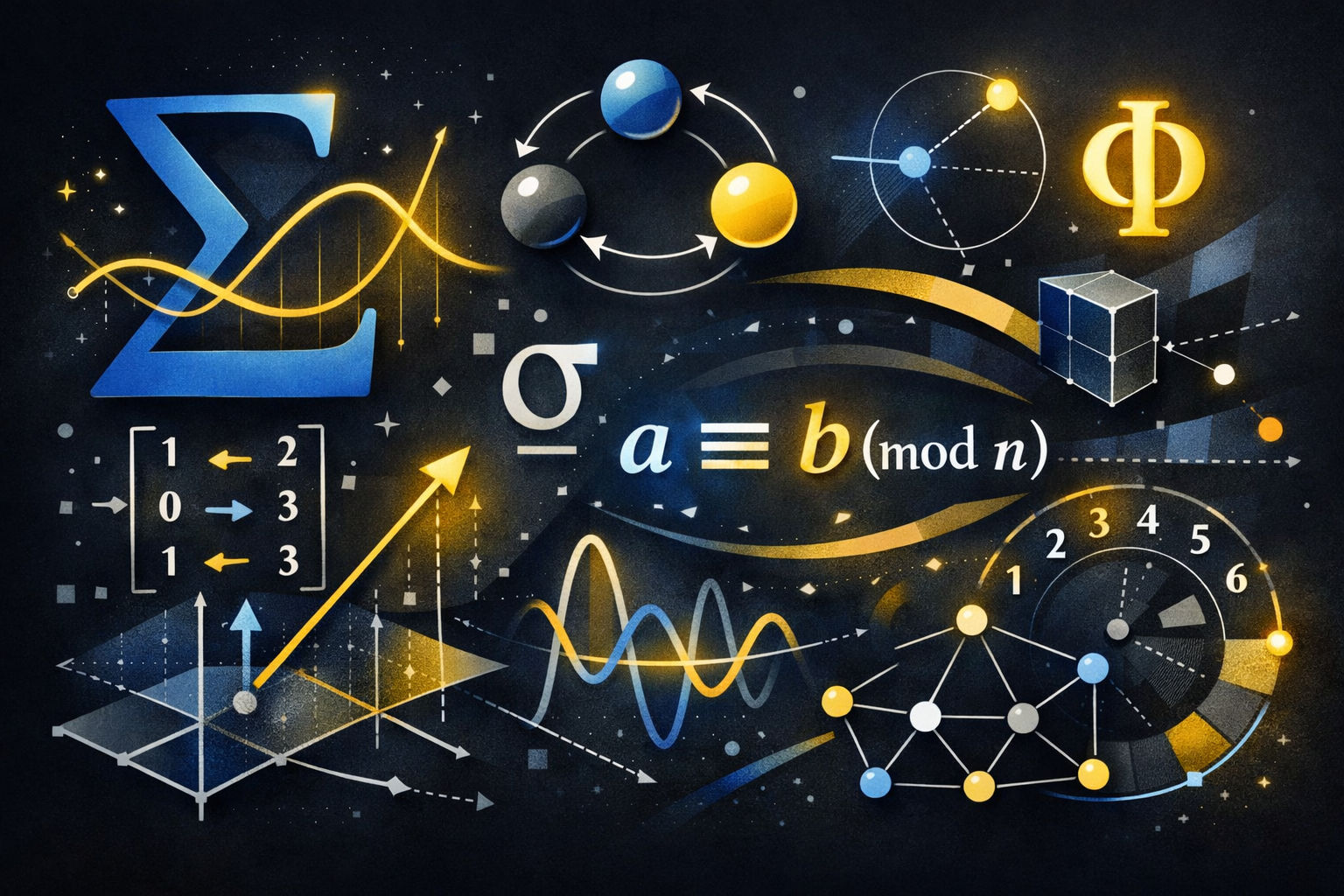
Algebra studies structure through symbols and operations. It replaces specific numbers with relations, rules, and transformations that remain valid across entire classes of objects.
Where arithmetic computes, algebra generalizes. It is the language of patterns that persist under substitution.
Sets & Operations
Algebra begins with a set and one or more operations obeying specified rules.
Groups
Groups encode symmetry through invertible operations and identity elements.
Rings & Fields
Rings allow addition and multiplication; fields permit division and algebraic solvability.
Variables
Variables represent placeholders for elements, allowing statements to remain universally valid.
Equations
Equations assert equivalence under transformation, defining solution sets rather than single values.
Systems
Systems of equations encode multiple constraints simultaneously, revealing intersections of structure.
Linear Algebra
Vector spaces and linear maps organize dimension, transformation, and solvability.
Abstract Algebra
Groups, rings, and fields studied independently of representation.
Commutative Algebra
Algebraic structures underlying geometry and number theory.
Algebraic Number Theory
Extends arithmetic into abstract number systems governed by algebraic laws.
Algebra underpins modern mathematics, physics, cryptography, computation, and logic.
It reveals what remains invariant when symbols change, and how structure governs possibility.