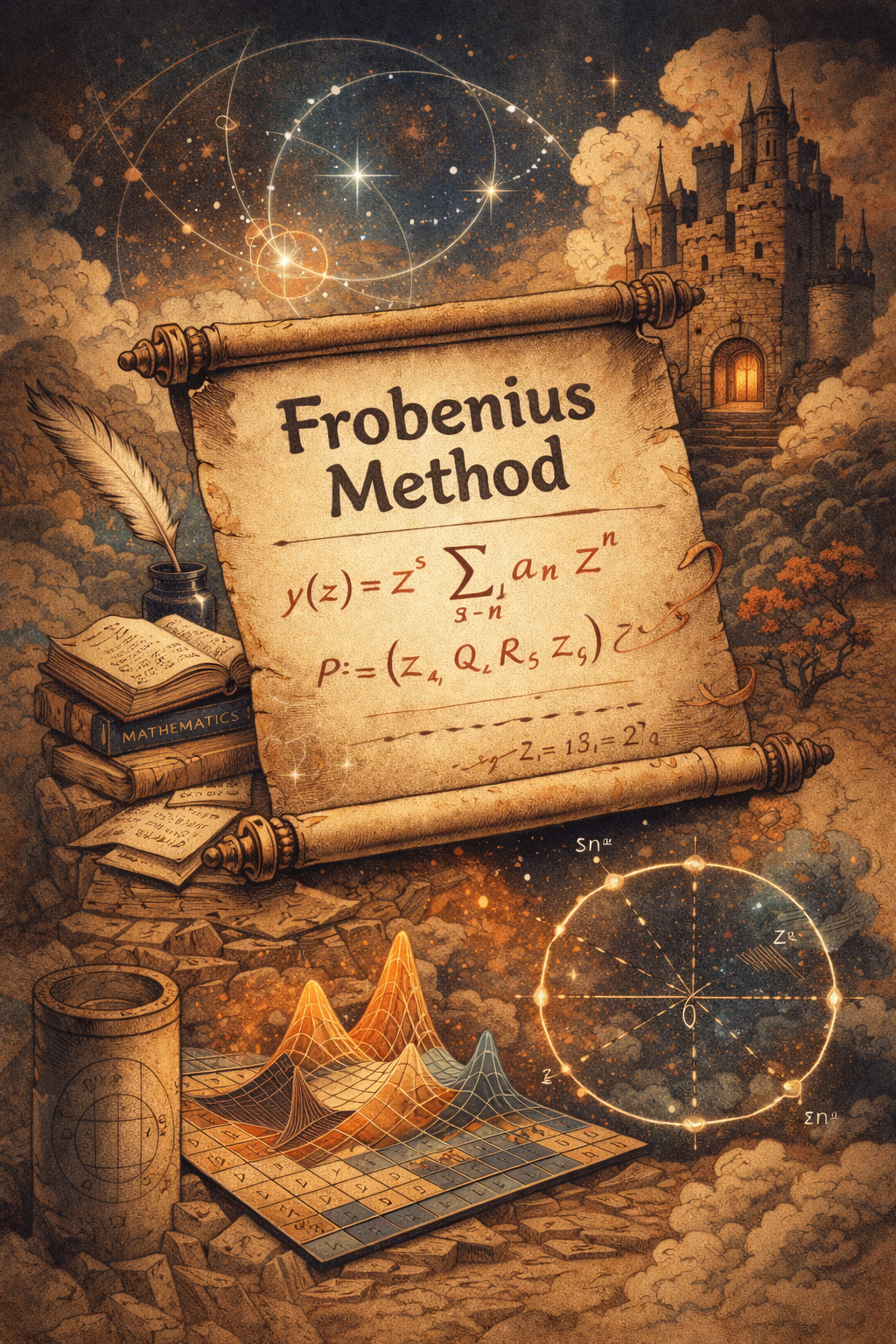
The Frobenius method is a technique for solving linear ordinary differential equations near regular singular points. It generalizes power series solutions by allowing non-integer exponents.
Where ordinary Taylor series fail, the Frobenius method restores analytic structure through controlled expansion.
Ordinary vs Singular
At an ordinary point, coefficients are analytic. At a singular point, direct power series may diverge.
Regularity Condition
A singular point is regular if the equation can be rewritten so that singular behavior is polynomially bounded.
Solutions are assumed in the form y(x) = xʳ ∑ aₙ xⁿ, allowing leading behavior to absorb the singularity.
Indicial Equation
Substitution yields an algebraic equation for r, determining admissible leading exponents.
Recurrence Relations
Higher coefficients follow from recurrence, encoding the local analytic structure.
Distinct Roots
Two independent solutions arise directly when indicial roots differ by a non-integer.
Repeated or Integer-Separated Roots
Logarithmic terms may appear, reflecting resonance in the solution space.
The Frobenius method underlies special functions, quantum mechanics, wave equations, and stability analysis near critical points.
It reveals how local singular behavior determines global solution structure.
- Apps & Games
- Articles
- Bio & Works
- Documents
- Dynamics, Information, and Logic
- EBOOKS
- Encryption
- Functions
- Galois Groups
- Geometry
- Hilbert's Problems
- Index
- Knot Theory
- Learning Paths
- Modular Math
- Quaternions
- Recursive Q & A
- Rodrigues’ Formula & the Geometry of Rotation
- Simulations
- Socials
- Tools
- Topology
- Traced Lines
- Harmony of Numbers