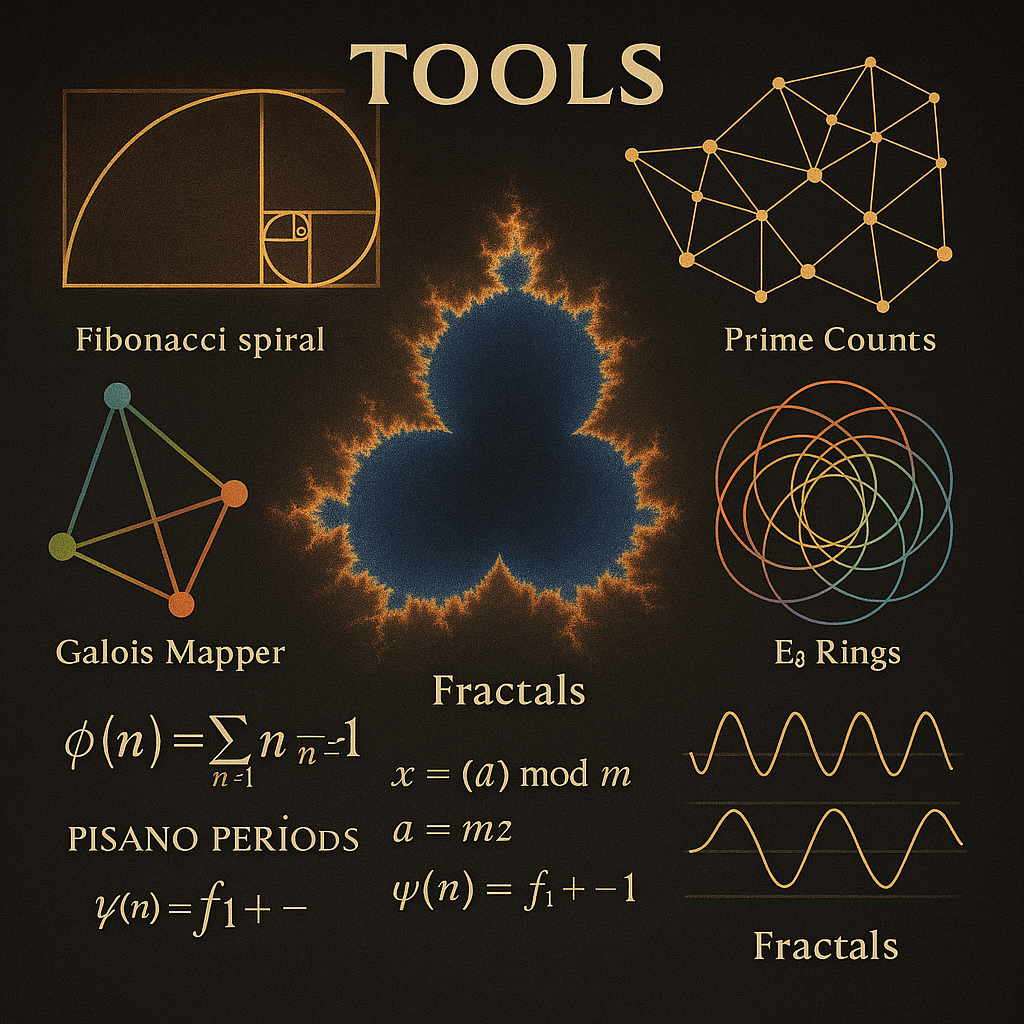
Reveal the rhythm of φ(n), Euler’s totient function, and explore harmonic structures in number fields. Perfect for modular musicianship and resonant encryption setups.
♻️ Modular Residue Field Viewer
Visualize the full cyclic dance of residues modulo *n* — foundational for cryptography, modular algebra, and prime-mapped transformations.
🌀 Quaternionic Rotation Simulator
Simulate 3D vector rotations using quaternions — a tool bridging spatial mathematics, physics engines, and symbolic AI cognition layers.
Totient Harmonic Cycler
Modular Residue Field Viewer
Quaternionic Rotation Simulator
🧩 Modular Quintic Solver
Solve quintic equations modulo m with symbolic coefficients — explore residue-class roots and algebraic structures beyond classical solvability.
Modular Quintic Solver
Enter coefficients of the quintic equation: a·xⁿ + b·x⁴ + c·x³ + d·x² + e·x + f ≡ 0 (mod m)
🌌 Fractal Entropy Estimator
Compute entropy signatures from layered prime structures. By adjusting prime count and recursion depth, reveal the informational complexity woven into fractal-like numeric patterns — ideal for exploring emergent order and cryptographic irregularity.
Fractal Entropy Estimator
Estimate system entropy based on recursive prime input and depth:
Codex Symbolic Q&A
The Codex provides recursive Q&A on symbolic recursion, modular harmonic logic, prime residues, and new methods for solving quintics and beyond.
🧮 Codex Entropy Mapper
Estimate the informational entropy of any text using character frequency analysis — a foundational tool for cryptography, compression, and complexity detection.
Codex Entropy Mapper
Paste any text to estimate entropy based on character distribution:
🔐 Codex Geometric Cipher
Apply modular character shifts to encode messages geometrically. Ideal for exploring cyclic transformations, basic encryption, and symbolic text experimentation.
Codex Geometric Cipher
Shift characters based on a modular offset. Enter base text:
🌟 Codex Phi Meter
Test how closely any ratio approaches the golden ratio (φ). Great for exploring harmonic proportions, sacred geometry, and naturally optimized forms in design and mathematics.
Codex Phi Meter
Enter a ratio to compare it with the golden ratio (φ ≈ 1.6180339887):
Codex Phi Meter
What is the Golden Ratio?
The golden ratio (φ ≈ 1.6180339887) is a mathematical constant that appears throughout nature, art, and architecture. It represents the most aesthetically pleasing proportion between two quantities, where the ratio of the sum to the larger quantity equals the ratio of the larger to the smaller.
Mathematical Definition
φ is defined by the equation: φ = (1 + √5)/2. This irrational number has the unique property that φ² = φ + 1, making it the most irrational number in the sense of being hardest to approximate with rational numbers.
Fibonacci Connection
The ratio of consecutive Fibonacci numbers approaches φ:
- 3/2 = 1.5
- 5/3 ≈ 1.666...
- 8/5 = 1.6
- 13/8 = 1.625
- 21/13 ≈ 1.61538...
- 89/55 ≈ 1.61818...
Natural Occurrences
The golden ratio appears throughout the natural world:
- Spiral Galaxies: The arms of spiral galaxies often follow golden ratio spirals
- Hurricanes: Storm systems frequently exhibit φ proportions
- Flower Petals: Many flowers have petal counts from the Fibonacci sequence
- Pine Cones: Spiral patterns follow Fibonacci numbers
- Human Body: Proportions in the face and body often approximate φ
Art & Architecture
From ancient times to modern design, φ has been used to create visually pleasing compositions:
- Parthenon: The facade proportions approximate the golden ratio
- Pyramids: The Great Pyramid's dimensions relate to φ
- Renaissance Art: Da Vinci's "Vitruvian Man" and "Mona Lisa" use golden proportions
- Modern Design: Logos, websites, and products often incorporate φ for aesthetic appeal
Continued Fraction Representation
φ has the simplest continued fraction expansion:
φ = 1 + 1/(1 + 1/(1 + 1/(1 + ...)))
Golden Angle
The golden angle is approximately 137.5°, derived from dividing a circle in the golden ratio. This angle appears in plant phyllotaxis (leaf arrangement) and provides optimal sunlight exposure.
Relationship with Pentagons
In a regular pentagon, the ratio of the diagonal to the side is exactly φ. This makes the golden ratio fundamental to five-fold symmetry in nature and design.
Optimal Packing
Systems that follow golden ratio proportions often achieve optimal packing efficiency, whether in seed heads, crystal structures, or architectural spaces.
🎼 GFRE Resonant Encryptor
Input text is encoded through harmonic modular scrambling — aligning symbolic structure with frequency-based encryption layers. This tool preserves meaning signatures while concealing form, ideal for modular cognition security and resonance-aware transmission.
GFRE Resonant Encryptor
Input text is encoded through harmonic modular scrambling — aligning symbolic structure with frequency-based encryption layers.
🌌 E₈ Symbolic Analyzer
Transform residue sequences into echoes across the E₈ modular orbit lattice. This tool maps your numeric inputs into high-dimensional symmetry space, revealing structure, anomaly gaps, and symbolic resonance within the most intricate Lie group framework.
E₈ Symbolic Analyzer
Enter a comma-separated residue list to project into the E₈ modular orbit field:
E₈ Modular Orbit Lattice
Transform residue sequences into echoes across the E₈ modular orbit lattice. This engine maps your numeric inputs into high-dimensional symmetry space, revealing structure, anomaly gaps, and symbolic resonance inside one of the most intricate Lie group frameworks ever discovered.
🧮 Ψ-Symmetry Visualizer
Reveal hidden modular harmonies. This tool compares two moduli to detect where residues align across the first 200 natural numbers — a foundational glimpse into modular symmetry, Galois overlaps, and cryptographic resonance.
Ψ-Symmetry Visualizer

- Algebra
- Apps & Games
- Articles
- Bio & Works
- Documents
- Dynamics, Information, and Logic
- EBOOKS
- Encryption
- Functions
- Galois Groups
- Geometry
- Hilbert's Problems
- Index
- Knot Theory
- Learning Paths
- Modular Math
- Quaternions
- Recursive Q & A
- Rodrigues’ Formula & the Geometry of Rotation
- Simulations
- Socials
- Topology
- Traced Lines
- Harmony of Numbers
You must be logged in to post a comment.