Pascal’s Triangle Visualizer
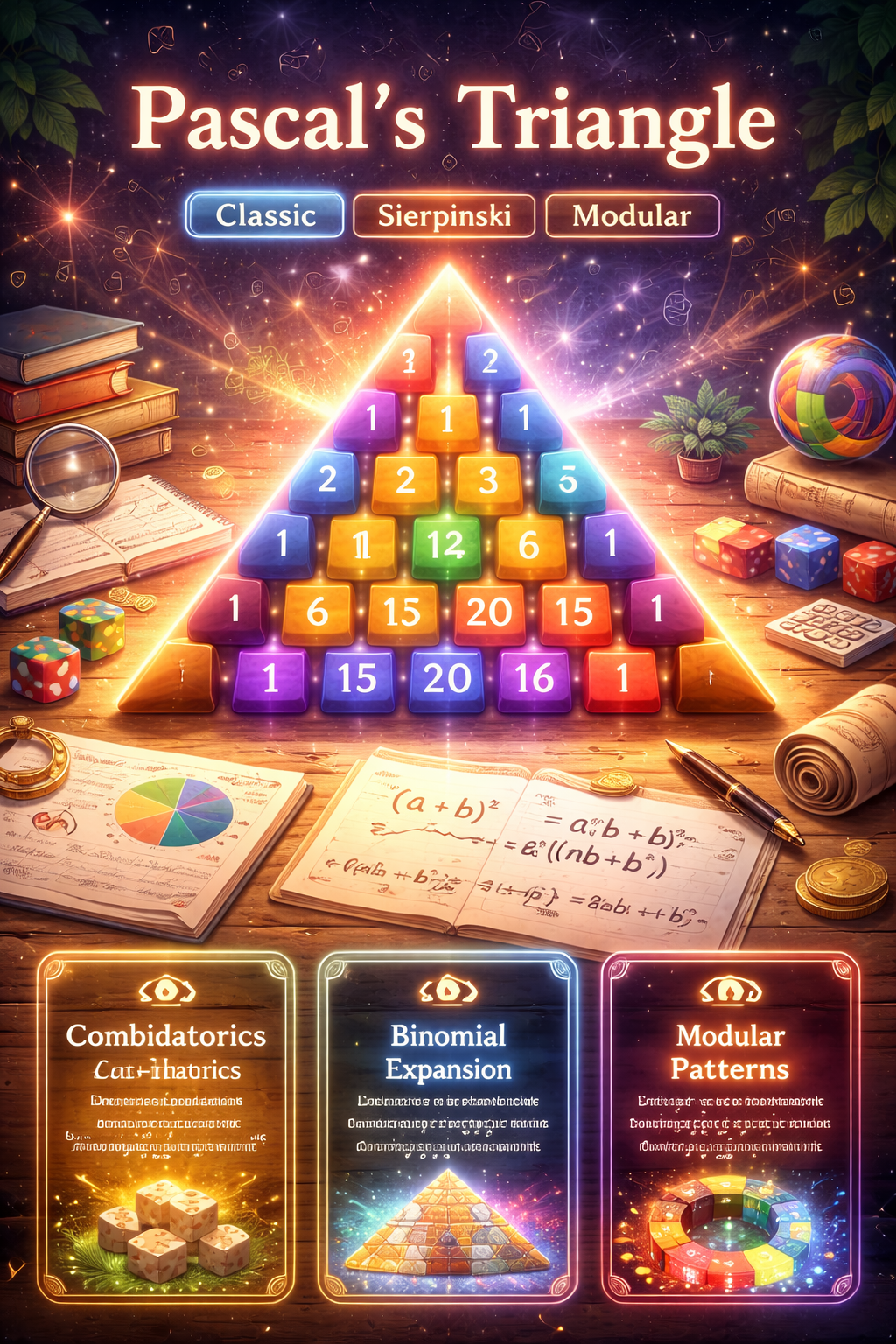
Pascal’s Triangle is one of the clearest examples of recursion generating structure. Each entry is formed by summing the two above it, yet from this simple rule emerge binomial coefficients, combinatorial counts, modular fractals, harmonic residue patterns, and unexpected geometric regularities.
The triangle is not just an arithmetic table. It is a machine for generating symmetry. In one mode it gives exact coefficients. In another it reveals fractal reduction. In another it becomes a modular color field.
What is Pascal’s Triangle?
Each number in Pascal’s Triangle is the sum of the two directly above it.
That single recursive rule generates rows of binomial coefficients, giving exact values for combinations,
coefficients for powers of (a+b)^n, and modular patterns that can become fractal.
In mod 2, the triangle reveals the Sierpiński pattern. In other moduli, residue classes create cyclical coloring and harmonic repetition. This makes Pascal’s Triangle a bridge between arithmetic, combinatorics, algebra, and modular geometry.
Switch between classic coefficients, Sierpiński reduction, and modular color modes. You can also change the number of rows and the modulus used in modular view.
Classic mode: coefficient architecture
Each visible entry is a true binomial coefficient. This is the arithmetic form of the triangle and the one most directly linked to combinations and binomial expansion.
How to read the three modes
Classic
Shows the actual binomial coefficients. This is the arithmetic form of the triangle and the one most directly linked to combinations and expansions.
Sierpiński
Reduces entries mod 2. Odd entries remain visible and even entries disappear, exposing the familiar triangular fractal pattern.
Modular
Colors entries by residue class. This makes higher modular repetition visible, turning the triangle into a harmonic field of arithmetic phases.
Related mathematical ideas
Combinatorics
The triangle gives direct values for combinations. Each entry counts how many ways one can choose k objects from n.
C(n, k) = n! / (k!(n−k)!)
Binomial Expansion
Each row supplies the coefficients in the expansion of powers of a binomial.
(a + b)^4 = a^4 + 4a^3b + 6a^2b^2 + 4ab^3 + b^4
Modular Patterns
Residue reduction creates repeating symmetries, fractals, and wave-like structures across the rows of the triangle.
Pascal mod 2 → Sierpiński pattern