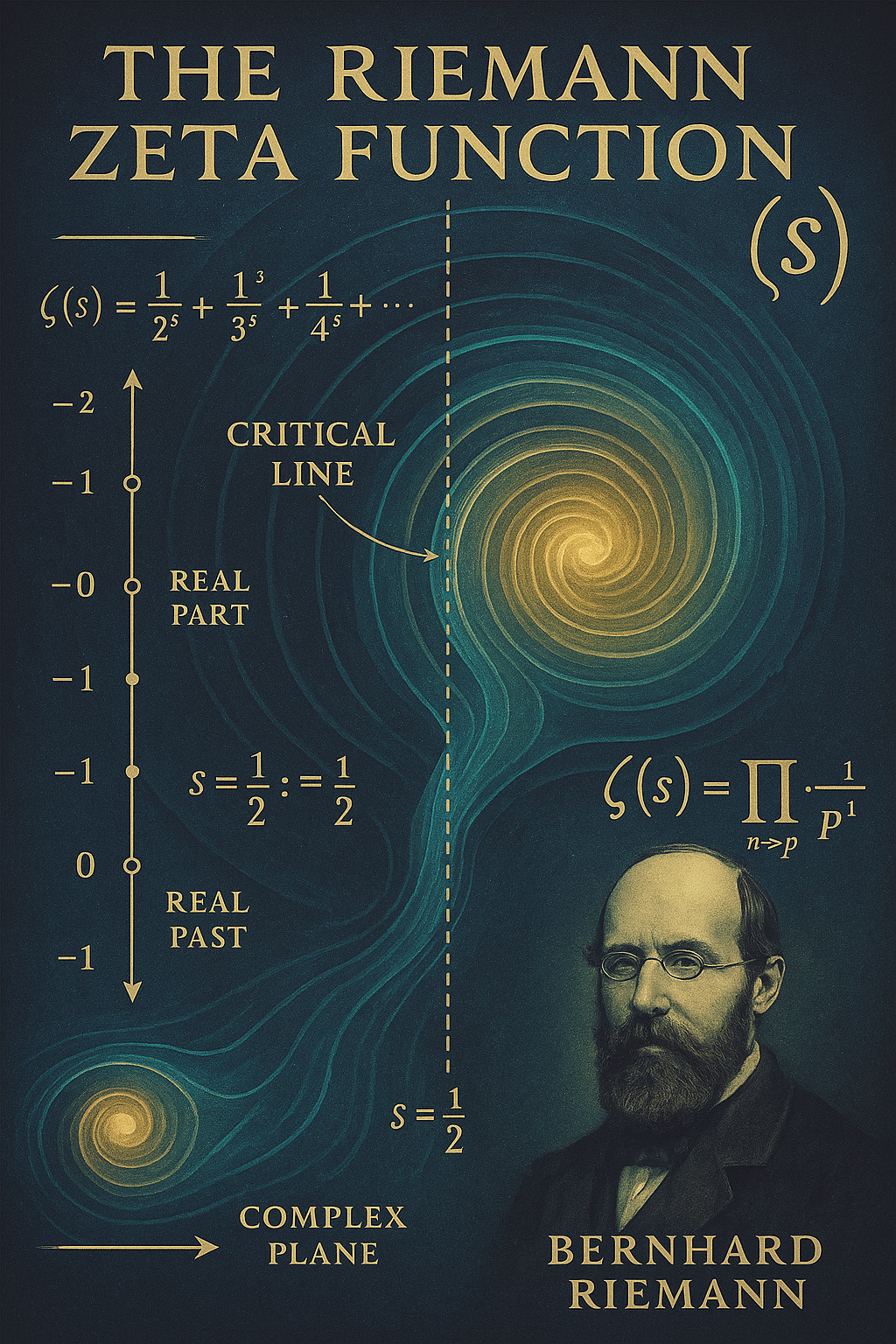
The Zeta Function reveals the hidden harmonic structure within the distribution of prime numbers. It is the echo chamber of modular frequency, the waveform within which prime residues resonate and compress across dimensions.
This tag bridges into the heart of the Riemann Zeta Recursive Framework, where zeta-zero alignment meets Fibonacci descent, and fractal recursion shapes prime distributions. It integrates with the Totient Harmonic Scaling Function to model entropy compression and the zeta-lattice resonance grid.
Explore the foundations where zeta harmonics influence modular encryption, resonance phase-locking, and attractor basin topology in prime fields.
What is the Zeta Function?
The Riemann zeta function is defined for complex numbers s = σ + it as:
ζ(s) = Σ 1/nˢ
It extends (via analytic continuation) to almost the whole complex plane and encodes deep information about the distribution of prime numbers.
ζ(s) = Σ 1/nˢ
It extends (via analytic continuation) to almost the whole complex plane and encodes deep information about the distribution of prime numbers.
What the Animation Shows
• The vertical line is the critical line Re(s) = 1/2.
• The point s(t) moves up and down along it, representing different imaginary inputs t.
• The vector ζ(s) rotates and changes length, showing complex output values.
• The orange spiral represents a stylized Euler sum of n−s.
• The green pulsing dot is a hint of a nontrivial zero, where ζ(s) = 0.
• The point s(t) moves up and down along it, representing different imaginary inputs t.
• The vector ζ(s) rotates and changes length, showing complex output values.
• The orange spiral represents a stylized Euler sum of n−s.
• The green pulsing dot is a hint of a nontrivial zero, where ζ(s) = 0.
Why the Critical Line Matters
The Riemann Hypothesis states that every nontrivial zero of ζ(s) lies on the line:
Re(s) = 1/2
These zeros control the distribution of prime numbers and the fine structure of number theory. The animation visually suggests the strange oscillatory behavior near these zeros.
Re(s) = 1/2
These zeros control the distribution of prime numbers and the fine structure of number theory. The animation visually suggests the strange oscillatory behavior near these zeros.
What the Spiral Represents
The spiral is an artistic but meaningful representation of:
ζ(1/2 + it) = Σ n-1/2 e-it ln n
Each term is a rotating vector, and the sum traces a winding path. This spiral rotates and breathes as t changes.
ζ(1/2 + it) = Σ n-1/2 e-it ln n
Each term is a rotating vector, and the sum traces a winding path. This spiral rotates and breathes as t changes.
- Algebra
- Apps & Games
- Articles
- Bio & Works
- Documents
- Dynamics, Information, and Logic
- EBOOKS
- Encryption
- Galois Groups
- Geometry
- Hilbert’s Problems
- Index
- Knot Theory
- Learning Paths
- Modular Math
- Quaternions
- Recursive Q & A
- Rodrigues’ Formula & the Geometry of Rotation
- Simulations
- Socials
- Tools
- Topology
- Traced Lines
- Harmony of Numbers